
-

Hansadutta das -
Recent Posts
Recent Comments
- Avinesh Singh Kishan on Passing of Ananta Shanti Prabhu
- Jaya Madhava das on How to Make Hansadutta Soup
- Nitai Gauranga Das Hammari on Bitcoins, gold and silver and government
- Ramananda Roy Dass on Bitcoins, gold and silver and government
- Amar Puri on DOM is a sideshow – BBT is at the center
Categories

Maya is like a mirror. It reflects all our desires. We can look into the world, which is a wonderful mirror, and see everything we want. We see the world as we want it, not as it is. The spiritual master forces us to open our eyes while we are standing in the darkest ignorance. When we see the world with the help of the spiritual master, we will become free from all material desires, and then we'll see the world as it is.
The Next Wave – Part 2
Posted in Economy, Krishna Consciousness, Prabhupada's Discipes, Society and Culture, Vedas - Vedic culture
Tagged Krishna consciousness, Krishna farms, varnashram dharma, vedic culture
Comments Off on The Next Wave – Part 2
The Next Wave – Part 1
Posted in Krishna Consciousness, Society and Culture, Vedas - Vedic culture
Tagged varnashram dharma, vedic culture
Comments Off on The Next Wave – Part 1
Bitcoins, gold and silver and government
Questions About Bitcoin, Alternative Investing Lead to Freedom Fund
The Daily Bell – STAFF REPORT – Dec 9, 2013
It always seemed to us – throughout this ongoing bitcoin mania – that gold and silver were perfectly good alternatives to a wretchedly complex digital system. Granted, they are not directly as fungible as bitcoin, but they’ve been around for millennia. That’s more than bitcoin’s few years. more
Passing of Ananta Shanti Prabhu
Dear Das and Bhima, Please accept my most humble obeisances, all glories to Srila Prabhupada.
This passing away, leaving the body of ANANTA SHANTI PRABHU is very, very sad and unhappy news for me. He is the number one, LEADING PIONEER DEVOTEE of RUSSIA.
After Srila Prabhupada left Russia, Ananda Shanti never saw Srila Prabhupada again in this life. Srila Prabhupafda sent me to Russia and had me secretly bring him Bhagavad gita As It Is, karatals, harmonium and other things.
We would walk the Red Square and over the river bridge, go shopping for bhoga. There was not much to buy – cabbage, potatoes re-constituted milk, a pretty meager selection of eatable ingredients. I would cook, and we would share prasadam, talking for hours and days. more
Posted in Announcements, Prabhupada's Discipes
Tagged Ananda Shanti, Prabhupada's disciples, Russian devotee
3 Comments
DOM is a sideshow – BBT is at the center
Just yesterday, Praghosa Prabhu forwarded a copy of his email to Rocan das regarding the GBC and the Direction of Management (DOM). This is a discussion as to the constitution of the GBC and managerial duties related to ISKCON and their relationship with the BBT. There are devotees who think that all that’s dysfunctional within ISKCON can be fixed by reforms to the GBC, putting new guidelines in place, setting up committees to watch over the GBC members and make sure they perform their duties, etc. The call for implementing the DOM – whereby GBC members are elected by temple presidents – carries the same expectation, that all of ISKCON rides on the GBC.
But something is missing from this picture. And that is the BBT. ISKCON will never be right again as long as the BBT is not put right. The two are separate, yet BBT at the core of ISKCON. Humpty Dumpty cannot be put together again without the heart beat. more
Let’s be completely honest about Ramesvara’s complete honesty
Letter to Madhudvisa, revised
by Hansadutta das
Hare Krishna
Dear Madhudvisa Prabhu,
Please accept my humble obeisances. All glories to Srila Prabhupada.
Just the other day you sent out an email practically glorifying Ramesvara as a truthteller. Why are you promoting him? We are concerned that he has some intention to make a comeback on the ISKCON and BBT Int’l, Inc. stage (Ramesvara wants back in BBT). In the past he has shown himself to be duplicitous, ambitious, cunning and disloyal, and what kind of restitution has he made to demonstrate that he is a changed person with sincere intentions to serve Srila Prabhupada and preserve Srila Prabhupada’s books? more
Posted in Prabhupada's books
Tagged BBT, BBT court case, Bhaktivedanta Book Trust, book changes, Ramesvara
Leave a comment
Just what was Ramesvara’s Role?
The following is a repost from harekrishnamalaysia.com/KRSNAinsight:
Over at Rochan das’s Sampradaya Sun, Ramesvara has retorted to Brhatasloka’s statement that Ramesvara was instrumental in bypassing the BBT, operating a shell. Ramesvara claims that Srila Prabhupada made him trustee at Mayapur in 1976 after the marathon production of 17 volumes of Sri Chaitanya-charitamrita. He also suggests that Hansadutta had nothing to do with BBT after 1975, that he himself was running the entire BBT operations in North America, and that Hansadutta had no part in the conversations that Ramesvara had with Srila Prabhupada pertaining to the BBT structure and accounts. Read Ramesvara’s article.
TL;DR:
When ISKCON and BBT International, Inc. brought the courtcase against Hansadutta and Srila Prabhupada’s BBT, Ramesvara could not produce any document showing his appointment as trustee, and so the court excluded him from giving testimony. The court found that he had no legal standing to claim that he was a trustee. Whether Srila Prabhupada named him a trustee or not, without the formal resolution on record, he was never a legal trustee. This, from Hansadutta. more
Ramesvara was NEVER a BBT Trustee
In response to “A Reply to Rupanuga’s Article” by RAMESVARA DASA, published on Mar 23, 2013 — NEW YORK, USA by Sampradaya Sun —
If Rameswara was ever a BBT Trustee, then when I was in litigation with ISKCON / BBT International, Inc. (the bogus BBT that illegally converted the assets of Prabhupasda’s trust into their “For profit” corporation BBT International, Inc.), why when they attempted to bring Rameswara for testimony as an expert witness, claiming he had credentials as a legally appointed BBT for-life Trustee by Srila Prabhupada, he (Rameswara) could produce no legally acceptable BBT document supporting his claim as a legal BBT Trustee? And none have been produced since that time, about 15 years to date.
The court found that he had no standing, no position as a BBT Trustee legally appointed by the trust, filed by Srila Prabhupada, or added since the original filing. Rameswara was subsequently DISMISSED BY THE COURT and excluded from testifying in that case.
Atomic Energy, the unloved child of the living dead
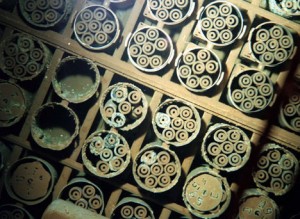
Uncapped fuel stored underwater in K-East Basin. This is spent nuclear fuel at the Hanford site.
Radioactive Waste Is Leaking From Washington’s Hanford Nuclear Reservation
Zero Hedge – TYLER DURDEN – Feb 22, 2013And now for a quick lesson in government spending: in the 1940s the federal government created the now mostly decommissioned Washington’s Hanford Nuclear Reservation as part of the Manhattan Project to build the atomic bomb. more
Posted in Environment, History
Tagged atomic bombs, atomic energy, Hanford, karma, nuclear waste, radioactive waste
Leave a comment
Please show me right direction
Here is the answer to the question so many sincere devotees have: Who to trust for guidance? This is the answer. YOU HAVE TO READ AND HEAR EVERYTHING OF PRABHUPADA’S TEACHING, THEN YOU HAVE THE STANDARD, THE YARDSTICK WHEREBY WHICH YOU CAN JUDGE, MEASURE AND WEIGH THEIR QUALIFICATION. THEN ONE HAS TO GO FORWARD ON THE BASIS OF HIS OWN HEART. more

