[Posted
March 23, 2007]
Who
is Mischievous?
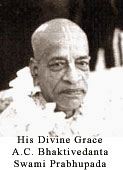
A.C. Bhaktivedanta Swami |


|
Wanting
More
|
Dirty Hearts and Dusty Brains Hansadutta das The clue to real satisfaction is to become free from material desires. Material desires can never be satisfied, just as a fire can never be satisfied or extinguished by adding more fuel. Our desires are binding us to perpetual mieries in the shape of birth, old age, disease and death. There are also other problems, but these are primary—everyone is subjected to these four sufferings. more |
A saintly person is tolerant, very kind to everyone, is a friend to all living entities, is no one's enemy and is always peaceful. There are twenty-six basic qualifications for a holy man, and in the Bhagavad-gita we find that Sri Krishna Himself gives the following verdict:
api chet su-duracharo
bhajate mam ananya-bhaksa
dhur eva sa mantavyah
samyag vyavasito hi sah
"Even if one commits the most abominable actions, if he is engaged in devotional service, he is to be considered saintly because he is properly situated." (Bg. 9.30)
On
the mundane platform, what is morality for one person is immorality for
another, and what is immorality for one person is morality for another.
According to the Hindu conception, the drinking of wine is immoral,
whereas in the Western world, wine drinking is not considered immoral
but is a common thing. So morality is dependent on time, place,
circumstance, social position, etc. There is, however, a sense of
morality and immorality in all societies. In this verse Krishna points
out that even if one is engaged in immoral acts but at the same time is
fully in Krishna consciousness, he is to be considered a sadhu
or a saint. In other words. although a person may have some immoral
habits due to his past association, if he is engaged fully in Krishna
consciousness, these habits are not to be considered important.
Whatever the case, if one becomes Krishna conscious, he will gradually
be purified and will become a sadhu. As one progresses in
executing Krishna consciousness, his bad habits diminish, and he
attains to saintly perfection.
In this regard there is the story of a thief who went on a pilgrimage
to a holy town, and on route he and the other pilgrims stopped to rest
overnight at an inn. Being addicted to stealing, the thief began making
plans to steal the other pilgrims' baggage, but he thought, "I'm going
on a pilgrimage, so it doesn't seem appropriate that I should steal
this baggage. No, I shall not do it." Nonetheless, due to his habit, he
could not keep his hands off the baggage. So he picked up one person's
bag and placed it in another place, and then another person's bag and
placed it elsewhere. He spent all night placing different bags in
different places, but his conscience bothered him so that he could not
take anything from them. In the morning, when the other pilgrims awoke,
they looked around for their bags and couldn't find them. There was a
great row, and eventually, one by one, they began to find the bags in
various places. After they were all found, the thief explained:
"Gentlemen, I am a thief by occupation. Being that I am habituated to
stealing at night, I wanted to steal something from your bags, but I
thought that since I am going to this holy place, it is not possible to
steal. So I may have rearranged the baggage, but please excuse me."
This is the characteristic of a bad habit. He does not want to commit
theft anymore, but because he is habituated, sometimes he does. Thus
Krishna says that one who has decided to refrain from his immoral
habits and make progress in Krishna consciousness is to be considered a
sadhu, even if out of past habit or by chance he yields to
his fault. In the next verse we find that Sri Krishna says:
kshipram bhavati dharmatma
shashvach-chantim nigacchati
kaunteya pratijanihi
na me bhaktah pranashyati
"He quickly becomes righteous and attains lasting peace. O son of Kunti, declare it boldly that My devotee never perishes." (Bg. 9.31)
Because one has committed himself to Krishna consciousness, it is proclaimed here by Sri Krishna that within a very short time he will become saintly. One may pull the plug out of an electric fan, and the fan may still go on even though the juice has been disconnected, but it is understood that the fan will soon come to a stop. Once we take shelter of the lotus feet of Krishna, we turn the switch off for our karmic activities, and although these activities may still revolve, it is to be understood that they will quickly diminish. It is a fact that whoever takes to Krishna consciousness does not have to endeavor independently to become a good man. All the good qualifications will automatically come. It is stated in Srimad-Bhagavatam that one who has attained Krishna consciousness has simultaneously attained all good qualities. On the other hand, if a person is devoid of God consciousness and yet has many good qualities, his good qualities are to be considered useless, for he will not in any way be prohibited from doing that which is undesirable. If one is devoid of Krishna consciousness, he is sure to commit mischief in this material world.
Who is Mischievous?/ WORLD SANKIRTAN PARTY ©2007 - Hansadutta das
Home | About | Events | World Sankirtan Party | Inside Nam Hatta
eBooks | Site Map | Store