
Krishna Books
What is Hare Krishna?
The Founder-Acharya
Hare Krishna Mantra
Sankirtan Movement
Personality of Godhead
Lord Chaitanya
A.C.Bhaktivedanta Swami Prabhupada
Hansadutta das
Events: Kirtan Festival
World Sankirtan Party
Submit News
© 2004 - Hansadutta das
Can't Get No Satisfaction
A.C. Bhaktivedanta Swami Prabhupada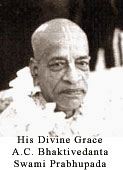
Antiwar.com, Monday, Feb 13, 2006—Backtalk— By Wali Muhammad
—In Response to
"The Adulation of Ignorance"
...I was at a loss to understand the Bush
administration's policies until I recently watched the movie Goldfinger.
In the movie, James Bond discovered that Goldfinger's target was the
gold depository at Fort Knox. But what puzzled 007 was that, although
Mr. Goldfinger could get to the gold, it would be totally impossible
for him to remove it without being caught. When Bond asked Goldfinger
about this, his reply was that he had no intention of removing the
gold. He was simply going to destroy it and in so doing, raise the
value of the gold that he already possessed astronomically.
That's when it hit me: all Bush had to do was to disrupt the flow of
oil and that would make the oil prices skyrocket. If the last-quarter
profits of the oil companies are any indication, the plan is working
just fine. Additionally, the tremendous money that has been sucked out
of the public sector and put into the hands of private military
contractors helps to feed the war machine while shredding the social
contract. The goal is war—continual war. It is not important to win. In
fact, it is vital not to win. Peace is bad business when your business
is war. War itself is the goal.
 Printer friendly page
The ambition for happiness is natural and good, but the attempt to derive it from inert matter by so-called scientific arrangements is an illusory attempt doomed to frustration. Those who are befooled cannot understand this. How a person is driven by the lust for material happiness is also described in Bhagavad-gita.
idam adya maya labdham
imam prapsye manoratham
idam astidam api me
bhavishyati punar dhanam
"The demoniac person thinks: 'So much wealth do I have today, and I will gain more according to my schemes. So much is mine now, and it will increase in the future, more and more.'" (Bhagavad-gita 16.13)
This atheistic
or godless civilization is a huge affair contrived for the
gratification of our senses, and now we are all mad after money in
order to maintain this empty shell. Money is sought after by everyone
because that is the medium of exchange for objects for sense
gratification. Obviously the expectation of peace in such an atmosphere
of gold rush pandemonium is a utopian dream. As long as there is the
slightest tinge of sense gratification or desire for sense
gratification, peace will remain far, far away. This is because by
nature we are all eternal servants of the Supreme Lord and therefore
cannot enjoy anything for our personal interests. It is therefore
necessary for us to learn how to employ our senses in the
transcendental service of the Lord, and to utilize everything to serve
His interest. This alone can bring about much desired peace. A part of
the body cannot in itself be independently happy. It can only derive
its happiness and pleasure out of serving the entire body. The Supreme
Lord is the whole, and we are the parts, but we are all busily engaged
in activities of self-interest. No one is prepared to serve the Lord.
This is the basic cause for our conditioning in material existence and
for our resultant unhappiness.
From the highest executive in his skyscraper office down to the coolie
in the street—all are working with the thought of accumulating wealth,
legally or illegally. Actually it is all illegal, for to work for one's
self-interest is both unlawful and destructive. Even the cultivation of
spiritual realization for one's own self-interest is unlawful and
destructive. The point is that all activities must be directed to the
satisfaction of Krishna and His service.
Those who are not engaged in the transcendental loving service of the
Supreme Lord wrongfully think that they are accumulating so much money
day after day.
asha-pasha-shatair baddhah
kama-krodha-parayanah
ihante kama-bhogartham
anyayenartha-sanchayan
"Being bound by hundreds and thousands of desires, by lust and anger, they secure money by illegal means for sense gratification." (Bhagavad-gita 16.12)
Consequently,
although there is no lack of money in the world, there is a scarcity of
peace. So much human energy is being diverted to making money, for the
general population has increased its capacity to make more and more
dollars, but in the long run the result is that this unrestricted and
unlawful monetary inflation has created a bad economy all over the
world and has provoked us to manufacture huge and costly weapons to
destroy the very result of such cheap money-making. The leaders of the
big money-making countries are not really enjoying peace but are making
plans to save themselves from imminent destruction by nuclear weapons.
In fact, huge sums of money are being thrown into the sea by way of
experiments with these dreadful weapons. Such experiments are being
carried out not only at huge costs but also at the cost of many lives.
In this way the nations are being bound by the laws of karma.
When men are motivated by the impulse for sense gratification, whatever
money is earned is spoiled, being spent for the destruction of the
human race. The energy of the human race is thus wasted by the laws of
nature because of man's aversion to the Lord, who is actually the
proprietor of all energies.
Wealth is worshiped and is referred to as Mother Lakshmi, or the
goddess of fortune. It is her position to serve Lord Narayana, the
source of all the naras, or living beings. The naras
are also meant to serve Narayana under the guidance of the goddess of
fortune. The living being cannot enjoy the goddess of fortune without
serving Narayana, and therefore whoever desires to enjoy her wrongly
will be punished by the laws of nature. These laws will make certain
that the money itself will bring about destruction instead of peace and
prosperity.
Unlawfully accumulated money is now being snatched from miserly
citizens by various methods of state taxation for the future civil and
international war fund, which is spending money in a wasteful and
destructive manner. The citizens are no longer satisfied with just
enough money to maintain a family nicely and cultivate spiritual
knowledge, both of which are essential in human life. Now everyone
wants money unlimitedly to satisfy insatiable desires. In proportion to
the people's unlawful desires, their accumulated money is taken away by
the agents of illusory energy in the shape of medical practitioners,
lawyers, tax collectors, societies, constitutions, so-called holy men,
famines, earthquakes, and many similar calamities. One miser who
hesitated to purchase a copy of Back to Godhead spent
$2,000 for a week's supply of medicine and then died. Another man who
refused to spend a cent for the service of the Lord wasted thousands of
dollars in a legal suit between the members of his home. There are
innumerable similar instances occasioned by the dictation of illusory
nature. Indeed, that is the law of nature; if money is not devoted to
the service of the Lord, it must be spent as spoiled energy in the form
of legal problems or diseases. Foolish people do not have the eyes to
see such facts; therefore the laws of the Supreme Lord befool them.
The laws of nature do not allow us to accept more money than is
required for proper maintenance. There is ample arrangement by the law
of nature to provide every living being with his due share of food and
shelter, but the insatiable lusts of human beings have disturbed the
arrangement set forth by the Almighty Father of all species of life. By
the arrangement of the Supreme Lord, there is an ocean of salt because
salt is so necessary for the living being. God has, in the same manner,
arranged for sufficient air and light, which are also essential. Anyone
can collect any amount of salt from the natural storehouse, but
constitutionally we cannot take more salt than what we need. If we take
more salt, we spoil the broth, and if we take less salt our food
becomes tasteless. On the other hand, if we take only what we require,
our food is tasty and we are healthy. presently there is a great deal
of concern over the fact that our natural resources are becoming
polluted and exhausted. Actually there is ample supply, but due to
misuse and greed everything is being spoiled. What conservationists and
ecologists do not understand is that everything will continue to be
spoiled by the insatiable lusts of mankind unless this Krishna
consciousness process is taken up. It is impossible to have peace on
any platform of existence without Krishna consciousness.
Man is therefore suffering due to his insatiable desires and lusts. Not
only is man suffering, but the planet on which he resides, his mother
earth, represented in Srimad-Bhagavatam by mother cow, is
also suffering. Once a well-known swami in India was asked
whether God or providence is responsible for the sufferings of
humanity. The swami replied that these sufferings were all
God's pastimes or lila. The questioner continued to ask why a
living entity should be put under the dictations of the law of karma.
The swami could not answer these questions to the satisfaction
of his inquirers. The monists and impersonalists who think only in
terms of the oneness of the living entities with the Supreme Lord
cannot give satisfactory answers to such questions. Such an imperfect
reply can hardly satisfy the heart of a living entity.
The Lord is described in all scriptures as lila-purushottama,
or the Personality of Godhead, who is by His own nature always engaged
in transcendental pastimes. In the Vedanta-sutra He is
also described as anandamayo 'bhyasat (Vedanta-sutra
1.1.12). The monists and impersonalists try with great difficulty to
explain this sutra in diverse ways in order to support their
imperfect theory of oneness and impersonality. However, the fact
remains that ananda, pleasure, cannot be enjoyed alone. That
variety is the mother of enjoyment is a well-known fact. Cities, for
instance, are known to be attractive if they contain a variety of
things. Living entities are naturally attracted by variety, by
attractive streets, buildings, cinemas, parks, conveyances, businesses,
employments, foodstuffs, etc. Despite all this variety, the English
poet Cowper once said, "The city is made by man, but the country is
made by God." The countryside is also full of natural variegatedness in
a crude form, whereas in the city this variegatedness is displayed in a
modernized scientific manner. Poets like Cowper are attracted to the
variegatedness of the country, and prosaic people who live in the city
are attracted by the colorful varieties manufactured by man. In any
case, it is variegatedness which attracts people both to the country
and the city. This is the proper explanation of the verse of the
Vedanta-sutra.
Many so-called swamis who are so frequently attracted by the
cities often seek a kind of pleasure in society and feminine
friendship. Generally they are not attracted by the natural beauty of
the woods, although they may assume the dress of a man who is meant to
live in the woods. Such swamis are seeking varieties of
enjoyment in matter because they have no information of the
variegatedness of spiritual life. On the one hand they enjoy
variegatedness in matter, and on the other they deny spiritual
variegatedness to the Absolute. Because they are pledged to the theory
of monism and impersonalism, they deny that whatever pertains to matter
can pertain also to spirit. According to them, spirit is the denial of
matter. The fact is, however, that spirit is not a negation of matter,
but matter is a perverted reflection of spirit.
The real pleasure of variety exists in spirit without deluding
relativity. On the other hand, inert matter, in association with
dynamic spirit, manifests a false representation or a perverted
reflection of that very spiritual variegatedness which is so adamantly
denied by the monist class of so-called swamis.
As stated before, the Supreme Lord is sach-chid-ananda-vigraha [Brahma-samhita
5.1], joyful by nature, and therefore He expands Himself by His
different energies, parts, and differentiated and plenary portions. The
Supreme Lord is the Absolute Truth, and He is one without a second, but
He also includes His diverse energies, parts, and plenary portions
which are simultaneously one with and different from Him. Because He is
joyful by nature, He expands Himself in diverse ways, and the
activities of these expansions are called His transcendental pastimes
or His lila. These pastimes, however, are not blind and inert;
they exhibit full sense, independence, and freedom of action and
reaction. The complexities of the actions and the reactions of the
diverse energies of the Absolute Truth constitute the subject matter of
a vast science called the transcendental science of God, and the Bhagavad-gita
is the ABC or primary book of knowledge for students interested in that
science. Every intelligent human being should become interested in this
transcendental science; indeed, according to the opinions of the sages,
human life is only meant for learning this science. The opening words
of the Vedanta-sutra proclaim: "Now is the time to
inquire about Brahman."
Human life by nature is full of suffering, and lower life forms are
even more miserable. Any sane man with properly discriminating senses
can understand that life in the material world is full of miseries and
that no one is free from the actions and reactions of such miseries.
This is not a pessimistic view of life but is an actual fact which we
should not be blind to. The miseries of life are divided into three
categories, namely miseries arising from the body and mind, miseries
arising from other living entities, and miseries arising due to natural
calamities. A sane man must look to eliminate these miseries and
thereby become happy in life. We are all trying to achieve peace and
freedom from these miseries, at least unconsciously, and in the higher
intellectual circles there are attempts to get rid of these miseries by
ingenious plans and designs. But the power that baffles all the plans
and designs of even the most intelligent person is the power of Maya
devi, or the illusory energy. The law of karma, or the result
of all actions and reactions in the material world, is controlled by
this all-powerful illusory energy. The activities of this energy
function according to principles and regulations, and they act
consciously under the direction of the Supreme Lord. Everything is done
by nature in full consciousness; nothing is blind or accidental. This
material energy is also called Durga, which indicates that it is a
force which is very difficult to surpass. No one can surpass the laws
of Durga by any amount of childish plans.
To get rid of the sufferings of humanity is simultaneously a very
difficult and also a very easy affair. As long as the conditioned
souls, who are themselves bound up by the laws of nature, manufacture
plans to get rid of the three miseries, there will be no solution. The
only effective solutions are those mentioned in Bhagavad-gita,
and we have to adopt them in our practical lives for our own benefit.
The three miseries of material nature are not found in the pastimes of
the Supreme Lord. As mentioned before, He is eternally joyful, and His
transcendental pastimes are not different from Him. Because He is the
Absolute Truth, His name, fame, form, qualities and pastimes are all
identical with Him. His pastimes, therefore, cannot be equated with the
sufferings of humanity as the so-called swami contends. The
pastimes of the Supreme Lord are transcendental to the actual miseries
and sufferings of human beings.
The sufferings of humanity are caused by the misuse of the
discriminative power or the little independence which is given to
individual souls. The fraudulent swamis or mental speculators,
in order to remain consistent with the theory of monism, must pass off
the miseries of mankind as the pastimes of God, but actually these
miseries are only the enforced punishments of Maya devi inflicted upon
the misguided conditioned souls.
As living entities, we are part and parcel of the Supreme Lord. Indeed,
we actually belong to His superior energy. As such, we may join His
transcendental pastimes in our unconditioned state of life, but as long
as we are conditioned by the laws of karma, in contact with the
inferior energy, our sufferings are our own creations, born of a gross
misuse of our little independence. The impersonalist monists only
misguide people by contending that the threefold miseries are a part of
the Lord's pastimes. Such impersonalists and monists have misguided
their followers because they incorrectly think that the Supreme Lord
and the individual souls are equal in all respects. True, the
individual souls are equal in quality with the Supreme Lord, but not in
quantity. If the individual soul were quantitatively equal to the
Supreme Lord, he would have never been subjected to the laws of
material nature. Material nature is subordinate to the will of the
Supreme Lord, and therefore He cannot be subjected to the laws of
material nature. It is contradictory for the Lord to be subjected to
the laws of His own inferior energy.
mattah parataram nanyat
kinchid asti dhananjaya
mayi sarvam idam protam
sutre mani-gana iva
"O conqueror of wealth (Arjuna), there is no truth superior to Me. Everything rests upon Me, as pearls are strung on a thread." (Bhagavad-gita 7.7)
Again, Sri Krishna states:
tribhir gunamayair bhavair
ebhih sarvam idam jagat
mohitam nabhijanati
mam ebhyah param avyayam
"Deluded by the three modes (goodness, passion, and ignorance), the whole world does not know Me who am above them and inexhaustible." (Bhagavad-gita 7.13)
The individual souls, who are put into the miseries of the material world, are suffering the resultant reactions of their unsanctioned activities. This is the verdict of Bhagavad-gita.
tan aham dvishatah kruran
samsareshu naradhaman
kshipamy ajasram ashubhan
asurishv eva yonishu
"Envious, mischievous, the lowest of mankind, these do I ever put back into the ocean of material existence, into various demoniac species of life." (Bhagavad-gita 16.19)
The parts
and parcels are meant to serve the whole, and when they misuse their
independence they are subject to the miseries of the laws of matter,
just as criminals are subject to police action. The state considers its
citizens to be its parts and parcels, and when a citizen misuses his
relative independence, the state puts him under police authority. The
life of a citizen outside the prison and the life of a citizen within
the prison are not the same. Similarly, the sufferings of the living
entities within the prison of material nature cannot be equated with
the pastimes of the Supreme Lord which exist in the absolute freedom of
sach-chid-ananda.
No government wants its citizens to act in such a way that they must go
to prison and suffer tribulations. The prison house is undoubtedly
constructed by the state government, but this does not mean that the
government is anxious for its citizens to be put into it. Indirectly,
the disobedient citizens force the government to construct the prison
house. It is not done for the pleasure of the government, which has to
spend a great deal of money in constructing and maintaining it. On the
contrary, the government would be very glad to demolish prisons
altogether provided that there are no disobedient citizens in the
state. In the same way, this material world is created by the Supreme
Lord, but the Supreme Lord does not will that living entities be put in
it. The living entities themselves make that decision. The residents of
this material world are therefore different from those who are
eternally engaged in the transcendental pastimes of the Supreme Lord.
The impersonal monists have no information of full-fledged independent
life in the eternal spiritual realm. According to them, the spiritual
realm is simply void. This is like prisoners thinking that there is no
life outside the prison. Life outside of a prison is certainly free
from prison activities, but is not devoid of activity. The soul is by
nature eternally active, but the impersonalists try to negate the
activities of the soul in the spiritual realm. Thus they misunderstand
the miseries of prison life to be the pastimes of the Supreme Lord.
This is due to their poor fund of knowledge.
The Supreme Lord never creates the actions and reactions of an
individual soul. In Bhagavad-gita this matter is clearly
defined in the following way:
na kartritvam na karmani
lokasya srijati prabhuh
na karma-phala-samyogam
svabhävas tu pravartate
nadatte kasyacit papam
na chaiva sukritam vibhuh
ajnanenavritam jnanam
tena muhyanti jantavah
"The embodied spirit, master of the city of his body, does not create activities, nor does he induce people to act, nor does he create the fruits of action. All this is enacted by the modes of material nature. Nor does the Supreme Spirit assume anyone's sinful or pious activities. Embodied beings, however, are bewildered because of the ignorance which covers their real knowledge." (Bhagavad-gita 5.14-15)
It is clear
from these passages that the sufferings of humanity are not to be
equated with the pastimes of the Supreme Being, nor is the Supreme
Being responsible for them. The Lord is never responsible for anyone's
vices or virtues. By vicious actions, we are put into more and more
distressful conditions, whereas by pious actions we place ourselves on
the path of happiness. Thus man is the architect of his own material
distress or happiness. The Lord does not want the living entity to
become entangled in the reactions of activities, be they good or bad.
He simply wants everyone to go back home, back to Godhead. As long as
we are not awakened to our pure eternal relation with God, we are
certainly bewildered in our actions. Our actions, in respect to right
and wrong, are all performed on the platform of ignorance. We must rise
to the platform of pure knowledge, which is the pure realization that
we are the eternal servitors of the Supreme Lord and enjoyers of His
transcendental pastimes. The Supreme Lord is the master-enjoyer of
those pastimes, and we are the servitor-enjoyers.
Transcendental knowledge is only attainable by transcendental
devotional service, as described in Bhagavad-gita.
tesham satata-yuktanam
bhajatam priti-purvakam
dadami buddhi-yogam tam
yena mam upayanti te
"To those who are constantly devoted and worship Me with love, I give the understanding by which they can come to Me." (Bhagavad-gita 10.10)
By rendering such devotional service only, and not by merely acquiring a bulk of discriminative knowledge, can we know the Supreme Lord as He is. When we know the Personality of Godhead in reality, we can then enter into His pastimes. That is the verdict of all revealed scriptures.
Can't Get No Satisfaction/ WORLD SANKIRTAN PARTY ©2004 - Hansadutta das
Home | About | Events | World Sankirtan Party | Inside Nam Hatta
eBooks | Site Map | Store
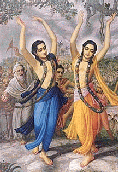
Sri Guru and Gauranga
Related Articles
Everyone is After the Oil
Energy Problem will be Solved As Soon As We are Localized
Who are the Terrorists?
Fools Elected by Fools
Related Topics
World Community - Government, Economy, Politics
Back to Top
Back to Top
Back to Top
Back to Top
Back to Top
Back to Top
Back to Top
Back to Top
Back to Top