
Krishna Books
What is Hare Krishna?
The Founder-Acharya
Hare Krishna Mantra
Sankirtan Movement
Personality of Godhead
Lord Chaitanya
A.C.Bhaktivedanta Swami Prabhupada
Hansadutta das
Events: Kirtan Festival
World Sankirtan Party
Submit News
© 2004 - Hansadutta das
Nirvana
and the Noble Path, Morality and Krishna
His Divine
Grace A.C. Bhaktivedanta Swami PrabhupadaComment Send this story to a friend
 Printer
Friendly Page
Printer
Friendly PageBhagavad-gita 2.26-27—Lecture on Bhagavad-gita, London, August 29, 1973

"Even if you say there is no soul..."
Pradyumna: [reads:]
atha chainam nitya-jatam
nityam va manyase mritam
tathapi tvam maha-baho
nainam shochitum arhasi [Bg. 2.26]
"If, however, you think that the soul is perpetually born and always dies, still you have no reason to lament, O mighty-armed."
Prabhupada: [reads:]
jatasya hi dhruvo mrityur
dhruvam janma mritasya cha
tasmad apariharye 'rthe
na tvam shochitum arhasi [Bg. 2.27]
So
Krishna is putting forward the modern scientific view. The modern
scientific view is that there is no soul. Life is generated from
matter. By combination of material elements at a... Just like chemical
combination. You mix acid and soda, alkaline and acid. There will be
some reaction, effervescence, movement. Similarly, the Buddhist
philosophy mostly, they do not believe in the existence of the soul.
The Buddhist philosopher thinks that the combination of matter makes a
living symptom. Their ultimate goal is nirvana. Nirvana means
stop this combination. Due to this combination, we feel pains and
pleasure. Therefore, if we disintegrate the combination, there will be
no more pains and pleasure. Materialistic. Their solution, pains and
pleasure, any philosophy or any religious system, ultimately aims at atyantika-duhkha-nivritti.
Duhkha means pain, and nivritti, nivritti means
stop. Why people go to the church? Because they feel some pain, they go
to church or temple to appeal, "If there is somebody as God..." They
think like that. "Let me appeal to the Supreme Person so that my
distress may be mitigated." So aim is atyantika-duhkha-nivritti.
We are also cultivating this Krishna consciousness. Our aim is also the
same. Duhkha-nivritti. Krishna says janma-mrityu-jara-vyadhi-duhkha
-doshanudarshanam [Bhagavad-gita 13.9]. We keep
always in view that in this material existence there are four kinds of
miserable condition, primarily. To stop this. Duhkhalayam
ashashvatam [Bg. 8.15]. Everyone's aim is
duhkha-nivritti. It may be presented in a different way. So the
Buddha philosophy is also duhkha-nivritti, stop pains.
Anandamayo 'bhyasat (Vedanta-sutra
1.1.12), we are, by nature, we want blissfulness. But we do not know
how to become actually happy and blissful. That is ignorance. In the
material world, they also want to enjoy, everyone. They are thinking
that this wine, woman, meat-eating, gambling, intoxication, these
things will give me pleasure. So
atyantika-duhkha-nivritti. The Bhagavata says that atyantika-duhkha-nivritti,
means ultimate solution of miserable condition, is in the fact that we
realize God and we go back to home, back to Godhead. This is our
philosophy. And persons who cannot understand what is God, what is
kingdom of God, they want to adjust. The aim is the same,
atyantika-duhkha-nivritti, ultimately solution of all miseries. In
a different way.
So
Krishna says, putting forward the Buddha philosophy
which was formerly known as lokayatikas and vaibhashikas...
These two kinds of philosophers, they did not believe. Mostly the
materialistic philosophers, they have no understanding of the soul.
Therefore they have different kinds of theories which we do not accept.
Krishna says that if you are not "sanatanist" [1] or followers of the Vedic principles, if you think
that your principle and views are different, that by combination of
matter this existence coming, atha chainam nitya-jatam... Nityam
means by combination of... Just like so many things are taking place by
interaction of different material elements. Similarly, if you don't
believe in this existence of the soul, if you think that there is no
soul, the life is the result of combination of matter, nitya-jatam,
and when this combination of matter is some way or other dismantled,
then there is no more soul, it is finished. It began at a point by
combination of matter, and it ends in a point by disintegration of
matter. If you think like that, then also tathapi tvam maha-baho.
Krishna is criticizing Arjuna, maha-bahu. Actually he [Arjuna] is maha-bahu.
Maha-bahu means mighty-armed. One who has got a very strong, mighty
arm, he can fight very strongly. Then also, why should you give up your
fighting spirit? Why should you lament for combination of chemicals and
material elements. Suppose this house is a combination of material
elements. So some way or other, if it is dismantled, who laments for
it? No sane man will lament. Similarly, if you have no idea of the
existence of soul, then also you do not require to lament. Tathapi
tvam maha-baho nainam shochitum arhasi.
Next verse:
jatasya hi dhruvo mrityur
dhruvam janma mritasya cha
tasmad apariharye 'rthe
na tvam shochitum arhasi
"For one who has taken his birth, death is certain; and for one who is dead, birth is certain. Therefore, in the unavoidable discharge of your duty, you should not lament."
Duty, good deeds and karma
This
is karma-vada. In the previous verse, Krishna tried to explain bauddha-vada,
nastika-vada, atheism. Atheist means one who does not believe in
the soul and God. These are correlative terms. If you understand what
is soul, then you can understand what is God. If you understand what is
God, then you can understand what is soul. But those who are agnostic,
atheist, they neither believe in God nor in the soul. So combination of
matter... Here Krishna says in a different way, that combination of
matter is taking place and again it is being dismantled. That is going
on. Either there is soul or not soul, just like Darwin's theory,
evolution of material body. So that is going on. One body is created
and the same body again annihilated, another body created, another
body, the same body annihilated, and it is going on. So where is the
cause of lamenting? You cannot stop. You cannot stop this process. Jatasya
hi dhruvo mrityur dhruvam janma mritasya cha tasmad apariharye 'rthe.
Duty. The same thing is going on. Duty is very important thing. Krishna
is stressing on it. One cannot stop his duty. Then he becomes sinful.
That is karma-vada. If, just like so many people, they argue
that if we discharge our duties nicely, then where is the need of
accepting God? The karma-vada philosophy is that if there is
God, then he's giving us the result of our activities, and if I do
nicely, then He gives me nice opportunity, and if I do not do things
very nicely, I am put into suffering. So there is a karma-phala-datta,
decides... Just like the high-court judge, he is giving judgement
according to the case, different cases. Similarly, our goodness or
badness will be decided according to our karma. That is also
fact. Then what is the use of accepting one God? If I do my duties very
nicely, then He must give me nice result. Why shall I worship Him? Why
shall I become a devotee of God? It is His duty. This is karma-vada.
Everyone is trying to avoid the principle of devotional service. It is
only we, the Krishna conscious persons, we are advocating the
philosophy of Bhagavad-gita, man-mana bhava
mad-bhakto mad-yaji mam namaskuru [Bg. 18.65]. Krishna says that
"Always think of Me." These karma-vadis [moralists],
they will say, "Why shall I waste my time thinking of Krishna? If I do
my duty nicely then I will get good result. Why shall I be devotee of
Krishna?" This is their argument.
One Arya-samaji postmaster, long ago, not very long ago, 1956,
1956... In Delhi at that time I was publishing this
Back to Godhead. So we had concession rate for posting, and it
was to be delivered to the postmaster. So the postmaster was talking
with me about the paper, Back to Godhead. He raised the
same question. He said, "If we do our duty nicely then what is the use
of worshiping God? If we become honest, if we become moral, if we do
not do anything which is harmful to anyone, in this way, if we act,
then where is the...?" Because our paper's name was Back to
Godhead. So he was indirectly protesting, that What is the use
of propagating this philosophy of Godhead if we act nicely? The Arya-samajists'
view... They are called... There is a English name, what is called? I
forget now. Moralists. The technical name there is. Anyway, this is
their point of view, how to avoid God. So I replied that if one is not
God conscious, he cannot be moralist, he cannot be truthful, he cannot
be honest. This is our point of view. You study the whole world only on
these three points, morality, honest, and dutiful. So many nice things
are there. But if he's not God conscious, he cannot continue such
thing. He must fail. Even the, there are so many instances, even
amongst the devotees, because this material world is made so that you
cannot continue this principle perpetually. That is explained in the Bhagavad-gita,
you'll find. Because the three modes of material nature is working,
even if you are on the platform of goodness, the other modes of
material nature will try to attack you. And your goodness, morality,
honesty, these things will be polluted by the onslaught of the other
two inferior modes of nature. Therefore, sometimes we find that a very
nice man is committing some sinful activities.
Different standards of morality
So
the decision of the Srimad-Bhagavatam is harav
abhaktasya kuto mahad-gunah. Mahad-gunah. We can find it
easily, just like we say that no illicit sex, no meat-eating, we
consider this is sinful. But there are others, big, big leaders,
politicians, philosophers, even religious priests, they do not think
that this is immoral or this is sinful. Meat-eating is sinful. Why?
What is the sin there? Illicit sex, what is the wrong there?
Intoxication, what is wrong there? They do not find any immorality. So
this standard of morality, there cannot be fixed up if one is not God
conscious. There cannot be. Standard of morality, standard of goodness,
cannot be. That is the decision of the Srimad-
Bhagavatam. Harav abhaktasya kuto mahad-gunah.
Lack of Krishna consciousness. They think that animal has no soul. They
do not accept this morality that animal cannot be killed, it is sinful,
it is immoral. They have created their own theory. So without being
standardized by Krishna consciousness, or God consciousness, you cannot
find the standard platform of morality, honesty. These things you
cannot find. This is not possible. Therefore, the verdict of the
Srimad-Bhagavatam is harav abhaktasya kuto mahad-gunah.
Just like if you do not follow a standard law, how you can fix up "This
is morality" or "This is honesty or dishonesty." There must be standard
law. And who can give you the law unless he is the greatest authority?
So law changes according to different countries, climate, situation. So
man-
made law cannot give you standard morality, honesty or... It is not
possible. Because one will think "This is morality," another will
think, "No, this is not morality." Same thing. Keep to the left, keep
to the right. Somebody says "Keep to the left is right," somebody says
"Keep to the left, it is wrong." Manorathenasati dhavato bahih
[Srimad-Bhagavatam 5.18.12]. Because those who are not
Krishna conscious, they are hovering on the mental plane. They cannot,
there cannot be any fixed up morality, honesty, dishonesty. No. And
rascals will also say yato mata tato patha. Means,
whatever you think is all right, that is all right. According to you,
your conception this is right, and according to my conception, both of
them are right. How both of them can be right?
So this contradiction, opposing elements, will continue unless there is
Krishna consciousness. So this is not a fact that the karma-vadis
simply by discharging your duties nicely... This is... On principle, it
is all right. But we must know what is actual morality. There are so
many examples. Just like when there is war, to kill the enemies, that
is morality. But in peaceful condition if you kill a person that is
immorality or sinful. The process is the same, morality or immorality,
the process is the same. But sometimes it is moral, sometimes immoral.
So how it will be standardized? Therefore Bhagavata says dharmam
tu sakshad bhagavat-pranitam [SB 6.3.19]. Real dharma,
real religion, morality, honesty, they can be decided on the words of
the Supreme Lord. That is the... When Krishna says "This is all right,"
then it is all right. When Krishna says it is not right, then it is not
right. This is our decision. We Krishna conscious men, we simply
accept. And that is a fact. That is a fact in this way because Krishna
is the greatest authority, Supreme Being. Supreme means the greatest
authority. Just like state says "Now it is wartime. If you kill a
number of enemies then you will be awarded with gold medal." The same
process of killing. But at another time, when there is no war, if you
kill one person you'll be hanged. The killing process is the same, but
the judgement is given by the greatest authority, the government. "This
is all right, this is not right." Therefore, standard of morality means
to abide by the orders of the greatest authority. That is standard of
morality. This is the conclusion. You cannot make your own morality.
No. If Krishna says "This is all right," then it is all right.
Otherwise, it is not.
Krishna says patram pushpam phalam toyam yo me bhaktya
prayacchati [Bg. 9.26]. "If somebody offers Me vegetables,
leaves, grains, milk, water, flowers, then I accept." So this is nice
foodstuff, it is to be accepted. Because Krishna likes to eat this.
Krishna can eat anything because He is the supreme, He is omnipotent,
He can eat anything, but He particularly mentions this. Therefore,
foodstuff made of these ingredients is nice, sattvika,
goodness. So the
karma-vada, that you follow morality you'll get good results... But
where is your morality? Because you are disobedient to God. In the
beginning of your life, you are immoral. You are disobeying the
greatest authority. There is another example, a story, that a gang of
thieves, they stolen some property from different houses, then out of
the village they are dividing amongst themselves the booties. So one
thief is saying, "Please divide it morally so that one may not be
cheated." Now just imagine, the property is stolen. Where is the
morality there? But when dividing, they are thinking of morality. The
basic principle is immoral. Where you can have morality? Similarly,
according to Vedic injunction, ishavasyam idam sarvam [Ishopanishad
mantra 1]. Everything belongs to the Supreme Personality of Godhead. It
is His property. So the whole planet is God's property, whole universe
is God's property. But when we are claiming that this is my property,
then where is morality? If you claim other's property as your property,
then where is the morality?
So in this material world, such kind of morality, honesty, is going on.
But our morality is if Krishna is satisfied, then it is honesty,
morality, everything. There are many examples. Just like Prahlada
Maharaja. Prahlada Maharaja is standing and his father is being killed
by Nrsimhadeva in his presence. So do you think it is morality that
one's father is being killed in the presence of his son, and the son
without protest is seeing, with a garland, that "As soon as my father
is killed, I shall offer this garland to Nrsimhadeva"? Is it morality?
From material point of view? We are worshiping... Prahlada Maharaja has
become mahajana, the greatest authority in devotional service,
but if we study his morality that he did not protest the killing of his
father, rather he was waiting with a garland, that "As soon as the
killing business is finished I'll reward this." You see? Where is
material morality, there is no morality.
The gopis, they were young girls, wife of somebody, sister of
somebody, daughter of somebody, but when Krishna was playing on His
flute at dead of night, they gave up all their engagement and began to
run, "Where Krishna is present?" So from Vedic standard of view, this
is immorality. They are going to another young boy and leaving family.
Even somebody, some of the gopis, they left their sons also,
and went to Krishna. From material point of view this is immoral. So
you'll find in such a way that what is from material point of view
immoral, it is the most magnificent morality in relationship with
Krishna. And similarly, from material point of view, what is moral,
that is most, I mean to say, abominable from the point of view... Just
like Yudhisthira Maharaja. Yudhisthira Maharaja became very moral.
Krishna advised him, "Just go and tell Dronacharya that 'Your son is
dead,' " although his son was not dead. Because Dronacharya will not
die unless he hears the news of the death of his son. He'll not die. So
he would not believe anyone, but Yudhisthira Maharaja is famous, very
moral. So Krishna asked him that "You go, otherwise he'll not believe
anyone." So Yudhisthira Maharaja hesitated, "How can I say lies?" So
for this [hesitation] he had to see hell.
He became immoral. Man-nimitte kritam papam punyaya eva kalpate.
So our standard of morality and immorality is to see whether Krishna is
satisfied. If Krishna is satisfied, then it is morality. If Krishna is
dissatisfied, then it is immoral. And Krishna's representative also.
Therefore, it is said
yasya prasadad bhagavat-prasado yasyaprasadan na gatih kuto 'pi .[2] Our morality is to
satisfy Krishna or His representative, guru. Yasya prasada. If
he's satisfied, then it is moral. If he's not satisfied, then it is
immoral. Na gatih kuto 'pi. So this karma-vada, that
you act nicely and you'll get nice result, that is all right, but there
may be some mistakes. There are so many instances. One very great
charitable king, he was giving in charity so many cows to the brahmanas.
So there was some mistake, and for that purpose, although he was all
throughout his whole life he was giving in charity, a little mistake,
he became a big lizard in the well. Therefore the conclusion is that
this material morality has no value. Spiritual morality. Spiritual
morality means to abide by the order of Krishna. That is morality.
Whatever Krishna says, if we accept, samsiddhir hari-toshanam.
Many places.
atah pumbhir dvija-shreshtha
varnashrama-vibhagashah
svanushthitasya dharmasya
samsiddhir hari-toshanam [SB 1.2.13]
In
many places. Svanushthitasya dharmasya samsiddhir hari-toshanam.
In another place, that, if you execute your morality principles but if
by executing such morality principle you do not, I mean to say, awaken
your Krishna consciousness, it is simply waste of time. Wherever you
go, the Bhagavata conclusion, harav abhaktasya kuto
mahad-gunah. We have to keep in point of view that to become...
Krishna also says in Bhagavad-gita: api chet
su-duracharo bhajate mam ananya-bhak sadhur eva sa mantavyah
[Bg. 9.30]. Even one is found
su-duracharah, not very strictly following moral principles, but he
is an unflinching devotee of Krishna, he's sadhu. These things
are there. Therefore the point should be that we should not accept this
karma-vada or the
bauddha-vada or Mayavada [impersonalists—those
who do not accept that God has personality], there are so many vadas.
We shall simply take Krishna-vada. Simply, simply accept
Krishna. And whatever He orders, whatever He likes, for His
satisfaction, we shall do anything and everything. That is our morality.
Thank you very much. END
Footnotes
1. sanatanists—those who live
according to sanatana-dharma (literally, the "eternal
occupation of the living being"), referring to the soul's eternal
relationship with the Supreme Personality of Godhead, Krishna. Back to text
2. yasya prasadad bhagavat
prasado yasyad prasadan na gatih kuto 'pi: "By satisfaction
of the
spiritual master, the Supreme Personality of Godhead becomes satisfied.
And by not satisfying the spiritual master, there is no chance of being
promoted to the plane of Krishna consciousness." Back to Text
Home | About | Events | World Sankirtan Party | Inside Nam Hatta
eBooks | Site Map | Store
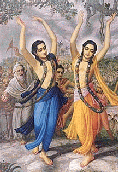
Sri Guru and Gauranga
Related Articles
Lord Buddha's Secret Mission
One Sun, One Religion: There is Only One Religion
The historical perspective
Food for Life
Related Topics
Karma - Work
Krishna Consciousness, the Process
Religion
Back to Top
Back to Top
Back to Top
Back to Top