In
these days, when men are trying to go to the moon, people should not
think that Krishna consciousness is concerned with something
old-fashioned. When the world is progressing to reach the moon, we are
chanting Hare Krishna. But people should not misunderstand and assume
that we are lagging behind modern scientific advancement. We have
already passed all scientific advancement. In Bhagavad-gita
it is said that man's attempt to reach higher planets is not new.
Newspaper headlines read, "Man's First Steps on the Moon," but the
reporters do not know that millions and millions of men went there and
came back. This is not the first time. This is an ancient practice. In Bhagavad-gita
(8.16) it is clearly stated, abrahma-bhuvanal lokah punar
avartino 'rjuna: "My dear Arjuna, even if you go to the highest
planetary system, which is called Brahmaloka, you will have to come
back." Therefore, interplanetary travel is not new. It is known to the
Krishna conscious devotees.
Since we are Krishna conscious, we take what Krishna says to be the
Absolute Truth. According to Vedic literature, there are many planetary
systems. The planetary system in which we are living is called
Bhurloka. Above this planetary system is Bhuvarloka. Above that is
Svarloka (the moon belongs to the Svarloka planetary system). Above
Svarloka is Maharloka; above that is Janaloka; and above that is
Satyaloka. Similarly, there are lower planetary systems. Thus there are
fourteen statuses of planetary systems within this universe, and the
sun is the chief planet. The sun is described in the
Brahma-samhita (5.52):
yach-chakshur
esha savita sakala-grahanam
raja samasta-sura-murtir ashesha-tejah
yasyajnaya bhramati sambhrita
-kala-chakro
govindam adi-purusham tam aham bhajami
"I worship Govinda [Krishna], the primeval Lord, by whose order the sun
assumes immense power and heat and traverses its orbit. The sun, which
is the chief among all planetary systems, is the eye of the Supreme
Lord."
Actually,
without the sun we cannot see. We may be very proud of our eyes, but we
cannot even see our next-door neighbor. People challenge, "Can you show
me God?" But what can they see? What is the value of their eyes? God is
not cheap. We cannot see anything, not to speak of God, without
sunshine. Without sunlight we are blind. At night, we cannot see
anything, and therefore we use electricity because the sun is not
present.
There is not only one sun in the cosmic manifestation; there are
millions and trillions of suns. That is also stated in the Brahma-samhita
(5.40):
yasya
prabha prabhavato jagad-anda-koti-
kotishv
ashesha-vasudhadi-vibhuti-bhinnam
tad brahma nishkalam anantam ashesha
-bhutam
govindam adi-purusham tam aham bhajami
The
spiritual bodily effulgence of the Supreme Personality of Godhead,
Krishna, is called the brahmajyoti, and in that brahmajyoti
there are countless planets. Just as within the sunshine there are
innumerable planets, in the shining effulgence of the body of Krishna
there are innumerable planets and universes. We have knowledge of many
universes, and in each universe there is a sun. Thus there are millions
and billions of universes and millions and billions of suns and moons
and planets. But Krishna says that if one tries to go to one of these
planets, he will simply waste his time.
Now someone has gone to the moon, but what will human society gain from
it? If, after spending so much money, so much energy and ten years of
effort, one goes to the moon and simply touches it, what is the benefit
of that? Can one remain there and call his friends to come? And even if
one goes there and remains, what will be the benefit? As long as we are
in this material world, either on this planet or other planets, the
same miseries—birth, death, old age and disease—will follow us. We
cannot rid ourselves of them.
If we go to live on the moon—assuming it is possible—even with an
oxygen mask, how long could we stay? Furthermore, even if we had the
opportunity to stay there, what would we gain? We might gain a little
longer life perhaps, but we could not live there forever. That is
impossible. And what would we gain by a longer life? Taravah kim
na jivanti: [Srimad-Bhagavatam 2.3.18] are not the
trees living for many, many years? Near San Francisco I have seen a
forest where there is a tree seven thousand years old. But what is the
benefit? If one is proud of standing in one place for seven thousand
years, that is not a very great credit.
How one goes to the moon, how he comes back, etc., is a great story,
and this is all described in the Vedic literature. It is not a very new
process. But the aim of our Krishna consciousness society is different.
We are not going to waste our valuable time. Krishna says, "Don't waste
your time attempting to go to this planet or to that planet. What will
you gain? Your material miseries will follow you wherever you go."
Therefore, in the Chaitanya-charitamrita (Adi 3.97) it is
very nicely said by the author:
keha
pape, keha punye kare vishaya-bhoga
bhakti-gandha nahi, yate yaya bhava-roga
"In this material world someone is enjoying and someone is not
enjoying, but actually everyone is suffering, although some people
think that they are enjoying, whereas others realize that they are
suffering."
Actually
everyone is suffering. Who in this material world does not suffer
disease? Who does not suffer from old age? Who does not die? No one
wants to grow old or suffer from disease, but everyone must do so.
Where then is the enjoyment? This enjoyment is all nonsense because
within this material world there is no enjoyment. It is simply our
imagination. One should not think, "This is enjoyment, and this is
suffering." Everything is suffering! Therefore, it is stated in the Chaitanya-charitamrita,
"The principles of eating, sleeping, mating and defending will always
exist, but they will exist in different standards." For example, the
Americans have taken birth in America as a result of pious activities
performed in previous lifetimes. In India the people are
poverty-stricken and are suffering, but although the Americans are
eating very nicely buttered bread and the Indians are eating without
butter, they are both eating nevertheless. The fact that India is
poverty-stricken has not caused the whole population to die for want of
food. The four principal bodily demands—eating, sleeping, mating and
defending—can be satisfied under any circumstances, whether one is born
in an impious condition or in a pious condition. The problem, however,
is how to become free from the four principles of birth, death, old age
and disease.
This is the real problem. It is not "What shall I eat?" The birds and
beasts have no such problem. In the morning they are immediately
chirping, "Jee, jee, jee, jee." They know that they will have their
food. No one is dying, and there is no such thing as overpopulation
because everyone is provided for by God's arrangement. There are
qualitative differences, but obtaining a superior quality of material
enjoyment is not the end of life. The real problem is how to get free
of birth, death, old age and disease. This cannot be solved by simply
wasting time traveling within this universe. Even if one goes to the
highest planet, this problem cannot be solved, for there is death
everywhere.
The duration of life on the moon, according to Vedic information, is
ten thousand years, and one day there is equal to six months here. Thus
ten thousand multiplied by one hundred eighty years is the duration of
life on the moon. However, it is impossible for earthmen to go to the
moon and live there for very long. Otherwise the whole Vedic literature
would be false. We can attempt to go there, but it is not possible to
live there. This knowledge is in the Vedas. Therefore, we
are not very eager to go to this planet or that planet. We are eager to
go directly to the planet where Krishna lives. Krishna states in Bhagavad-gita
(9.25):
yanti
deva-vrata devan
pitrin yanti pitri-vratah
bhutani yanti bhutejya
yanti
mad-yajino 'pi mam
"One can go to the moon, or one can even go to the sun or to millions
and trillions of other planets, or if one is too materially attached he
may remain here—but those who are My devotees will come to Me."
This
is our aim. Initiation into Krishna consciousness insures that the
student ultimately can go to the supreme planet, Krishnaloka. We are
not sitting idly; we are also attempting to go to other planets, but we
are not merely wasting time.
A sane and intelligent man does not wish to enter any of the material
planets because the four conditions of material miseries exist on all
of them. From Bhagavad-gita we can understand that even
if we enter Brahmaloka, the highest planetary system of this universe,
the four principles of misery will be present. We learn from Bhagavad-
gita that the duration of one day on Brahmaloka is millions of
years of our calculation. That is a fact.
Even the highest planetary system, Brahmaloka, may be reached, but
scientists say that it will take forty thousand years at sputnik speed.
Who is prepared to travel in space for forty thousand years? From the
Vedic literature we can understand that we can enter any of the
planets, provided we prepare for that purpose. If one prepares himself
to enter into the higher planetary systems, which are said to be
inhabited by demigods, he can go there. Similarly, one can go to a
lower planetary system, or if one desires he can remain on this planet.
Finally, if one desires, he can enter the planet of the Supreme
Personality of Godhead. It is all a matter of preparation. However, all
planetary systems within our material universe are temporary. The
duration of life on certain material planets may be very long, but all
living entities in the material universe are eventually subject to
annihilation and have to again develop other bodies. There are
different types of bodies. A human body exists one hundred years,
whereas an insect body may exist for twelve hours. Thus the duration of
these different bodies is relative. If one enters the planet called
Vaikuëöhaloka, the spiritual planet. However, he then
achieves eternal life, full of bliss and knowledge. A human being can
attain that perfection if he tries. That is stated in Bhagavad-gita
when the Lord says, "Anyone who knows in truth about the Supreme
Personality of Godhead can attain to My nature."
Many people claim, "God is great," but this is a hackneyed phrase. One
must know how He is great, and that can be known from authorized
scripture. In the Bhagavad-gita God describes Himself. He
says, "My appearance of taking birth just like an ordinary human being
is actually transcendental." God is so kind that He comes before us as
an ordinary human being, but His body is not exactly like a human body.
Those rascals who do not know about Him think that Krishna is like one
of us. That is also stated in Bhagavad-gita (9.11):
avajananti
mam mudha
manushim tanum ashritam
param bhavam ajananto
mama
bhuta-maheshvaram
"Fools deride Me when I descend in the human form. They do not know My
transcendental nature and My supreme dominion over all that be."
We
have a chance to know about Krishna provided we read the right
literature under the right direction, and if we simply know what the
nature of God is, then by understanding this one fact alone we become
liberated. It is not possible in our human condition to understand the
Absolute Supreme Personality of Godhead completely, but with the help
of Bhagavad-gita, the statements given by the Supreme
Personality of Godhead, and of the spiritual master, we can know Him to
the best of our capacity. If we can know Him in reality, then
immediately after leaving this body we can enter into the kingdom of
God. Krishna says, tyaktva deham punar janma naiti mam eti so
'rjuna: "After leaving this body, one who is in knowledge does
not come again to this material world, for he enters into the spiritual
world and comes to Me." (Bg. 4.9)
The purpose of our Krishna consciousness movement is to propagate this
advanced scientific idea to people in general, and the process is very
simple. Simply by chanting the holy names of God—Hare Krishna, Hare
Krishna, Krishna Krishna, Hare Hare/ Hare Rama, Hare Rama, Rama Rama,
Hare Hare—one cleanses the dirt from his heart and gains understanding
that he is part and parcel of the Supreme Lord and that it is his duty
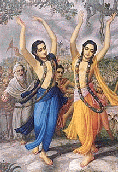
to serve Him. This process is very pleasant: we chant the Hare Krishna mantra,
we dance rhythmically, and we eat nice prasada. While enjoying
this life, we are preparing to enter into the kingdom of God in our
next life. This is not a fabrication—it is all factual. Although to a
layman this appears to be a fabrication, Krishna reveals Himself from
within to one who is serious about God realization. Both Krishna and
the spiritual master help the sincere soul. The spiritual master is the
external manifestation of God, who is situated in everyone's heart as
Supersoul. For one who is very serious about understanding the Supreme
Personality of Godhead, Supersoul immediately renders assistance by
directing him to a bona fide spiritual master. In this way the
spiritual candidate is helped from within and without.
According to the Bhagavata Purana, the Supreme Truth is
realized in three stages. First there is impersonal Brahman, or the
impersonal Absolute; then the Paramatma, or localized aspect of
Brahman. The neutron of the atom may be taken as the representation of
Paramatma, who also enters into the atom. This is described in the Brahma-samhita
. But ultimately the Supreme Divine Being is realized as the supreme
all-attractive person (Krishna) with full and inconceivable potencies
of opulence, strength, fame, beauty, knowledge and renunciation. These
six potencies are fully exhibited by Sri Rama and Sri Krishna when They
descend before human beings. Only a section of human beings—the
unalloyed devotees—can recognize Krishna on the authority of revealed
scriptures, but others are bewildered by the influence of material
energy. The Absolute Truth is therefore the Absolute Person who has no
equal or competitor. The impersonal Brahman rays are the rays of His
transcendental body, just as the sun's rays are emanations from the sun.
According to the Vishnu Purana, the material energy is
called avidya, or nescience, and is exhibited in the fruitive
activities of sense enjoyment. But although the living being has the
tendency to be illusioned and trapped by the material energy for sense
enjoyment, he belongs to the antimaterial energy, or spiritual energy.
In this sense the living being is the positive energy, whereas matter
is the negative energy. Matter does not develop unless in contact with
the superior spiritual, or antimaterial, energy, which is directly part
and parcel of the spiritual whole. The subject matter of this spiritual
energy exhibited by living beings is undoubtedly very complicated for
an ordinary man, who is therefore astounded by the subject. Sometimes
he partially understands it through the imperfect senses, and sometimes
he fails to know it altogether. It is best, therefore, to hear from the
highest authority, Sri Krishna, or from His devotee who represents Him
in the chain of disciplic succession.
This Krishna consciousness movement is meant for the purpose of
understanding God. The spiritual master is the living representative of
Krishna who helps externally, and Krishna as Supersoul helps
internally. The living entity can take advantage of such guidance and
make his life successful. We request that everyone read authoritative
literature in order to understand this movement. We have published Bhagavad-gita
As It Is; Teachings of Lord Chaitanya; Srimad-Bhagavatam;
Krishna, the Supreme Personality of Godhead; and The
Nectar of Devotion. We are also publishing our magazine Back
to Godhead every month in many languages. Our mission is to save
human society from the pitfalls of incarnating again in the cycle of
birth and death.
Everyone should attempt to go to Krishna. We have published an article
in our Back to Godhead magazine entitled "Beyond the
Universe." This article describes a place beyond this universe
according to knowledge which is in
Bhagavad-gita. Bhagavad-gita is a very popular
book, and there are many editions of it in America and also many from
India. Unfortunately, however, many rascals have come to the West to
preach Bhagavad-gita. They are designated as rascals
because they are bluffers who do not give real information. In our
Bhagavad-gita As It Is, however, the spiritual nature is
authoritatively described.
This cosmic manifestation is called "nature," but there is another
nature, which is superior. The cosmic manifestation is inferior nature,
but beyond this nature, which is manifested and unmanifested, there is
another nature, which is called sanatana, eternal. It is easy
to understand that everything manifested here is temporary. The obvious
example is our body. If one is thirty years old, thirty years ago his
body was not manifested, and in another fifty years it will again be
unmanifested. That is a factual law of nature. It is manifested and
again annihilated, just as waves in the sea rise frequently and then
recede. The materialist, however, is simply concerned with this mortal
life, which can be finished at any moment. Furthermore, as this body
will die, so the entire universe, this gigantic material body, will be
annihilated, and whether we are fortunate or unfortunate, on this
planet or another planet, everything will be finished. Why then are we
wasting our time trying to go to a planet where everything will be
finished? We should try to go to Krishnaloka. This is spiritual
science; we must try to understand it, and, after understanding it
ourselves, we should preach this message to the whole world. Everyone
is in darkness. Although people have no knowledge, they are very proud.
But it is not advancement of knowledge to go to the moon after ten
years of effort and take a rock and come back. The space travelers are
very proud: "Oh, I have touched it." But what have they gained? Even if
we were able to live there, it would not be for long. It will all be
destroyed in the end.
Try to find that planet from which one will never return, where there
is eternal life, and where one can dance with Krishna. This is the
meaning of Krishna consciousness. Take this movement seriously, for
Krishna consciousness gives one a chance to reach Krishna and to dance
with Him eternally. From Vedic literature we understand that this
material world is a manifestation of only one fourth of the complete
creation of God. The three-fourths portion of God's creation is the
spiritual world. That we find in Bhagavad-gita. Krishna
says, "This material world is but a fractional part of the whole." If
we look as far as we can see—up to the sky—our vision is still confined
within only one universe, and there are unlimited universes clustered
together within what is called the material world. But beyond those
clusters of unlimited numbers of universes is the spiritual sky, which
is also mentioned in Bhagavad-gita, where the Lord says
that beyond the material world is another nature, which is eternal;
there is no history of its beginning, and it has no end. "Eternal"
refers to that which has no end and no beginning. The Vedic religion is
therefore called eternal because no one can trace back when it began.
The Christian religion has a history of two thousand years, and the
Muhammadan religion also has a history, but if one were to trace back
Vedic religion, he would not find its historical beginning. Therefore
it is called eternal religion.
We may rightly say that God created this material world, and this
indicates that God existed before the creation. This very word
"created" suggests that before the creation of the cosmic
manifestation, the Lord was existing. Therefore God is not under the
creation. If God were under the creation, how could He have created? He
would instead have been one of the objects of this material creation.
But God is not under the creation; He is the creator, and therefore He
is eternal.
There is a spiritual sky, where there are innumerable spiritual planets
and innumerable spiritual living entities, but those who are not fit to
live in that spiritual world are sent to this material world.
Voluntarily we have accepted this material body, but actually we are
spirit souls who should not have accepted it. When and how we accepted
it cannot be traced. No one can trace the history of when the
conditioned soul first accepted the material body. There are 8,400,000
forms of living entities 900,000 species of living entities are within
the water, 2,000,000 species of life are among the plants and
vegetables. Unfortunately, this Vedic knowledge is not instructed by
any university. But these are facts. Let the botanist and
anthropologist research into the Vedic conclusion. Darwin's theory of
the evolution of organic matter is, of course, very prominent in the
institutions of learning. But the Bhagavata Purana and
other authoritative scriptures of scientific magnitude describe how the
living entities in different forms of body evolve one after another. It
is not a new idea, but educators are giving stress only to Darwin's
theory, although in Vedic literature we have immense information of the
living conditions in this material world.
We are only a fractional portion of all the living entities in the many
universes of the material world. Those who are in the material world
and material body are condemned. For example, the population in prison
is condemned by the government, but their number is only a fraction of
the whole population. It is not that the whole population goes to
prison; some, who are disobedient, are confined in prison. Similarly,
the conditioned souls within this material world are only a fraction of
all the living entities in the creation of God, and because they have
disobeyed God—because they did not abide by the order of Krishna—they
have been put into this material world. If one is sensible and
inquisitive, he should try to understand: "Why have I been put into
this conditional life? I do not wish to suffer."
There are three kinds of suffering, including miseries pertaining to
the body and mind. In Hawaii, in front of my house, a man was keeping
some animals and birds for the purpose of taking them to be
slaughtered. I gave this example to my students: "These animals are
standing here, and if you tell them, 'Oh, my dear animals, why are you
standing here? Go away! You are meant for the slaughterhouse,' they
cannot go. They have no intelligence."
Suffering without knowledge, without remedy, is animal life. One who
cannot understand that he is suffering and who thinks that he is very
well off is in animal consciousness, not human consciousness. The human
being should be cognizant of suffering the threefold miseries of this
planet. One should know that he is suffering in birth, suffering in
death, suffering in old age and suffering in disease, and one should be
inquisitive as to how he may avoid the suffering. That is real research
work.
We have suffered from the beginning of our birth. As a baby, the human
being is tightly placed in the abdomen of the mother in an airtight bag
for nine months. He cannot even move, there are insects biting him, and
he cannot protest. After the child comes out, the suffering continues.
The mother undoubtedly takes much care, but still the child cries
because he is suffering. There are bugs biting or there are pains in
his stomach; the child is crying, and the mother does not know how to
pacify him. His suffering begins in the womb of his mother. Then, after
his birth, as he grows up, there is more suffering. He does not want to
go to school, but he is forced to. He does not want to study, but the
teacher gives him tasks. If we analyze our life, we will find that it
is full of suffering. Why then are we coming here? The conditioned
souls are not very bright. We should inquire, "Why am I suffering?" If
there is a remedy, we must take advantage of it.
We are eternally connected with the Supreme Lord, but somehow or other
we are now in material contamination. Therefore, we must take up a
process by which to go back again to the spiritual world. That linking
process is called yoga. The actual translation of the word yoga
is "plus." At the present moment we are minus God, or minus the
Supreme. But when we make ourselves plus—connected—then our human form
of life is perfect. During our lifetime we have to practice approaching
that point of perfection, and at the time of death, when we give up
this material body, that perfection has to be realized. At the time of
death, one must be prepared. Students, for instance, prepare for two to
five years in college, and the final test of their education is the
examination. If they pass the examination, they get a degree.
Similarly, in the subject of life, if we prepare for the examination at
the time of death and pass it, then we are transferred to the spiritual
world. Everything is examined at the time of death.
There is a very common Bengali proverb that says that whatever one does
for perfection will be tested at the time of his death. Bhagavad-gita
describes what we should do at the point of our death, when we are
giving up this present body. For the dhyana-yogi (meditator)
Sri Krishna speaks the following verses:
yad
aksharam veda-vido vadanti
vishanti yad yatayo vita-ragah
yad icchanto
brahmacharyam charanti
tat te padam sangrahena pravakshye
sarva-dvarani samyamya
mano hridi nirudhya cha
murdhny
adhayatmanah pranam
asthito yoga-dharanam
"Persons learned in the Vedas, who utter omkara
and who are great sages in the renounced order, enter into Brahman.
Desiring such perfection, one practices celibacy. I shall now explain
to you this process by which one may attain salvation. The yogic
situation is that of detachment from all sensual engagements. Closing
all the doors of the senses and fixing the mind on the heart and the
life air at the top of the head, one establishes himself in yoga."
(Bg. 8.11-12)
In
the yoga system this process is called pratyahara,
which means, in technical language, "the opposite." Now the eyes are
engaged in seeing worldly beauty, so one has to withdraw them from
enjoying that beauty and concentrate on seeing beauty inside. That is
called pratyahara. Similarly, one has to hear the omkara
sound from within.
om
ity ekaksharam brahma
vyaharan mam anusmaran
yah prayati tyajan deham
sa
yati paramam gatim
"After being situated in this yoga practice and vibrating the
sacred syllable om, the supreme combination of letters, if one
thinks of the Supreme Personality of Godhead and quits his body, he
will certainly reach the spiritual planets." (Bg. 8.13)
In
this way all the senses have to be stopped in their external
activities, and the mind must be concentrated on vishnu-murti,
the form of Lord Vishnu. That is the perfection of yoga. The
mind is very turbulent, so it has to be fixed upon the heart. When the
mind is fixed within the heart and the life air is transferred to the
top of the head, one can attain the perfection of
yoga.
The perfect yogi then determines where he is to go. There are
innumerable material planets, and beyond these planets there is the
spiritual world. Yogis have this information from Vedic
scriptures. For example, before I came to the United States I read
descriptions of it from books. Similarly, a description of the higher
planets and the spiritual world can be found in the Vedic scriptures.
The yogi knows everything; he can transfer himself to any
planet he likes. He does not need the help of spacecraft.
Material scientists have been trying for many years, and they will go
on trying for one hundred or one thousand years more, but they will
never reach any planet. Maybe by a scientific process one or two men
can reach some planet, but that is not the general process. The
generally accepted process for transferral to other planets is the
practice of the yoga system or the jnana system. The bhakti
system, however, is not meant for transferral to any material planet.
Those who engage in the devotional service of Krishna, or the Supreme
Lord, are not interested in any of the planets of this material world
because they know that no matter to which planet one elevates himself,
he will still find the four principles of material existence there
nonetheless. On some planets the duration of life is much longer than
on this earth, but death is there. Those who are Krishna conscious,
however, transcend this material life of birth, death, disease and old
age.
Spiritual life means release from this botheration and misery. Those
who are intelligent, therefore, do not try to elevate themselves to any
planet of this material world. Men are trying to reach the moon, and
although it is very difficult to gain entrance to that planet, if we do
gain entrance the period of our lives will be enhanced. Of course, that
does not apply to life in this body. If we were to enter the moon with
this body, instant death would be certain.
When one enters into a planetary system, he must have a suitable body
for that planet. Every planet is inhabited by living entities with
bodies suitable for that planet. For instance, we can enter the water
in this body, but we cannot live there. We may stay there fifteen or
sixteen hours, or maybe twenty-four hours, but that's all. Aquatic
animals, however, have particular bodies suitable for living their
whole lives in water. Similarly, if one takes a fish out of water and
puts it on the land, it will die instantly. As we understand that even
on this planet there are different kinds of bodies for living in
particular places, so, similarly, if we want to enter another planet,
we have to prepare ourselves to get a suitable body.
If one transfers himself and his soul transmigrates to the moon by this
yogic process, he gets a long duration of life. On the higher planets,
six of our months equal one day. Thus the beings there live for ten
thousand years. That is the description in the Vedic literature. So
undoubtedly one can get a very long duration of life, but still there
is death. After ten thousand or twenty thousand years, or even after
millions of years (it does not matter), death comes.
Actually, we are not subject to death. That is affirmed in the
beginning of Bhagavad-gita (2.20): na hanyate
hanyamane sharire. We are spirit soul, and therefore we are
eternal. Why then should we subject ourselves to death and birth? It is
intelligent to think in this way. Those who are Krishna conscious are
very intelligent because they are not interested in getting promotion
to any planet where there is death, despite a long duration of life
there. Rather, they want to get a body like God's. Ishvarah
paramah krishnah sach-chid-ananda-vigrahah. (Bs. 5.1) God's body
is sach-chid-ananda. Sat means "eternal," and chit
means "full of knowledge." Ananda means "full of pleasure."
As stated in our pamphlet Krishna, the Reservoir of Pleasure,
if we transfer ourselves to the spiritual world, to Krishna's planet or
to any other spiritual planet, then we will get a body similar to
God's: sach-chid-ananda
—eternal, full of knowledge and full of bliss. So those who try to be
Krishna conscious have a different aim of life than those who are
trying to promote themselves to the better planets in this material
world. Lord Krishna says, murdhny adhayatmanah pranam asthito
yoga-dharanam: "The perfection of yoga is to transfer
oneself to the spiritual world." (Bg. 8.12)
The spirit soul is a minute particle within the body. We cannot see it.
One practices the yoga system to raise the soul to the topmost
part of the head. This practice goes on while one is living, and the
perfection is reached when one can place himself on the top of the head
and then break through. Then he can transfer himself to whatever higher
planets he likes. That is the perfection of the yogi.
If the yogi is inquisitive to see the moon, he can say, "Ah,
let me see what the moon is like. Then I shall transfer myself to
higher planets," just like travelers who go to Europe, California,
Canada, or other countries on earth. One can transfer oneself to many
planets by this yoga system, but anywhere he goes he will find
visa systems and customs systems. To go to other planets, one must be
qualified.
Krishna conscious persons are not interested in any temporary planet,
even if it offers a long duration of life. If the
yogi, at the time of death, can pronounce om, the concise
form of transcendental vibration, and at the same time mam
anusmaran, remember Krishna, Vishnu, he will attain perfection.
The purpose of the entire yoga system is to concentrate the
mind on Vishnu. Impersonalists imagine that they see the form of
Vishnu, or the Lord, but those who are personalists do not imagine
this—they actually see the form of the Supreme Lord. Either way, if one
concentrates his mind through imagination or if one actually sees, one
has to concentrate his mind on the Vishnu form. Mam means "unto
the Supreme Lord, Vishnu." Anyone who leaves this body and concentrates
his mind on Vishnu enters into the spiritual kingdom after quitting his
body. Those who are actually yogis do not desire to enter any
other planet because they know that life is temporary on the temporary
planets, and thus they are not interested. That is intelligence.
Those who are satisfied with temporary happiness, temporary life and
temporary facilities are not intelligent according to Bhagavad-gita
(7.23). Antavat tu phalam tesham, tad bhavaty alpa-medhasam:
"One whose brain substance is very meager is interested in temporary
things." That is the version of Srimad Bhagavad-gita. I
am eternal, so why should I be interested in nonpermanent things? Who
wants nonpermanent existence? No one wants it. If we are living in an
apartment and the landlord asks us to vacate, we are sorry, but we are
not sorry if we move to a better apartment. This then is our
inclination. We do not wish to die, because we are eternal.
The material atmosphere is robbing us of our eternality. The Srimad-Bhagavatam
says, "Our duration of life is being diminished by the sun, beginning
from its rising until the time it sets." Daily we are losing the
duration of our lives. If the sun rises at 5:30 in the morning, at 5:30
in the evening twelve hours have been taken away from the duration of
our lives. We will never get this time back. If we ask any scientist,
"I will give you twelve million dollars—please give me back these
twelve hours," he will reply, "No, it is not possible." The scientist
cannot do it. Therefore the
Bhagavatam says that from sunrise to sunset the duration of our
lives is being diminished.
Time is called kala—past, present and future. What is now
present, tomorrow will be past, and what is now future, tomorrow will
be present. But this past, present and future are the past, present and
future of the body. We do not belong to the category of the past,
present and future. We belong to the category of eternity. Therefore
one should be concerned with how to attain or how to be elevated to the
platform of eternity. The developed consciousness of the human being
should be utilized not in the animal propensities of eating, sleeping,
mating and defending but in searching out the valuable path which will
help him get that life of eternity. It is said that the sun is taking
away our duration of life—every minute, every hour, every day—but if we
engage ourselves in the topics of uttama-shloka, the topics of
the Lord, that time cannot be taken away. The time one devotes in a
Krishna consciousness temple cannot be taken away. It is an asset—a
plus, not a minus. The duration of life, so far as the body is
concerned, may be taken; however one tries to keep it intact, no one
can do it. But the spiritual education we receive in Krishna
consciousness cannot be taken away by the sun. It becomes a solid asset.
Chanting Hare Krishna, Hare Krishna, Krishna Krishna, Hare Hare/ Hare
Rama, Hare Rama, Rama Rama, Hare Hare is a very easy thing to do. Time
spent chanting cannot be taken away like time pertaining to the body.
Fifty years ago I was a young man, but that time has been taken and
cannot be returned. The spiritual knowledge I received from my
spiritual master, however, cannot be taken away, but will go with me.
Even after I quit this body, it will go with me; and if it is perfect
in this life, then it will take me to the eternal abode.
Both the material and spiritual worlds belong to Krishna. We are not
proprietors of anything. It is all the property of the Supreme Lord,
just as everything in the state belongs to the government, either in
the prison house or outside the prison house. Conditioned life is just
like life in a prison house in this material world. A prisoner cannot
freely change from one cell to another. In free life one can go from
one home to another home, but in prison life one cannot do that but
must stay in his cell. All these planets are like cells. We are trying
to go to the moon, but it is not practical by mechanical means. Whether
we are American, Indian, Chinese or Russian, we have been given this
planet to live on. We cannot leave—although there are millions and
billions of planets and although we have machines by which we
can—because we are conditioned by the laws of nature, God's laws. A man
who is put into a certain cell cannot change at will without superior
authority. Krishna says in the Bhagavad-gita that one
should not try to change from one cell to another. That will not make
anyone happy. If a prisoner thinks, "I am in this cell—let me request
the warden to change my cell, and I will be happy," that is a mistaken
idea. One cannot be happy so long as he is within the prison walls. We
are trying to be happy by changing cells—from capitalism to communism.
The aim should be to become free from this "ism" and that "ism." One
has to change completely from this "ism" of materialism; then he can
become happy. That is the program of Krishna consciousness.
We are taking advice from the Supreme Person. He says, "My dear Arjuna,
you may be elevated to the highest planetary system, which is called
Brahmaloka and is desirable because life there is very long." We cannot
calculate even a half-day there. It is beyond our mathematical
calculations. But even in Brahmaloka there is death. Therefore Krishna
says, "Do not waste your time trying to elevate yourself or transfer
yourself from this planet to that planet."
The people I have seen in America are very restless. They go from one
apartment to another apartment or from one country to another country.
That restlessness is there because we are searching after our real
home. To go from this place to that place will not give eternal life.
Eternal life is with Krishna. Therefore Krishna says, "Everything
belongs to Me, and I have the superexcellent abode, which is called
Goloka Vrindavana." If one wants to go there, he must simply become
Krishna conscious and try to understand how Krishna appears and
disappears, what His constitutional position is, what our
constitutional position is, what our relationship with Him is, and how
to live. Simply try to understand these ideas scientifically.
Everything in Krishna consciousness is scientific. It is not bogus,
whimsical, sentimental, fanatical or imaginary. It is truth, fact,
reality. One must understand Krishna in truth.
We have to give up this body, willingly or unwillingly. The day will
come when we will have to submit to the laws of nature and give up this
body. Even President Kennedy in his procession had to submit to
nature's law and change his body for another body. He could not say,
"Oh, I am the President; I am Mr. Kennedy. I cannot do that." He was
forced to do it. That is the way nature works.
The purpose of our developed human consciousness is to understand how
nature works. Aside from human consciousness, there is consciousness in
dogs, cats, worms, trees, birds, beasts and all other species. But we
are not meant to live in that consciousness. The Srimad-Bhagavatam
says that after many, many births we have attained the human form of
body. Now we should not misuse it. Please utilize this human life to
develop Krishna consciousness and be happy.