The
Independent, March 12, 2006--Death
of the World's Rivers
Disaster warning from UN as investigation reveals half of the planet's
500 biggest rivers are seriously depleted or polluted...
GEOFFREY
LEAN, Environment Editor
The world's great rivers are drying up
at an alarming rate, with devastating consequences for humanity,
animals and the future of the planet.
The Independent on Sunday can today reveal that more than half the
world's 500 mightiest rivers have been seriously depleted. Some have
been reduced to a trickle in what the United Nations will this week
warn is a "disaster in the making".
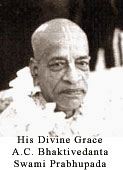
Morning Walk and Room Conversation with His Divine Grace A.C.
Bhaktivedanta Swami Prabhupada, August 9, 1976, Tehran, Iran
Prabhupada:
No tree. In the desert, where is tree? All desert. All this Middle
East, desert. So they can be allowed to eat meat. Otherwise, what
they'll eat? So everyone must eat something. So if there is no
vegetation, if there is no sufficient, they can be allowed.
Parivrajakacharya: I visited some of these small villages
in the south of Iran, and the tents of nomads who kept sheep, that was
their life. They had a tent and they had hundreds of sheep, and they
would move the tent every month. They would take the tent, for one
month they would live here, next month they would move.
Prabhupada: Why they're changing?
Parivrajakacharya: Because they're desert people. The
sheep eat all the little green, and then they have to move on.
Pradyumna: Same thing as the Bible. When the sheep eat up
all the green in that place, then they have to go to another place with
their sheep. In the Bible the same thing. All that Abraham, Joseph...
Prabhupada: Bible was produced here, in this desert.
Jerusalem is not far away. Mecca, (indistinct), Arabia.
Parivrajakacharya: All they had to eat was the milk of
sheep and goats and sometimes when they would camp near a farm they
would have vegetables. Sometimes. And then the meat of the sheep.
Prabhupada: And these dates. In the desert the date tree
grows. Sometimes they eat camel also. Do they not?
Parivrajakacharya: Yes. But I don't think if they...
Prabhupada: They cannot be strictly vegetarian; it is not
possible.
Parivrajakacharya: It is difficult.
Prabhupada: But even they eat meat they can chant Hare
Krishna, there is no harm.
Parivrajakacharya: But now they are farming in the desert.
The Iranian government has started farms. They are irrigating the land
with water, and when they put water on the desert they get all kinds of
vegetables and grains very easily. So if they do that then they can
become vege... They have no excuse. The excuse of the people is that
"We have to eat meat."
Prabhupada: They can have rains from the sky by chanting.
The rain will fall from the sky. Who can check it? Krishna gives the
water from the sky. Yajnad bhavati parjanyah [Bhagavad-gita
3.14].
Parivrajakacharya: They say in the books that this area
used to be all forest with many, many trees two to three thousand years
ago. It was a very thick forest. But since then it has become desert,
the rain has stopped since then.
Prabhupada: Because the yajna stopped.
Pradyumna: The Sahara Desert used to be all trees, very
fertile. Sahara Desert in Africa, it is the biggest desert in the
world. Nothing...
Prabhupada: Sahara, Sahara.
Pradyumna: Sahara Desert. It used to be very rich
thousands of years ago, but then became desert.
Hari-sauri: It's supposed to increase its size by ten
miles every year.
Pradyumna: Desert growth. Formerly, that city Carthage
used to be there. Carthage was fighting Rome. Carthage was very rich,
all farms.
Prabhupada: Cartharian civilization was very big
civilization. The thing is that the more people become sinful, they'll
be disturbed by this natural atmosphere.
Morning Walk at Villa Borghese (Rome), May 25, 1974
Devotee:
Why is it that the rains come in certain parts of the world and in
other parts people do not have enough?
Prabhupada: No, no part of the world is nowadays
sufficient rain. Because they are not performing yajna.
Sometimes it is seen that over-rain, overflood, not systematic. But if
you perform yajna, there will be systematic rainfall, which you
can utilize properly. Yajnad bhavati parjanyah. [Bhagavad-gita
3.14]: "Rains are produced by performance of yajna
{sacrifice}."].
Lecture on Bhagavad-gita 2.22, Hyderabad, India, November
26, 1972
Prabhupada:
So yajnad bhavati parjanyah: [Bhagavad-gita
3.14] If you perform yajna, then there will be regular
rainfall. If you avoid yajna, there will be restriction, and
what your plan and fund-raising capacity will help? Now there is sankirtana-yajna
and rain is falling. This is a fact. So if you continue performing yajna,
then there will be no distress, no unhappiness. That is the plan. Just
like the birds and beasts. They have no problem. Because they are less
than human being, they are working according to the prakriti's,
nature's ways of life. So their foodstuff is ample. Their foodstuff is
ample. So the...
Yajnad bhavati parjanyah parjanyad anna-sambhavah [Bhagavad-gita
3.14]. If there is no rain, how you can produce food? And this.... And
the rain is possible when there is yajna. This is described in
the
Bhagavad-gita, that when there was creation, it was the advice
of Brahma to perform yajna.
So we have given up all kinds of yajna. Although
performing yajna at the present moment is very difficult
because we cannot get pure ghee... The yajnas, or the
sacrifices mentioned in the Vedas, it requires tons of
ghee. But that is not possible to obtain at the present moment. But
there is another yajna. Yajnaih sankirtana-prayair
yajanti hi su-medhasah. There is another yajna
recommended in this Kali, Kali-yuga.
krishna-varnam
tvishakrishnam
sangopangastra-parshadam
yajnaih sankirtana-prayair
yajanti hi su-medhasah [Srimad Bhagavatam 11.5.32]
In this
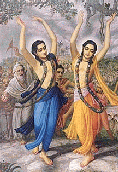
Kali-yuga it is recommended that this sankirtana-yajna should
be performed. Then you'll be happy. So what is the difficulty? In every
village... The government has raised so much fund. Why not engage all
the people to perform this sankirtana-yajna? Every village,
every house, every home, just perform this sankirtana-yajna:
Hare Krishna, Hare Krishna, Krishna Krishna, Hare Hare/ Hare Rama, Hare
Rama, Rama Rama, Hare Hare. Simply you sit down, all family members.
Where is the difficulty? Husband, wife, children, friends. Sit down
together. There is no need of instrument. Simply clap and chant Hare
Krishna. Then you'll see the face of the world is changed. That is
recommended... But we have no faith. We do not believe. Although there
is no expenditure, there is no loss, still, we shall not do. We shall
make plan by raising fund. So after raising fund, what is done, we know
everything. So that will not relieve. Take this yajna process. Yajnad
bhavati parjanyah [Bhagavad-gita 3.14]. If you are
in scarcity of rain, perform yajna, the sankirtana-yajna.
There will be regular rain, and if there is regular rain, there is
ample food production. There is no question of overpopulation. God can
supply you more than you want, provided you become God conscious,
Krishna conscious. That is the way.