Vedic
Scheme for Elevation, Not Suppression
Lecture
on Srimad-Bhagavatam 1.2.16, Vrindaban, November 6,
1972
|
Today's
Caste System a Perversion of the Original
|
Talks
with Stillson Judah - Part 1 Hansadutta
das
Krishna
says (Bhagavad-gita 4.13), "According
to material nature, the four divisions of human society are created by
Me." That means by nature's way there are four very distinct classes of
men working in human society: (1) those who are inclined for
intellectual work, (2) those who are inclined for administrative work,
(3) those who are inclined for agriculture and trade, and (4) those who
have no inclination; they simply work.
This system, of course, is known today as the caste system, but the
caste system practiced today is not the system that is actually
described in the shastras. The caste system is a perverted form
of the original system. Today the idea is that if a man is born in the
family of a brahmana, automatically he is accepted as a brahmana.
But this is not correct, according to Bhagavad-gita or Srimad-Bhagavatam,
where it says guna karma. Guna means quality, karma
means work. A man is recognised, or his position in society is
recognised according to his quality and work. more |
The
whole Vedic civilization is meant for making people brahmana.
Not to keep him in ignorance, not to keep him in the position of a shudra.
The whole Vedic scheme is that from the lowest grade of existence, one
can be elevated to the highest grade. Shudhyanti. Shudhyanti,
purification. That is purification. In ordinary life also, there are
purificatory methods, dasha-vidha-samskara. That purificatory
method begins before the birth, which is called garbhadhana-samskara.
Not that a man, a high-caste brahmana or kshatriya or
even vaishya... Especially brahmana and kshatriya.
Especially brahmana. He's not meant for giving birth to a child
like cats and dogs. He has to observe the garbhadhana-samskara.
In the shastra it is said in a brahmana family, if the garbhadhana-samskara
is not observed, he immediately falls down to the shudra class.
Kalau shudra-sambhavah. Because this garbhadhana-samskara
is not observed, therefore it is to be taken, accepted, everyone is a shudra.
But the Krishna consciousness movement is to again elevate the shudra
to the standard of brahmana. This is the Krishna consciousness
movement.
Because without brahmana... Just like without head, what is the
value of your body? Brahmana means the head.
mukha-bahuru-padebhyah
purushasyashramaih saha
chatvaro jajñire varna
gunair vipradayah prithak [Srimad-Bhagavatam 11.5.2]
Brahmana means the head. Therefore brahmana is
offered so much respect. Because in the head, in the brain, you
conceive something, and the hands and legs, they execute the order.
Similarly, the head of the society, they should be the brahmanas.
They are not interested in capturing political power. No. brahmana
is to give instruction. We find from Vedic literature. There were
committees, privy council committees of great sages and brahmanas.
They would give the king advice that "You rule in this way." And if the
king is disobedient, sometimes the brahmanas would dethrone
them or kill them. That was the Vedic system. We find from the life and
ruling of Maharaja Prithu, how he was ruling over the world, how he was
observing that every community, either brahmana or kshatriya
or vaishya or shudra, they were properly employed.
There was no unemployment question. It was the duty of the king to see
that not a single man is unemployed. He must be engaged. So they made
arrangement like that.
So what is the idea? The idea is to elevate everyone gradually to the
position of brahmana and Vaishnava and thus make their life
perfect. That is the scheme of Vedic civilization. Chatur-varnyam
maya srishtam guna-karma-vibhagashah [Bg. 4.13]. Not that "Keep
the shudras or the mlecchas [so-called
untouchables, those who do not practice brahminical culture] in
the downtrodden position, and let me advance." No. Everyone should
cooperate. Why the shudras or mlecchas and yavanas
[foreigners] should remain as such?
Actually, India's falldown is meant by that process. Nobody cared. So
many Muslims, they converted, but the higher caste, they did not
care—"Oh, they have become Muslims. Reject them." Why reject? Krishna
says,
mam
hi partha vyapashritya
ye pi syuh papa-yonayah
striyo vaishyas tatha shudras
te 'pi yanti param gatim [Bhagavad-gita 9.32]
Why
these Muslims were neglected? Why they were not turned into Vaishnavas,
just like we are doing? This is the fault of the leaders. Therefore
India is now divided, Pakistan and Hindustan.
So if we actually try to understand Krishna and Krishna consciousness,
there is solution for all the problems of society, of government, and
everything. It is not a sentimental movement.
Vedic
religion is the original
Lecture
on Srimad-Bhagavatam 6.1.40, Surat, December 22, 1970
Prabhupada: Actually, the followers of Vedas
are everyone. Every human being is the follower of Veda
because the history of all other religions, they are all recent—one
thousand years, two thousand years, three thousand years—but you cannot
trace out the history of the Vedic religion. So from historical point
of view, suppose one religion is current for the last three thousand
years. Then what was their condition before three thousand years? So
the natural conclusion is: as there was no such religion three thousand
years and the Vedic religion has no history—it is coming from time
immemorial—that was the religion. Take for example in India. Twenty
years before there was no Pakistan, but now there is Pakistan. Under
certain circumstances, the religious principle has changed, but
originally every human being on this planet were following the Vedic
religion. And another sense, everyone is following the Vedic religion
if it is religion.
How? In the Bhagavad-gita you will find that vedaish
cha sarvair aham eva vedyah [Bg. 15.15]. Sarvam vedam:
"all Vedas." "All Vedas" means originally there was one
Veda, Rig Veda, or, somebody says, Atharva
Veda. Then, later on it was divided into four: Rig, Sama,
Yajur, Atharva. Then, from the Vedic injunction, then it was
summarized, which is called Vedanta, summarized in sutras.
Janmady asya yatah [SB 1.1.1], athato brahma
jijñasa [Vedanta-sutra 1.1.1]. In the sutra
there are so many meanings. Then the Upanishads, 108 Upanishads,
they are also Vedic. Then they were explained further for ordinary
men—the Puranas. They are also Vedas. Then
it was further explained by Mahabharata. So that is also Veda.
Ramayana, that is also Veda. So any
scripture, any literature, transcendental literature, whose aim is to
understand God, that is Veda. Therefore, anyone who is
searching after the Supreme Lord, he is following the Vedic religion.
This is another conclusion. The searching process may be different
according to the country, climate, but if the ultimate goal is God,
then that is accepted as religion. Just like Christian religion.
Christian religion, they are also searching after God—Lord Jesus Christ
advising, "Be lover of God." He presents himself as son of God. The
Muhammadan, Muhammad, he also presented himself as servant of God. In
this way, everyone is accepting. Or if anyone is accepting God as the
ultimate goal of religious process, that is also Vedic. Because Krishna
says that vedaish cha sarvair aham. And a godless
scripture, that is not accepted as religion. Therefore in India,
although Lord Buddha appeared in India—he was a kshatriya, and
he started some religious principle—it is not accepted because it is
not, in the Buddha religion, there is no acceptance of God or soul.
So these are some of the points. But the Bhagavata says
that although in the Buddha religion there is no, I mean to say,
mention of worshiping God, but Lord Buddha is himself incarnation of
God, and he induced his followers to worship him. Therefore in the Bhagavata
it is said that he cheated the atheists. The atheists were against God.
He appeared before them. He said, "Yes, you are right. You don't
worship God. You worship me." And he is incarnation of God. Keshava
dhrita-buddha-sharira jaya jagadisha hare. He is accepted in the
Vedic literature as incarnation of God, but he says that "There is no
God. You worship me. You follow me," because his principle was to stop
animal-killing. Sadaya-hridaya darshita-pashu-ghatam. God
became very much compassionate. When people were too much addicted in
killing animals unnecessarily, He appeared as Lord Buddha. Sadaya-hridaya
darshita-pashu-ghatam. Pashu-ghatam. The pashu-ghatam
means they were being implicated in innumerable sinful activities by
this process. Therefore God wanted to... Yada yada hi dharmasya
glanir bhavati [Bg. 4.7]. In the name of religion, they were
killing so many animals. Therefore to stop this nonsense, he appeared.
And he declined to accept the Vedic principles because there was no
other way to stop. If he would have accepted Vedic principles, then
these animal-killers would have shown him evidences that in the Vedas
there is mention of animal-killing in the sacrifice. But he wanted to
stop completely animal-killing; so therefore he adopted a new type of
religion. But those who were followers of Vedic religion, they did not
accept because that is not religion because it is against the Vedas.
These are the principles.
After Buddha, His Holiness Shankaracharya appeared to drive away
Buddhism, and he established again Vedic religion. But that Vedic
religion, being impersonal, that is also not Vedic religion. That is
also another thing, that God is person. Nityo nityanam....
Nityanam, the so many living entities—every one is person.
How God can be imperson? If God is the supreme father... If you are a
person, then how your father can be imperson? So that is imperfect
knowledge. When we speak of God as imperson, that is imperfect
knowledge.
vadanti
tat tattva-vidas
tattvam yaj jñanam advayam
brahmeti paramatmeti
bhagavan iti shabdyate [SB 1.2.11]
The
Absolute Truth is presented in three different phases. One is
Brahman, impersonal Brahman, another is localized Paramatma, and
another is the Supreme Personality of Godhead.
Malati: [break] Srila
Prabhupada, you said that Lord Buddha, he adopted a new type of
religion, but those who were strict followers of Vedas, they
would not accept him. Does that mean that there were still people who
were following those beliefs, scriptures, at his time, or did he
convert all of India?
Prabhupada: Yes. Lord
Buddha was patronized by the then emperor, Ashoka. And anything
patronized by the state, it becomes very popular. Yad yad
acharati shreshthah lokas tad anuvartate [Bg. 3.21]. So Lord
Buddha converted Ashoka, Emperor Ashoka, to this religion. Therefore
whole India became Buddhist. And later on, when Buddhism was driven out
of India, the Jainism and similar other religious principles became
visible. Ahimsa paramo dharmah. Ahimsa paramo
dharmah is also Vedic religion, but they stressed especially on ahimsa.
In the Bhagavad-gita you will find: amanitvam
adambhitvam ahimsa kshantir arjavam [Bg. 13.8]. These are the
different steps of progressing in knowledge and religion. The first
thing is amanitvam. Amanitvam means very humble. Very humble.
And therefore Chaitanya Mahaprabhu teaches that trinad api
sunichena, "Just become humbler than the straw in the street or
grass." To become religious means... Lord Jesus Christ also, he taught
like that—"The humble and meek will attain the kingdom of God." Is it
not said like that?
Hansadutta: He said, "The
greatest amongst you shall be the last..."
Prabhupada: Yes.
Hansadutta: "...and the
servant of all."
Prabhupada: So this is
taught also in the Bhagavad-gita. Amanitvam
adambhitvam. No false pride. Then ahimsa. Unless one is
prideless, unless one is humble, it is not possible to become
nonviolent. So this nonviolence is also there, the Vaishnava. So
automatically they don't encourage animal-killing. So every religion,
the highest principle of any religion is there in Vaishnavites, or the
followers of Krishna consciousness. Any best thing, in any religion,
you will find in Krishna consciousness. Therefore it is perfect. Buddha
religion teaches ahimsa; the Krishna conscious people are ahimsa.
Lord Jesus teaches love of God; the Krishna conscious people are the
best lover of God. And Hindu religion teaches liberation; they are...
As soon as they become Krishna conscious, immediately they are
liberated, immediately, instantly. There is no question of asking for
liberation. Bilvamangala Thakura says liberation means liberation from
this material hankering. And what is that material hankering? To
satisfy the senses. So these devotees, they are not for satisfying
their senses. They are simply trying to satisfy Krishna. Krishna said
that sarva-dharman parityajya mam ekam sharanam vraja
[Bg. 18.66]. They are determined to preach this cult, that "You
surrender to Krishna." Therefore they are actual representative of
Krishna. Immediately they are liberated. So, so far liberation is
concerned, there is. So far ahimsa, nonviolence, there is. So
far love of God is there, there is. So combination of Hindu religion,
Muslim religion... And Muslims also, they also say their bandeh.[?]
They also pray in the mosque. I do not know, of course, all other
religions. These principal things I know. They also accept "Allah
akbar", "God is great." We are all bandehs,[?] all servants. So
that is also... Vaishnavism, that is Krishna consciousness. "Krishna is
great."
So any highest principle of religion in any religion of the world you
take, this is the summarization of all religions, Krishna
consciousness. And that is accepted by Srimad-Bhagavatam—sa
vai pumsam paro dharmo yato bhaktir adhokshaje: [SB 1.2.6] "That
is first-class religion which teaches how to love God, how to learn to
love God." That is first class, not the rituals, not the formulas. That
is another thing. Just like when a man is diseased, the physicians
prescribes so many, that "You don't do this. You do this. You take this
medicine. You just..." That is according to the particular disease. But
the real aim is to be cured from the disease. So any religion which
teaches to be cured from the material disease of sense gratification
and teaches love of Godhead, that is perfect religion.
Revatinandana: You were
saying Lord Buddha gave impetus to Buddhism by converting the Emperor
Ashoka. What is...?
Prabhupada: No, no.
Lord Buddha, of course, did not come to convert... Ashoka liked it,
that's all.
Revatinandana: But because of
that, that gave impetus to the spreading of Buddhism.
Prabhupada: That is
natural. If the state is after some religion... Just like Christian
religion spread in India because there was Christian government. The
Muhammadan religion spread because there was Muhammadan government.
That is natural. If the state is following a certain type of religion,
then naturally... And that is said in the Bhagavad-gita: yad
yad acharati shreshthah [Bg. 3.21]. Just like in India, at least
in Bengal, we have got the history that educated persons, they saw that
"In Christian religion one can drink, one can eat meat. So why not
become Christian?" So the drunkards and meat-eaters, they became
Christians. Similarly the Muhammadans also, they thought a clue to
deviate from the Vedic principles, and they turned themselves. Just
like Aurangzeb enacted the tax, that all the Hindus will have to pay
this tax. So the untouchables... Because Hindus made these
untouchables, so untouchables, they thought that "Why shall I pay the
tax? Better become Muhammadan." So so many people, they became
converted into Muhammadans. So a state controls anything, if the
state... Now the state is secular, atheist. The people are becoming
atheist. They are teaching that "Throw away these scriptures. You eat
everything. What is the wrong in eating flesh, eating meat, eating
chickens?" They are advertising, "Eggs are available here." When the
state supports, so people follow.
yad
yad acharati shreshthas
tat tad evetaro janah
sa yat pramanam kurute
lokas tad anuvartate [Bg. 3.21]
Revatinandana: The Emperor Constantine in
Rome, when he became a Christian, that was the real beginning of the
Christian era.
Prabhupada: Yes.
Because the whole Europe was under Roman Empire. That's nice.
Malati: Srila Prabhupada, in
the United States constitution there is a bill of rights that says that
any religion can be practiced. Therefore anything goes and people
become atheistic?
Prabhupada: Yes, don't
you feel that your people are atheistic?
Malati: Yes. Because they can
do anything.
Prabhupada: They are
simply after wine and women. So that is fall of religion. Just like
Maharaja Parikshit. As soon as he saw that one man was trying to kill a
cow, immediately with his sword: "Who are you? You are killing a cow in
my kingdom?" So if the state does not take steps in maintaining
religion, then religion will fall down. Just like a father. If he does
not take care of his son to be a man of character, he becomes a
debauchee. That is natural. So according to Vedic principles, the kings
were very much highly trained to see how the people are advancing in
the spiritual knowledge. Just like one king... You will find in The
Nectar of Devotion. There was law that... He said that,
[chuckles] "If I do not find any one of my citizens with tilaka,
then I shall punish him." So everyone, out of that fear, they used to
have this tilaka. And they were looking all Vaishnavas.
[laughs] Although they had not very much faith in Vishnu, but out of
fear of the state orders, they were having tilaka. So sometimes
authority orders are accepted in that, out of fear.
 MWC
News
- May 27, 2007 - Agencies
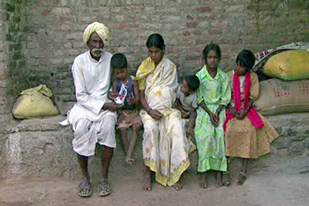
Mass
religious conversion in Mumbai
MWC
News
- May 27, 2007 - Agencies
Mass
religious conversion in Mumbai