The
historians will, of course, find stories about elements of this
extraordinary event – Bush’s denial of habeas corpus rights to
a fair trial, his secret prisons, his tolerance of torture, his
violation of Fourth Amendment protections against unreasonable
searches, his “signing statements” overriding laws, the erosion of
constitutional checks and balances.
But the historians will scroll through front pages of the New York
Times, the Washington Post and every other major newspaper – as well as
scan the national network news and the 24-hour cable channels – and
find not a single story connecting the dots, explaining the larger
picture: the end of a remarkable democratic experiment which started in
1776 and which was phased out sometime in the early 21st century. go to story
VIPINA:
His question is that now the government is corrupt, so what can be
immediately done?
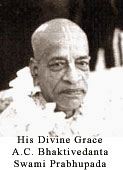
PRABHUPADA: How there can be, because the democracy? You are corrupt,
therefore your government is corrupt. You correct yourself, the
government will be automatically corrected. If you are rascals, the
government will be rascals. The government means elected. So if you are
not rascal, you'll not elect another rascal to take charge of the
government affairs. But because you are rascal, you'll send another
rascal. So how can you expect good government? You do not know whom to
select. more
Nationality
means expanded selfishness. They are very much fond of nationality, but
that nationality is also selfishness—by combined effort. Our, in our
country [India], Mahatma Gandhi is supposed to be the father of
nationality. Not only in our country, in many other countries. But what
is that nationality? Mahatma Gandhi wanted that "The Britishers must go
away. My countrymen shall enjoy." So this is extended selfishness. In
the beginning, I want to enjoy. Then if I, I extend my enjoyment,
family-wise, community-wise or nation-wise, that does not change the
quality of selfishness. People are going on in the name of nationality,
big leaders, but from our point of view, that neither as nation or
community or person you are the proprietor of things. Krishna is the
proprietor of... So if you expand your selfishness in the name of
nationality—"I possess this land"—we do not approve. We say, Ishavasyam
idam sarvam [Ishopanishad mantra 1]. Everything
belongs to Krishna. Why you are claiming yourself, as nation or
individual or community? That's not proper. Just like pickpocket and a
gang, gangsters, organized rogues, thieves. It does not change the
quality. There was some talk, you know, between Alexander the Great and
the robber. The robber proved that "You are a greater robber. That's
all. Why you are trying to punish me?" Alexander the Great arrested one
robber, and he was going to punish him. So the robber explained that
"Why you are punishing me? You are also a robber. You are going under
the name of conqueror, and because I am not as great as you are,
therefore you are trying to punish me. So why you are...?" So Alexander
the Great, he was very highly advanced in... He immediately released
him. "Yes. I am also a robber. Why shall I punish you?"
So every instance... Stenayor sa uchyate. Everyone in
this material world, one who has no Krishna consciousness, he's a
thief, he's a rogue, he's a robber. Everyone. Just like the Americans.
They occupied the land of America by killing the Red Indians, and now
they are claiming proprietor, and there is immigration department:
"Nobody can come here. It is our land." This is going on. The first
thing is stolen property, everyone. There is another story. A group of
thieves stole some things, and when they were dividing, one of them:
"Kindly, morally divide. Morally divide. Honestly divide." The thing is
taken dishonestly, and they are dividing honestly. This is going on,
whole world. Everything is taken dishonestly, and when there is
question of division, the United Nations honestly divides it. The
association of the honest men, United Nations. All plunderers, rogues,
thieves, and they have made an association, United Nations. You see.
Basically they're all rogues and thieves. As soon as there is
opportunity, they'll commit all criminal activities. And they're doing.
So this is not philosophy. So here happiness by material possession is
the happiness of the rogues and the thieves. One who is happy by
possessing some material things, he is no better than rogue and thief.
And one who is renouncing, brahma satyam jagan mithya, he
is a fool. Because how, what you are renouncing? When did you possess
it? If you possess something, then you can say, "I renounce it." But if
you do not possess, then where is the question of renouncement? So both
of them are wrong.
There, there are three kinds of so-called spiritual happiness, brahma-sukha,
brahmananda... Three kinds of ananda, jadananda, brahmananda.
Jadananda means material. As karmis are trying to possess
more and more, more and more—"Let me possess, let me possess"—this is jadananda.
Today I have got, say, one lakh of rupees. Idam adya
maya labdham imam prapsye punar dhanam.
This is stated, the asuric vicara: [demonic propensities]
"Today I have got so much money. And tomorrow I am going to increase it
to so much. I am the richest." This is karmi's conception. And jñanis,
because they're fed up, so they say, brahma satyam jagan mithya:
"This world is false." Grapes are sour. You know the story, jackal? He
wanted to take the grapes, jumping, jumping, jumping. When he could not
get it, he says, "Oh, grapes are sour. I have no necessity. I have no
necessity." Similarly these rascals, they renounce the world. What
renouncement? What you had? You are renouncing? This is also wrong. The
real happiness is seva: "This is Krishna's, and it must be used
for Krishna's purpose." That is real happiness. Actually, that is the
fact. The same example: If you pick up one hundred rupees' note, if you
pocket it, then you are a thief. If you don't touch it, then it will be
lost; somebody will take it. You pick up and give to the original
proprietor, that will be satisfaction. That is Vaishnava philosophy. We
do not say anything bad. We do not say. That is Rupa Gosvami's formula.
That is Vaishnava formula.

 Baltimore
Chronicle
- June 21, 2007 - ROBERT PARRY Transitioning to
Fascism: Bush's Mafia Whacks the Republic
Baltimore
Chronicle
- June 21, 2007 - ROBERT PARRY Transitioning to
Fascism: Bush's Mafia Whacks the Republic 