[Posted March 11, 2007]
Who's in
Charge of the Climate?
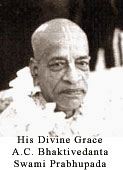
A.C. Bhaktivedanta Swami
  MyWay.com
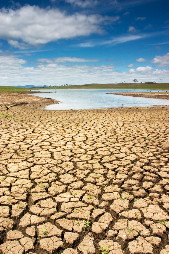
- March 10, 2007 - SETH BORENSTEIN Warming Report to Warn of Coming Drought MyWay.com
- March 10, 2007 - SETH BORENSTEIN Warming Report to Warn of Coming Drought
WASHINGTON
(AP) - The harmful effects of global warming on daily life are already
showing up, and within a couple of decades hundreds of millions of
people won't have enough water, top scientists will say next month at a
meeting in Belgium.
At the same time, tens of millions of others will be flooded out of
their homes each year as the Earth reels from rising temperatures and
sea levels, according to portions of a draft of an international
scientific report obtained by The Associated Press.
Tropical diseases like malaria will spread. By 2050, polar bears will
mostly be found in zoos, their habitats gone. Pests like fire ants will
thrive.
For a time, food will be plentiful because of the longer growing season
in northern regions. But by 2080, hundreds of millions of people could
face starvation, according to the report, which is still being revised.
go to story
Lawmaker
behind the laws of nature
excerpt
from Light of the Bhagawat
|
Unnatural
Nature?
|
Improving
on Nature A.C.
Bhaktivedanta Swami
Material
nature's business is beating and kicking. That's his only business. But
we are so fool, we are taking, "Oh, very nice kicking." That is the
disease. We accept the kicking as very nice. That is foolishness. We
are suffering always by three kinds of..., adhyatmika, adhibhautika,
adhidaivika disturbances. There is disturbance in the body, in the
mind, disturbance by other living entities, so many, disturbed by
climate, disturbed by famine. Always disturbance. Still, we are
thinking, "It is very nice place." This is foolishness. Still, we are
trying to improve it. That is foolishness. He does not think that "What
is the meaning of improvement? The disturbing is always continuing."
That does not come to his brain. more |
The
scorching heat of the sun evaporates water from the seas, rivers,
lakes, and reservoirs, and there is little water anywhere. The people
become thirsty and always look overhead for rain, but in despair. Yet
just at the right moment, torrents of rain begin to fall everywhere in
the land, even on the hard stones, and the land becomes overflooded.
The
welfare state imposes upon its citizens scorching taxes in various
forms—income tax, sales tax, land tax, terminal tax, excise tax,
customs tax, and so many other taxes. But in due course, when the taxes
accumulate into a large sum of money, they are utilized for the welfare
of the citizens in various ways. Nonetheless, sometimes it happens that
the benefits of the taxes fall like rains on stone-hearted men in the
state who are unable to utilize the money properly and who squander it
for sense gratification.
The common man supposes the unequal distribution of rain to represent
nature's wrath for our sinful acts. There is truth in this. Thus to
have an equal distribution of state-raised taxes, the citizens need to
be scrupulously honest and virtuous. They should be honest in the
payment of taxes to the state and should have honest representatives to
look over the administration. In the modern setup of democratic states
the citizens can have no cause for grievances, because the whole
administration is conducted by the people themselves. If the people
themselves are dishonest, the administrative machinery must be corrupt.
Although a damned government of the people may be given a good or fancy
name, if the people are not good they cannot have good government,
regardless of which party governs the administration. Therefore good
character in the consciousness of the mass of people is the first
principle necessary for a good government and equal distribution of
wealth.
In ancient days the kings were taught lessons in political philosophy
by ideal teachers, and the citizens from village to village were taught
the principles of self-realization according to the Vedic codes for
both the material and the spiritual upliftment of society. Therefore
the citizens were God conscious and honest in their dealings, and the
kings were responsible for the welfare of the state. The same basic
principles are accepted in the democratic governments of the present
day, for the irresponsible party of the people is always voted out of
power and must yield to the responsible party for a better government.
In the cosmic administration there is only one party, which consists of
the servants of God, and the responsible deities of the various planets
maintain the cosmic laws in terms of the orders of the Supreme Lord.
But the people suffer on account of their own folly.
And what is that folly? In Bhagavad-gita it is said that
people should perform yagñas, or sacrifices for the
satisfaction of the Supreme. The Supreme is all-pervading. Therefore
people must learn to perform yagñas to satisfy the
all-pervading Supreme Truth. There are different yagñas
prescribed for different ages, and in the present age of iron industry
the yagña
that enlightens the mind of the masses for God consciousness is
recommended. This process of yagña is called the sankirtana-yajña, or mass
agitation for invoking man's lost
spiritual consciousness. As soon as this movement is taken up through
spiritual singing, dancing, and feasting, the people will automatically
become obedient and honest.
Obedience is the first law of discipline. The people have become
disobedient to the laws of God, and therefore neither rain nor wealth
is equally distributed. A man who is ultimately disobedient cannot have
any good qualifications. When disobedient leaders lead the disobedient
people, the whole atmosphere of the administration becomes polluted and
full of dangers, as when a blind man leads several other blind men. The
state taxes, therefore, should be spent to build the character of the
people in general. That will bring happiness to the citizens of the
state.
Attracted
by electricity throughout the sky and driven by forceful winds, clouds
gradually cover the surface of the earth to satisfy the needy people by
supplying water, which is the substance of their life. The clouds
bestow rains upon man as the mercy of the Lord, who is always kind to
the needy living being.
We
should always know that God is ever kind to us. Despite our gross
disobedience to the laws of God's nature, the Lord is kind enough to
look after our maintenance. Water is one of the most important items
for our maintenance, because without water we can neither produce food
grains nor quench our thirst. Water is also required very liberally for
many other purposes. Thus the Lord has preserved water on three fourths
of the globe and has made it salty to preserve it. Salty water does not
decompose, and that is the arrangement of providence. The Lord has
engaged the powerful sun to evaporate the water of planets like earth
and distill it into clear water in the clouds and then stock it on the
peaks of mountains, as we stock water in overhead tanks for later
distribution. part of the stock of water is refrigerated into ice, so
that it will not flood the earth for no good purpose. The ice melts
gradually throughout the year, flows down through the great rivers, and
glides down to the sea again for preservation.
Therefore the laws of God's nature are neither blind nor accidental, as
men with a poor fund of knowledge conclude. Behind the laws of nature
is the living brain of God, just as there is always a lawmaker behind
all the laws of the state. It does not matter whether or not we see the
lawmaker behind the common laws; we must admit that there is a
lawmaker. Matter can never work automatically, without a living hand,
and therefore we must admit the existence of God, the supreme living
being, behind the laws of nature. The Lord says in Bhagavad-gita
that nature works under His superintendence. Nature is only a power,
and behind the power is a powerhouse and a brain, just as behind
electrical power there is an electrical powerhouse, where everything is
conducted by the brain of the resident engineer. The material nature
works so nicely, and not blindly, because of the superintendence of the
supreme powerful God. In the Vedic hymns (Atharva Veda)
the same thing is confirmed. It is only under the superintendence of
God that all the natural laws are conducted.
The Lord distributes His mercy in the form of rains on the scorched
earth at times of dire necessity. He supplies rain when we are
practically on the verge of death for want of water. God is merciful
undoubtedly, but He bestows His mercy on us when we need it most. This
is so because we forget God as soon as we obtain this mercy. We should
therefore remember the mercy of God constantly if we want to avoid
distress. We are eternally related with Him, despite the state of
forgetfulness already described above. Bhagavad-gita
confirms that the laws of nature are stringent because they are
conducted by three different modes. But one who surrenders unto the
Lord overcomes the stringency of nature easily.
Back
to Top |