 Krishna Books What is Hare Krishna? The Founder-Acharya Hare Krishna Mantra Sankirtan Movement Personality of Godhead Lord Chaitanya A.C.Bhaktivedanta Swami Prabhupada Hansadutta das Events: Kirtan Festival World Sankirtan Party Submit News © 2004 - Hansadutta das |
[Posted March 7, 2007]
Self-sufficiency closer to the ideal civilizationA.C. Bhaktivedanta Swami 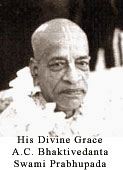 Der Spiegel - March 6, 2007 - NILS KLAWITTER Economic Cure or Fool's Gold? ...The system works like this. Pietsch uses Urstromtaler to pay for her purchases at, say, the health food shop. Its owners then use the same bills to pay the local cheese-makers, who pass those same bills along to the carpenter who repaired their goat stable. The ideal scenario is that a closed loop develops, boosting the regional economy and preventing money from being drained from the area. ...Regional currencies prevent money from being drained from the area where the currency is in use and transfered to booming regions like China or India, says Margrit Kennedy, the author of several books on alternative currencies. "Regional money is like a homeopathic cure for the chaos and suffering international financial markets cause in the world," Kennedy says. Gerhard Rösl, a political economist at Regensburg Technical College, is not convinced. "Social romanticism on the part of people who don't think in a structured way" is how he characterizes this way of thinking. Rösl has carried out a study on regional currencies for Germany's central bank. The basic thrust of his study is that regional money may be an entertaining gimmick for tourists, but it's largely nonsense from an economic point of view. Regional currencies are only helpful in the context of a generalized deflation, when shrinking liquidity needs to be compensated for, Rösl says. That was the case in the Austrian town of Wörgl in 1932, for example, when the township successfully issued a local currency or scrip. Admittedly it's also the case today in the region where the Urstromtaler is circulating, where people are gradually running out of euros. go to story conversation
with disciples, Vrindaban, September 16, 1976
Village Economy
Prabhupada: We have seen in our childhood
how happy people were. They were. Simple. If one has five rupees income
per month he's happy. I've seen it. Husband, wife, a small family. If
he has got five rupees income, they can maintain very nicely, happily.
Why not? Suppose he has got five rupees income. The rice was selling at
four rupees. So two person, say 1/4 kilogramme, 1/4 share each. A
gentleman cannot eat more than that. So means half a share. And the
whole month, fifteen share. It is about one rupee eight annas. And
further, one rupee eight annas add for vegetables and other things.
With three rupees they can maintain, the husband and wife. And two
rupees still there. He can spend for other purposes. I have seen it.
Fresh vegetables, rice, this and... Just like with banana leaf. The
pots were of earthen, the wife is cooking and she's utilizing dry
foliage as fuel, a little temperature, everything is cooked. The
husband takes one banana leaf and spreads, and the wife gives
sufficient rice, vegetables. And things were so cheap. I have seen it.
And fresh. Self-sufficiency closer to the ideal civilization/ WORLD SANKIRTAN PARTY ©2007 - Hansadutta das Home | About | Events | World Sankirtan Party | Inside Nam Hatta eBooks | Site Map | Store |
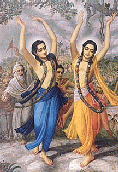 Sri Guru and Gauranga Related Articles New World Order: On the Basis of Spiritual Understanding Paper Currency is Cheating Worthless Money Hog Civilization Where is the Real Money? Spiritual Communism - Talks with Professor Kotovsky in Moscow Globalization in the Face of Disparity Global Economy at the Price of Civilization Advancement of Civilization Energy Problems will be Solved As Soon As We are Localized Related Topics Family, Community, Nation History - Human Civilization World Community - Government, Economy, Politics Back to Top Back to Top |
