Bhagavad-gita
As It Is by A.C. Bhaktivedanta Swami
Unabridged, unrevised reprint of the 1972 MacMillans ed. $14.95 Buy it now.
[Posted June
1, 2007]
Class
Not by Birth, Nor by Economic Status
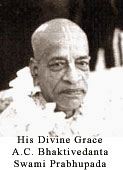
His Divine Grace A.C.
Bhaktivedanta Swami Prabhupada
New
York Times
- May 31, 2007 - ARCHIE TSE & BEN WERSCHKUL
How Class Matters While there are many characteristics that could be used to
describe a person's class, among the most influential are the person's
occupation, education, income and wealth. (Left:)
Snapshot
of an interactive graphic illustrating "How Class Matters", taken from
the New York Times article. go
to story
Lowborn
or highborn—it doesn't matter Interview
with freelance reporter Ms. Sandy Nixon, Philadelphia, July 1975 (cited
in Science of Self Realization, "What is Krishna
Consciousness?")
Vedic
society is not competitive as is capitalistic society. Capitalism
encourages everyone to make profit by exploiting the less intelligent
working class. The mercantile class organizes and exploits the laborer
class for sense gratification. In contrast, the Vedic society is
cooperative. The four classes cooperate for meeting the material
necessities of life: eating, sleeping, defending and sex. All classes
cooperate for the welfare of everyone. more
Ms. Nixon: Are you attempting to revive the
ancient Indian caste system in the West? The Gita
mentions the caste system...
Srila Prabhupada: Where does
the Bhagavad-gita mention the caste system? Krishna says,
chatur-varnyam maya srishtam guna-karma-vibhagashah:
"I created four divisions of men according to their quality and work."
(Bg. 4.13) For instance, you can understand that there are engineers as
well as medical practitioners in society. Do you say they belong to
different castes—that one is in the engineer caste and the other is in
the medical caste? No. If a man has qualified himself in medical
school, you accept him as a doctor; and if another man has a degree in
engineering, you accept him as an engineer. Similarly, the Bhagavad-gita
defines four classes of men in society: a class of highly intelligent
men, a class of administrators, a class of productive men, and ordinary
workers. These divisions are natural. For example, one class of men is
very intelligent. But to actually meet the qualifications of
first-class men as described in the Bhagavad-gita, they
need to be trained, just as an intelligent boy requires training in a
college to become a qualified doctor. So in the Krishna consciousness
movement we are training the intelligent men how to control their
minds, how to control their senses, how to become truthful, how to
become clean internally and externally, how to become wise, how to
apply their knowledge in practical life, and how to become God
conscious. All these boys [gestures toward seated disciples] have
first-class intelligence, and now we are training them to use it
properly.
We are not introducing the caste system, in which any rascal born in a brahmana
family is automatically a brahmana. He may have the habits of a
fifth-class man, but he is accepted as first class because of his birth
in a brahmana family. We don't accept that. We recognize a man
as first class who is trained as a brahmana. It doesn't matter
whether he is Indian, European, or American; lowborn or highborn—it
doesn't matter. Any intelligent man can be trained to adopt first-class
habits. We want to stop the nonsensical idea that we are imposing the
Indian caste system on our disciples. We are simply picking out men
with first-class intelligence and training them how to become first
class in every respect.
Propagating
brahminical culture for the world Renunciation
Through Wisdom
The
pious and saintly Vaishnavas understand the exact meaning of the Bhagavad-gita.
The simple message of the Gita is self-illuminated like
the sun. Its knowledge is not hidden under a gloomy shroud of
impersonalism. There is actually no room for extracting some
alternative meaning and then giving a so-called esoteric dissertation
on it. The devotees of Lord Krishna alone can fully take to heart the
instructions of the Gita, and by acting accordingly they
are liberated from the awesome and eternal enslavement of the cycle of karma.
Such persons are not restricted to a particular country, race, or
society. The Lord's devotees belong to a class of their own—they form a
spiritual society unhindered by geographical conditions. God is not the
monopoly of any particular group. Therefore the message of the Gita,
being universal can be followed by anyone and everyone. After all, it
is in the Gita (9.32) that Lord Krishna has
unconditionally declared
"O
son of Pritha, those who take shelter in Me, though they be of lower
birth—women, vaishyas (merchants), as well as shudras
(workers)—can attain the Supreme destination."
The
demons misinterpret the words of Lord Krishna concerning caste and
social division, and they act capriciously on that basis. But this
cannot blemish Lord Krishna or His words. In the Bhagavad-gita
(4.13) Lord Krishna clearly says
"According
to the three modes of material nature and the work associated with
them, the four divisions of human society are created by Me. And,
although I am the creator of this system, you should know that I am yet
the nondoer, being unchangeable."
The
four divisions of society—namely intellectuals, administrators,
merchants, and laborers—should be determined not by birth but by merit,
just as one becomes a doctor or a judge not by birthright but by merit
alone. In this world of the three modes of material nature, social
classes have always existed. Therefore a person's birth should never
determine his caste or class in society. The four classes were created
according to a person's qualifications.
Doctors are available in every country and society; similarly, the four
classes of men are also present in every country and society. A son
born to a doctor is not necessarily sure to grow up to be a doctor;
similarly, the progeny of the four classes of society do not
automatically fix their future career according to that of their
parents. The scriptures describe in detail the divisions of society,
with their inherent characteristics. Therefore we commit a serious
mistake when we regard the different classes of men as belonging to
particular countries or races. The Indian culture of today is
restricted by the hereditary caste system and kept in the custody of
narrow-minded people who are like frogs in a well. If instead India had
spread the transcendental message of Bhagavad-gita in the
generous manner befitting a noble brahmana, then peace and
tranquillity in this world would not be in such acutely short supply.
By the propagation of brahminical culture, the world would have greatly
prospered. Instead, the Vedic culture has been seriously maimed by the
imposition of the hereditary caste system, and this has had grievously
adverse effects on the world. The Supreme Lord in His incarnation as
Lord Chaitanya has opened many avenues to peaceful living by
propagating the brahminical culture, which He calls the religion of the
soul. Those who are fortunate can emulate His life, follow His divine
teachings, and perfect their lives.
Varnashrama-dharma, the system of four spiritual orders
and four social orders of life, is of two kinds: demoniac and
transcendental. They have nothing in common. The divisions of society
mentioned in the scriptures are present at all times and in all lands.
If one with knowledge of the scriptures scrutinizes the different
societies, he can easily discern the four classes. Persons possessing
brahminical or priestly qualities in varying degrees are seen in
practically every society. In modern terms they are called
intellectuals. All the other classes are also present. Therefore it is
an established fact that the four divisions of society, according to
merit, are, were, and will be present everywhere.

 (Left:)
Snapshot
of an interactive graphic illustrating "How Class Matters", taken from
the New York Times article.
(Left:)
Snapshot
of an interactive graphic illustrating "How Class Matters", taken from
the New York Times article.