| Get Srila Prabhupada's original, unrevised books. Beware of imitations. More than 160 titles published! Learn more. |
Science by accident, chance and chaos
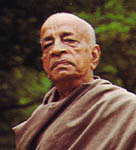
His Divine Grace A.C. Bhaktivedanta Swami Prabhupada
Founder-Acharya of the world-wide Hare Krishna Movement, Brahma Sampradaya Acharya
Probability
theory refutes scientists' claim that life began by chance
| Related
Articles The Founder Acharya The Challenge Life Comes From Life Related Topics Science |
Svarup Damodar: ...Next Sadaputa will take
over, and he'll describe the mathematical and physical concepts of
proving the existence of Paramatma.
Prabhupada: Yes, do it.
Pusta Krsna: Would you like
to [see more] tonight Srila Prabhupada?
Prabhupada: Why not? What
business we have got? [laughter]
Svarup Damodar: Shall I offer
it for you?
Prabhupada: Yes.
Sadaputa: This slide shows...
these are the laws of nature according to physicists. And the point we
make is that this is their understanding of the final cause of things,
and it's very limited. Actually, on this one page, these equations
describe everything that goes into all the actions and interactions of
chemistry according to their present understanding. And so there are
two main points to make about this. Number one, these are very... these
laws describe very simple forces, pushes and pulls between atoms and
things like that. And so intuitively it is very hard to imagine why
such simple forces should cause anything complex to organize itself
together. Now the scientists customarily make the assertion that laws
like this are universal, but one thing we can notice is they have no
proof of that. These laws which they say are universal are only studied
in certain limited experimental situations with inanimate matter, and
then they extrapolate and they say that they apply to everything. But
actually the equations are so hard to solve even for reasonably simple
molecules that they can't actually test out their assertion. So it's
actually just a bluffing statement. So in this slide we wanted to point
out how limited these laws are, how limited their concept of the laws
of nature is.
The
next slide, according to the scientist's idea, there are two things
going on—these laws and also chance. So this is a calculation showing
what happens if you just have chance acting to form one of these
proteins that Svarup Damodar was talking about, and you can
calculate... Actually here you calculate, suppose you threw a protein
together at chance—and here we even allow a ten percent error, you're
allowing to get it wrong among ten percent of the proteins—but still
chance comes out to ten minus two-hundred-and forty-fourth power. Now
the scientists are always saying if you wait for a long enough time,
even something very unlikely can happen; but here we have a calculation
of how long you'd have to wait, according to mathematics and the
probability theory, and even if you assume an unrealistically high rate
of forming proteins at random, still you'd have to wait, according to
this, ten to the hundred-and-sixty-seventh power billion years. And
that's a little bit too long. [laughter]
Prabhupada: Hare Krishna.
That is mathematics.
Svarup Damodar: That's longer
than Brahma's life.
Sadaputa: So mathematics
shows that chance alone would never begin to produce the things that go
into life, because this, say, is just for one protein, but it's
estimated in the simplest cell that they experiment with that there are
some three thousand proteins. This is what they estimate. And in a
human, in a single cell of the human body, they estimate three hundred
thousand, or even three million. It's just an estimate. But it shows
that chance is completely unrealistic.
Now
the scientists will say that both chance and natural laws somehow
mysteriously go together in what they call natural selection to produce
living structures. In the next slide, this is also a calculation, and
it shows that that is not correct either, at least as far as the
mathematics goes. What this says is suppose you look at the earth and
you're going to wait four point five billion years—that's what they
estimate is the age of the earth—and ask what is the chance of finding
a given organized structure. And mathematically there's a thing called
information theory, and you can show that the chance of getting an
organized structure with a high level of information goes down
exponentially, so that for an amount of information higher than that of
the laws that cause these things to move, the chance goes down
practically to zero. So it wouldn't happen.
So
this gets kind of complicated, but there's a basic point behind it;
namely it indicates that the natural laws that are causing things, like
that list of those laws, must already have in them, built into them,
whatever is going to be manifested. That is, if some given structure
can be manifested in the material world, that means the laws that are
causing things must already have at least that much built into them.
But their understanding of natural laws, the laws are too simple, too
short to have that kind of thing built into them. So there's that
argument. We'll go on to the next one. This is some mathematical
formulas related to that. I don't think we should dwell on that.
This
slide right here gives an example of the kind of structures you find
even in simple organisms. This is a bacterium. When they look at it
under a microscope, they can see that this bacterium has a reversible
motor built into it, and this motor spins a spiral flagellum, and by
spinning it it propels the bacteria through the water, just like a
submarine. So this very sophisticated motor is built into the wall of
the bacterium. So that shows the kind of structures for which designs
would have to be there. Actually, the scientific explanation, the way
that they explain how this comes about, is completely impossible,
because they would say that either by chance it came about all at
once—and the chances are way too small, so that would never happen—or
else it would have to come by small stages somehow. But what would be a
small stage in the formation of a workable motor? Can't even think of
how that would work. So it doesn't make much sense. So what we wanted
to argue was that these living structures are very highly complex, they
have a very great amount of information needed to specify them, and
then mathematically it follows that this evolution process can't
happen, because the probability is way down, it's something impossible.
So we wanted to argue that.
The
next slide—we wanted to compare some structures. This is the chemist's
idea of what a diamond... the top picture is a chemist's idea of what
the structure of a diamond looks like. It's based on very simple
repeating patterns. It's reasonable perhaps that chemical pushes and
pulls could produce a simple design like this just by pulling the
molecules together. The lower thing is a structure for graphite, which
is another simple design built on hexagons. But on the other hand, in
living systems you have things like this. [shows slide] According to
the way they've analyzed it, there are chemical structures of this
complexity. So we'd like to argue that this requires a very large
amount of information to specify this thing, and so the simple natural
laws couldn't account for this. On the other hand, it's very reasonable
to suppose that an intelligent designer can account for things like
that. These protein structures that Svarup
Damodar was pointing out, it's not just any old structure, but
it performs a very specific function within the cell, just like a
little automatic machine of some kind. So we'd like to argue that the
chance and molecular forces theory won't explain things like this, but
to say that there is an intelligent designer would be a sensible
explanation.
The
next slide, this shows some of the complexities of what goes on inside
a cell, and it's only a fraction of what is there. It's hard to read,
but each little bit of print refers to some very complicated chemical
reaction involving big molecules like the one in the last slide. So
there are hundreds of reactions like that on this one page, and this
page is one out of four from a chart that we found detailing some of
these things. This metabolism goes on even in the most primitive cells
like this bacterium, and yet it's only a fraction of the total of what
goes on. The scientists will admit they've only made a fractional study
of all that's going on in these cells. So that kind of argument is one
line of reasoning we'd like to present.
Consciousness
and Quantum Mechanics
[Points
to another slide:] Now this refers to another thing. We'd like to
describe the concept of consciousness as being something not
material—nonphysical and nonchemical. And it turns out that actually in
modern physics that's already a basic principle, and it's been that way
for the last fifty or sixty years, but that's not widely admitted or
taught in the schools. But actually in modern physics, it's called
quantum mechanics. They realize that in order to describe physical
processes you have to include the observer in the picture; you can't
describe these things without accounting for the observer, and so they
made an analysis. This was done by von Neumann, who was one of these
physicists. He analyzed the difference between the observer and the
observed. So here we have a man looking through, say, a microscope at
some object, and you can see that in this case you can draw the line
between the observer and the observed. So the man is observing the
microscope plus object. And physically there are, according to the
physicist's idea, there are these equations, represented by number one,
equation number one, which describe all the molecules and forces of
interaction on the observed side. But there's another kind of equation
that goes in quantum mechanics, which corresponds to the observer's
side, and this equation is completely different from the first
equation. So this indicates that the observer must be something
different in nature from the observed. Now the next slide shows here
the boundary between the observer and the observed is moved. It's kind
of arbitrary. You can move the boundary back so now the observed
becomes the eyeball and the microscope and the object, and the observer
is still on the other side. And the basic idea is you can move this
boundary back, step by step, and on one side you can put, at least in
principle, more and more of the parts of the body into the observed
system, but on the other side you still have the observer, and he
continues to be described by an equation that can't be reduced to the
force laws that are used to describe the observed. So the conclusion is
that the observer must be something nonphysical. He's not actually part
of that physical body at all. So that's actually basic in quantum
mechanics. So we wanted to present that.
Inspiration
Now
this slide... There's another line of evidence here. It's the
inspiration, and Srila Prabhupada has said that intelligence is the
form direction of Supersoul. So it's interesting, it's really striking
to observe how various people create things in mathematics and science
and art, like that. It's very striking. So we made two examples here.
This one is a mathematician names Gauss. He lived in the nineteenth
century, and his concern was to solve mathematical problms. The
interesting thing is that in a very difficult mathematical problem, the
person never solves it by figuring it out consciously, step by step.
But what happens is that he tries very hard to figure it out for a long
time, and nothing happens, and then all of a sudden the answer comes to
him. So it's hard to read that quote. This is a quotation by this Gauss
describing how that happened to him.
Devotee: "I've succeeded not
on account of my painful effort, but by the grace of God. Like a sudden
flash of lightning, the riddle happened to be solved. I myself cannot
say but when the conducting thread which connected what I previously
knew with what made my success possible."
Prabhupada: So the chance
theory is the grace of God.
Svarup Damodar: Grace of God?
Prabhupada: Yes, because if
God sees that the rascal is trying for so many years, "All right, give
him a chance." [laughter] That is His mercifulness. So what they call
chance theory, that is grace of God.
Svarup Damodar: So God is
all-merciful.
Prabhupada: Oh, yes. That is
the proof.
Sadaputa: Actually, this
couldn't come about by just chance, because the number of
possibilities...
Prabhupada: There is, but he
takes it as chance. All the possibilities taken together he is given by
God. That he does not know. He takes it as chance. But there is no
question of chance. It is the gift of God.
Sadaputa: Next example, this
is another example taken from music. This example is Mozart. Mozart was
a musician. He composed symphonies. And in that quote which-I'll just
summarize it instead of reading it—he explains how it was that he
created these symphonies. He explained that actually what happened was
that ideas just came into his mind, melodic themes and so on, and he
says "Whence do they come I do not know, and I have nothing to do with
it." And actually what would happen was that an entire symphony would
just blossom into his mind, and he wouldn't even know where it was
coming from. So...
Prabhupada: Unknown.
Svarup Damodar: Unknown
source.
Sadaputa: So we want to argue
that this demonstrates that Supersoul is acting. These cases of these
very famous musicians and scientists and such, there are many of them,
they can be multiplied at great length, and they are very striking that
way.
We are also
thinking that this inspiration illustrated the modes of nature and the
law of karma to some extent, because like the mathematician had
to struggle very painfully for a very long time without getting his
result, and then he got it, so that seemed more like the mode of
passion and like that. But Mozart apparently just got these things
without having to struggle for them, as though that was his past karma
or something.
Complexity
and Spiritual Varieties
Next
slide. This is a summary of the basic kind of argument we wanted
to make. The picture on the left, those ovals represent states of
matter, configurations of matter, and they go from simple, toward the
bottom, like just a chemical solution, up towards more complex as you
go up, like living bodies of different kinds. The theory of evolution
is sort of indicated in the left-hand one. According to that theory,
you have very simple natural laws, and you start out with simple
physical states, but somehow these natural laws produce a progressive
increase in order, as indicated by those arrows going up. But actually
we want to argue that simple natural laws don't have the power to do
that, and that the situation on the right is what would happen if you
just had simple natural laws, namely they would keep shoving things
around on a simple level but never produce anything complex. The next
slide, though, indicates that if you had natural laws with a high order
of complexity, then they could manifest physical situations with a high
order of complexity also, depending on how much was built into the
laws. So we wanted to, in these two examples, indicate a higher and
higher order of natural laws. So what we wanted to do was then combine
these two things together, on the one hand that consciousness is not a
physical phenomenon, and on the other hand, that in order to get...
Prabhupada: This is physical,
but subtle.
Sadaputa: The actual
perception of the soul is not...?
Prabhupada: Perception of the
soul is there, but this physical demonstration is of the soul by
consciousness. The more it is purified, it becomes spiritual. The
consciousness is there. The more it is purified, then it becomes
spiritual. Sarvopadhi-vinirmuktam tat-paratvena nirmalam [Chaitanya-charitamrita
Madhya 19.170]. It has to be purified. The water is crystal clear, but
when it comes in touch with the earth it becomes muddy. But again you
can clarify it, and water becomes crystal clear. That consciousness is
Krishna consciousness.
Sadaputa: So we wanted to
then say that, a few lines of reasoning, that you have to have
higher-ordered laws to cause complex forms...
Prabhupada: That higher-order
laws is explained, mayadhyakshena [Bhagavad-gita
9.10].
Svarup Damodar: Mayadhyakshena
prakritih?
Prabhupada: Suyate
sa-characharam, hetunanena kaunteya jagad viparivartate. Things
are going down on account of the superior direction.
Svarup Damodar: Actually,
that is shown in the next slide.
Prabhupada: That's all right.
Sadaputa: I want that next
slide on there. There it is.
Prabhupada: There. Yato
va imani bhutani jayante.
aham sarvasya prabhavo
mattah sarvam pravartate
iti matva bhajante mam
budha bhava-samanvitah [Bg. 10.8]
Vasudevah
sarvam iti sa mahatma sudurlabhah [Bg. 7.19]. Here is vasudevah
sarvam iti. Find out this verse, bahunam janmanam ante
jnanavan mam prapadyate vasudevah sarvam iti [Bg. 7.19]. This is
Vasudeva. Vasudeva must be, and from Him, everything is coming. That is
real knowledge.
Hari-sauri: [Reads:]
bahunam janmanam ante
jnanavan mam prapadyate
vasudevah sarvam iti
sa mahatma sudurlabhah [Bg. 7.19]
"After many births and deaths..."
Prabhupada: It is conclusion, vasudevah
sarvam iti. So you are mahatma, sudurlabhah, not
ordinary rascal mathematician. [laughter] But you are real
mathematician, that vasudevah sarvam iti sa mahatma sudurlabhah
[Bg. 7.19]. Read the purport.
Hari-sauri: [Reads:]
"After many births and deaths, he who is actually in knowledge surrenders unto Me, knowing Me to be the cause of all causes and all that is. Such a great soul is very rare."
Purport
"The living entity, while executing devotional service or transcendental rituals after many, many births may actually become situated in transcendental pure knowledge that the Supreme Personality of Godhead is the ultimate goal of spiritual realization. In the beginning of spiritual realization, while one is trying to give up one's attachment to materialism, there is some leaning towards impersonalism. But when one is further advanced he can understand that there are activities in the spiritual life and that these activities constitute devotional service. Realizing this, he becomes attached to the Supreme Personality of Godhead and surrenders to Him. At such a time one can understand that Lord Sri Krishna's mercy is everything, that He is the cause of all causes, and that this material manifestation is not independent from Him. He realizes the material world to be a perverted reflection of spiritual variegatedness and realizes that in everything there is a relationship with the Supreme Lord, Sri Krishna. Thus he thinks of everything in relation to Vasudeva, or Sri Krishna. Such a universal vision of Vasudeva precipitates one's full surrender to the Supreme Lord Sri Krishna as the highest goal. Such surrendered great souls are very rare. This verse is very nicely explained in the Third Chapter of Svetashvatara Upanishad: 'In this body there are power of speaking, of seeing, of hearing, of mental activities, etc. But these are not important if not related to the Supreme Lord. And because Vasudeva is all-pervading and everything is Vasudeva, the devotee surrenders in full knowledge.'"
Prabhupada: Vasudeva, surrenders. That's
nice. All right, continue tomorrow.
Vasudevah sarvam iti [Bg. 7.19].
Scientists mistaking effects for causes/ WORLD SANKIRTAN PARTY ©2004 - Hansadutta das
Home | About | Events | World Sankirtan Party | Inside Nam Hatta
eBooks | Site Map | Store