| Get Srila Prabhupada's original, unrevised books. Beware of imitations. More than 160 titles published! Learn more. |
Molecules to Chicken: Definition of Life
and Its Origin
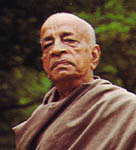
His Divine Grace A.C. Bhaktivedanta Swami Prabhupada
Founder-Acharya of the world-wide Hare Krishna Movement, Brahma Sampradaya Acharya
| Related
Articles The Founder Acharya The Challenge Life Comes From Life Related Topics Science |
The Absolute Truth
Svarup Damodar: Now most of these slides
will appear in our book, the origin of life and matter, Life Comes From
Life. Now Sadaputa and myself made these slides. These are some of
the... Only a few slides. We specifically want comments from your
Divine Grace Srila Prabhupada, whether these slides will be appropriate
to be in the book. Now this is the philosophy between the difference
between life and matter. So this is sankhya philosophy. The
principles and the philosophy, as Srila Prabhupada comments in Srimad-Bhagavatam
in the Third Canto, the sankhya philosophy is especially meant
for persons who are conditioned by this material world, and by
understanding the science of devotional service and
sankhya philosophy, one can become free from the modes of material
nature. So we want to impose that in order to understand the
distinction between life and matter, one must at least have a glimpse
of the Absolute Truth, at least some idea of the Absolute Truth.
Otherwise, it is completely impossible to understand the difference
between what is life and what is matter. That is why scientists
nowadays are so much confused about the concept of life and matter. So
in fact the scientist Orgell, in his book The Origin of Life,
he starts with saying "What is life? The question 'What is life?'
should not be inquired." He says...
Prabhupada: One minute. That
Absolute Truth is explained in the Vedanta-sutra, janmady
asya yatah [Srimad-Bhagavatam 1.1.1]. Absolute
Truth is that from whom everything comes into existence, everything
emanates. Now that has been discussed in the Srimad-Bhagavatam,
because
Srimad-Bhagavatam is the natural commentary by the same author.
So he begins janmady asya yato 'nvayad itaratash chartheshv
abhijnah [SB 1.1.1]. This word is used. He's not dead body, dead
matter-abhijnah, like that. In the beginning. That source of
everything... Janmady asya yato 'nvayad itaratash chartheshv
abhijnah [SB 1.1.1]. Just like a mother gives birth to a child.
She knows everything, how the child was born in the womb, how it
developed, how it is coming. At least, on the whole, she knows
everything. Similarly, the original source of everything is immediately
informed in the Srimad-Bhagavatam, that abhijnah,
experienced, knows everything. Anvayad itaratash cha,
directly and indirectly, everything it knows. So the origin of
everything cannot be a dead man. That is the beginning of Srimad-Bhagavatam.
Svarup Damodar: So the
scientists, since they do not know the Absolute Truth, they say such
fundamental and most important questions, "What is life," should not be
asked, say it is very unscientific. That is their verdict. But we say
no, that shouldn't be the case. We say what is life should be inquired
and it should be understood. Otherwise, how can one study the origin
without knowing what it is? It is rather meaningless to study the
origin of something which is not known.
Prabhupada: Yes.
Svarup Damodar: So we say,
yes, the fundamental and basic requirement is to understand this basic
difference between the two principles, life and matter. Now here the
Absolute Truth, in the shloka,
ity etat kathitam gurvi
jnanam tad brahma-darshanam
yenanubuddhyate tattvam
prakriteh purushasya cha [SB 3.32.31]
The translation
says, "My dear respectful mother, I have already described the path of
understanding the Absolute Truth by which one can come to understand
the real truth of matter and spirit and their relationship." So here it
clearly says that in order to understand these basic principles, one
must have at least some idea about the Absolute Truth. And it is quite
scientific. Comparing our normal scientific disciplines like physics,
chemistry and mathematics, in fact this very principle is utilized. But
the scientists, not knowing that the axioms, or fundamental truths, are
coming from the absolute source. So this is the basic requirement.
Prabhupada: I have heard that
mathematics believes by some imaginary thing, minus, so on, like that.
Svarup Damodar: The absolute
numbers?
Prabhupada: Something minus
one, like that. Who is mathematician here?
Svarup Damodar: [laughs] Here
is our mathematician.
Prabhupada: All right, so is
that the beginning of mathematics?
Svarup Damodar: What is the
beginning of mathematics?
Sadaputa: Well, the beginning
of mathematics is counting a number. We have that square root of minus
one.
Prabhupada: Yes. That I
heard. The beginning is minus one. That is imaginary; it is not fact.
But they imagine something at the beginning.
Svarup Damodar: Yes. In fact
it is called imaginary number. Square root of minus one.
Prabhupada: Yes, if
mathematics begins with imaginary something, why not Absolute Truth?
That Absolute Truth must be life. As Bhagavata explains, janmady
asya yato 'nvayad itaratash chartheshv abhijnah [SB 1.1.1]. He
must be aware of everything. That means life. That means life. Now the
question is how He became experienced? Svarat, independent.
Just like we require experience, knowledge, from somebody else.
Experienced knowledge is not gained automatically, but the Absolute
means that He is full of knowledge. How He got knowledge? Svarat,
independently. That is the description. You have to imagine at least
like that. It is Vedic injunction, it is the fact, that Absolute Truth
independently cognizant of everything. That is Absolute Truth.
Svarup Damodar: Now we want
to describe something about this Absolute Truth. His Divine Grace Srila
Prabhupada has explained that Absolute Truth is that from which
everything comes: janmady asya yatah [SB 1.1.1]. Now what
is the Absolute Truth, and how the Absolute Truth is to be known? Now
in Srimad-Bhagavatam, Absolute Truth is described anadir
atma purusho nirgunah prakriteh parah. The Absolute Truth or the
Supreme Personality of Godhead is the Supreme Soul, and He has no
beginning, anadi, He has no beginning. And He is also
nirguna, He's transcendental to the material modes of nature. And prakriteh
para, beyond the existence of this material world.
Prabhupada: The same thing is
explained also in the Brahma-samhita,
anadir-adi. He's anadi, He has no beginning, but He is
the beginning of everything. Anadir-adi, govindam adi-purusham
tam aham bhajami. He is the beginning of everything, but He has
no beginning.
Svarup Damodar: And He is purusha,
He's a person. Now how the Absolute Truth is to be known? In Bhagavad-gita
it is described bhaktya mam abhijanati [Bg. 18.55]. The
Absolute Truth must be understood as He is only by devotional service.
So...
Prabhupada: Otherwise, it is
not possible. That I explained this morning, panthas tu
koti-shata-vatsara-sampragamyo vayor athapi manaso muni-pungavanam, so
'pyasti yat prapada-simny avinchintya-tattve [Brahma-samhita
5.34]. Without bhakti, if you go on speculating for many, many
years with the speed of mind, if you want to go, still avinchintya-tattve,
it will remain inconceivable.
Svarup Damodar: So what it
means is that in order to understand this distinction between life and
matter one must be a devotee.
Prabhupada: Yes. We raise the
question, we challenge these rascals because we are following the path
of devotion. We are not scientists. And we could not challenge unless
we were convinced. How it is possible? Suppose I am layman, how I am
challenging these big, big scientists? It is not... Because we have
known it through devotional service, so this is science. That is the
difference.
Svarup Damodar: So these are
some of the axiomatic truths that are necessary steps in order to study
this problem between life and...
Prabhupada: In Bhagavad-gita
it is said bhaktya mam abhijanati: [Bg. 18.55] "One can
understand Me through bhakti." And the Vedic injunction is that
"If one knows Me, or knows the Absolute Truth, God, then he knows
everything." Kasmin tu bhagavo vijnate sarvam idam vijnatam
bhavati. If somehow or other one knows the Absolute Truth, then
he knows everything. Kasmin tu bhagavo vijnate sarvam idam
vijnatam bhavati. That is the benefit of knowing the Absolute
Truth. So a devotee knows everything. How it is possible? That is
explained in Bhagavad-gita,
tesham evanukampartham
aham ajnana-jam tamah
nashayamy atma-bhava-stho
jnana-dipena bhasvata [Bg. 10.11]
One may
challenge, "How a person can know everything?" So Krishna immediately
replies that "I help him specifically."
Tesham evanukampartham. "Just to show My personal, especial
favor upon him, I light up the torch of knowledge, and he knows
everything." So if Krishna helps one to know everything, who can check
it? That is not possible. This science must be there. We are not
all-powerful. Krishna is all-powerful means He can do everything.
Svarup Damodar: It is also
further described about this Absolute Truth as vadanti tat
tattva-vidas... [SB 1.2.11].
Prabhupada:
vadanti tat tattva-vidas
tattvam yaj jnanam advayam
brahmeti paramatmeti
bhagavan iti shabdyate [SB 1.2.11]
That is the
Absolute. Go on.
Svarup Damodar: Now these
statements are quite scientifically valid and sound. Now this will be
verified in our next slide that is called the axioms. This is called
structure of a theory. In scientific disciplines, specifically in
mathematics, now scientists work with a beginning called axioms. There
are two types of axioms. First one is logical axiom, and second one is
theoretical axioms. Now from these axioms, by inference, actually one
deduces these theorems. That's in the second block. From there, by
observation, we have this object of study. Now the basic question is
wherefrom these axioms coming from? The starting point, axioms, they
take it for granted, and actually there is no proof. It is beyond
proof, beyond any scientific proof.
Prabhupada: Vedanta-sutra
means all axiom. Vedanta-sutra, that is all axiom.
Axiomatic truth.
Svarup Damodar: So the way
that science works, also they depend on axioms. But actually, when one
analyzes this a little thoughtfully, one should come to the conclusion
that actually these axioms are coming from the Absolute. So our first
proposition that in order to understand life and matter one must have
this, er, some knowledge of the Absolute Truth is scientifically sound.
Prabhupada: I tried to
explain something in the beginning of Ishopanishad, my
lecture in the Conway Hall, what is that Absolute Truth.
"Introduction." I have given the example that the Vedas
say cow dung is pure. This is axiomatic truth. Now if you analyze cow
dung you'll find all the antiseptic properties are there. This is
axiomatic.
Difference between life and matter
Svarup Damodar: Now in the
next slide we establish the difference between the life and matter.
These are some of the basic differences between the...
Prabhupada: We can't read it.
I cannot read.
Pusta Krishna: One side it
says "matter," the other side it says "life."
Svarup Damodar: On the left
side, it is matter; on the right side, it is life. Now it is little
different from the way that this different set-up by biologists. This
is quite unique in a sense because we all take this from the sources of
Srimad-Bhagavatam and Bhagavad-gita.
So the first point says that matter is the inferior energy of the
Absolute Truth, and on the right column, it is the superior energy of
the Absolute Truth. Now in the...
Prabhupada: Yes. That is
explained in the Bhagavad-gita.
Svarup Damodar: Then in the
second point, under the heading of matter, it is describable to some
extent by physical and chemical laws. But on the other hand, life is
nonphysical and nonchemical; it is beyond matter; it is transcendental.
That is the basic difference.
Prabhupada: That is explained
indirectly. What are those verses? Na chindanti, na dahati.
Definition by negation. It is never dried up, it is never cut into
pieces, it is never moistened. Why don't you find that verse? Negative
way. Physical means this can be cut into particle, pieces, but here, it
cannot be cut into pieces. Your physical and chemical, you have got
idea. Any physical thing can be cut into pieces. But here the negative
description is given. It cannot be cut into pieces. Now we have to see
what is that thing which cannot be cut into pieces.
Svarup Damodar: So we say
nonphysical, nonchemical.
Prabhupada: Yes, that is
quite right. Physical, anything physical can be cut into pieces. Read
it.
Hari-sauri: This is Bhagavad-gita
2.20:
"For the soul there is never birth nor death, nor having once been does he ever cease to be. He is unborn, eternal, ever-existing, undying and primeval. He is not slain when the body is slain."
Purport: "The soul can never be cut into pieces by any weapon, nor can he be burned by fire, nor moistened by water, nor withered by the wind. This individual soul is unbreakable and insoluble, and can be neither burned nor dried."
Prabhupada: This is nonphysical. This is
not physical. Physical, what is that physical thing which cannot be
burned, which cannot be cut, which cannot be soaked? There is no such
thing to the physical exterior. Is there anything?
Svarup Damodar: No.
Prabhupada: Therefore not
physical. This is definition by negation. In the logic, there is a
process of definition by negation. The Mayavadis, they define this
Brahman, neti, neti, neti, neti, negation. "It is not this, it
is not this." What is, that they cannot tell. They simply negate. That
is a partial definition. Yes, go on.
Svarup Damodar: And the third
point, lacks—in matter column—lacks specific inherent complex form, and
life column has a specific complex form and activity by nature. Now
here we are talking about complex form. Normally the matter itself is
very simple by nature, but life tends, when the living entity is in a
living body, the matter itself is also very complex when it is
associated with life. But matter per se is a very simple,
simple structure.
Pusta Krishna: How can you
say, though, that the soul has a complex form?
Svarup Damodar: Well, we get
information that in the spiritual world the spiritual world is full of
variegatedness. It is not just one variety. It is full of varieties. So
we take that as proof of the complex nature of life.
Prabhupada: We see that so
long the life is there in the material body, he has got varieties of
thoughts. That is the proof that life is full of varieties. As soon as
the life is not there, no more varieties, only one variety, dead body,
that's all, finished. And as long as the life is there, he has got so
many ideas, so many arts, so many philosophies, so many... That is the
proof that life is full of varieties. That is the proof. As soon as the
life is off, there is no variety. So what do you want, more proof that
life is full of variety.
Svarup Damodar: Yes. Srila
Prabhupada, in this connection, this variegatedness in connection with
life, can you take it as some sort of complex structures?
Prabhupada: You can...
Because we, at the present moment, we cannot understand, except physics
and chemistry, we cannot understand life. So as we do not understand
life, so therefore the definition by negation is there. It is not
physical, not chemical. It is something beyond. But by practical
experience we can see that when there is life, a living man wants
varieties. That's a fact. Varieties. Otherwise, why we disagree? I have
got some varieties, you have got some varieties. So the conclusion
should be tested that living condition or life is full of varieties,
therefore the kingdom of life, the spiritual kingdom, must be full of
varieties. That is the conclusion.
Svarup Damodar: But in
the..., from our experience, it is quite clear though that matter, as
such... For example, let's take a crystal of diamond or, that will be
shown later in the slide, that there are... Actually crystal of diamond
is built in very simple structures. It's a hexagon, six carbon atoms,
one after another, forms a very simple structure. But on the other
hand, now when life is in association with matter, if we take a simple
cell, the cell is composed of so many big, big molecules like proteins
and DNA's and all these giant molecules. And they are wonderfully
complex.
Prabhupada: Yes. So what this
studying of a dead man, the molecules? When a man is dead, what is the
condition of the molecules?
Svarup Damodar: The molecules
will deteriorate to simple molecules. It will degrade from big, big
molecules to small molecules. In other words, it tends to be simple.
When the living entity is out of the material body, the body itself
becomes very simple.
Prabhupada: No varieties.
Svarup Damodar: No, no
variety.
Prabhupada: That I explained.
Hari-sauri: The complexity is
there because the spirit soul is complex.
Prabhupada: Yes, yes.
Rupanuga: The characteristic
here, Srila Prabhupada says, is that life has specific complex form and
activity by nature. So that this activity, complex activity...
Prabhupada: Yes. That is
explained in the Vedanta-sutra, axiomatic.
Anandamayo 'bhyasat (Vedanta-sutra 1.1.12). By
nature, anandamaya. And variety is the mother of enjoyment.
Unless... Just like these bunch of flowers... When there are varieties
of flowers, it becomes a very enjoyable bunches. If you simply bring
rose, although it is very valuable, it is not so enjoyable. But when
there are small, insignificant leaf also, which is not valuable than
the rose, but rose becomes beautiful. That is life. And who appreciates
it? When a man is living. A dead man cannot appreciate this beauty.
There is beauty. Combination of varieties is beauty, or blissfulness.
Svarup Damodar: Next point
says, in the column of matter, it says it has temporary complex forms
in association with life. On the other hand, life is immutable. From Bhagavad-gita,
it has neither beginning nor end. Now this is what actually we find
when a living entity is in association with matter, now matter tends to
the form, into definite specific forms. Like human body has a specific
form, like that, other living entities have forms. But this is only due
to in association with life.
Prabhupada: Yes. As he
desired, so he got a form. Karmana daiva-netrena [SB
3.31.1]. The form is offered by the Supreme Absolute Truth, as he
desires. Just like the cloth has no form, but as the customer desires,
the tailor gives a form suitable to his desire. Similarly, material
world means we have got varieties. In the spiritual world also we have
got varieties. Because we are originally of varieties of form, we are
getting these varieties of body, being influenced by the modes of
material nature. So I'm desiring that if I get such body, I can eat
even stool. So God gives you, "All right, you take this body. Become a
pig and eat stool." This is going on. Why? Your desiring. You eat,
actually. So ishvarah sarva-bhutanam hrid-deshe 'rjuna tishthati
[Bg. 18.61]. He's friendly, He's sitting in everyone's heart, and the
living entity is desiring. So bhramayan. Desiring means he
wants to go here and there. Bhramayan sarva-bhutani yantrarudhani
[Bg. 18.61]. He gives a particular type of yantra, machine.
This body is machine. Body is machine, everyone accepts. This is a
machine. If we want to go to India, we ride on a machine, airplane, and
go there. Similarly, bhramayan sarva-bhutani. We want
varieties of life, and God gives us a particular machine to ride on and
travel, go to heaven, go to hell, become a dog, become a cat, become a
demigod, become a tree. This is going on. Transmigration of the soul.
God gives us a particular type of body, and we change from one machine
to another. This is transmigration.
Svarup Damodar: In this
connection, one quality that is quite visible is the, that matter in
association with life, there is a constant flow of matter that
biologists describe as metabolism. Means we eat some food, and then prasadam
is digested in specific ways by so many chemical reactions in the body.
But that happens only...
Prabhupada: That is also
stated, aham vaishvanaro bhutva pachamy annam chatur-
vidham. That digestion is also helped by God. Is it not? Aham
vaishvanaro bhutva pachamy annam chatur-vidham. Is it not in the
Bhagavad-gita?
Hari-sauri: Yes, "I am the
fire of digestion."
Prabhupada: Yes.
Svarup Damodar: So that
differentiates also the simple matter without life. For example,
sometimes it has been asked whether a crystal is alive or not. This is
confusing to the scientists. Sometimes they say that a crystal is
behaving just like a living body, it grows and this and that, they say.
But actually there is no flow of matter. That tells us that crystal is
not life. There's a fundamental difference. The last point in this
connection is that matter is impersonal and life has personality.
Prabhupada: Yes.
Svarup Damodar: So that
implies that matter is unconscious and the life is fully conscious.
Vrishakapi: It's been said
sometimes, Prabhupada, that you have said that some rocks have life.
Some rocks, some stones, are actually souls in them?
Prabhupada: Yes. Just like in
the tree there is spirit soul. Everywhere there is spirit soul, but
development of consciousness makes difference. The difference between
the tree and man is that man is developed consciousness. Consciousness
is developed. Tree is not developed. That is difference, but life is
there both in the tree and in man.
Rupanuga: What about the
crystal? The crystal grows, but we don't say that the crystal has life
in the usual sense of the term. Is the crystal also...
Svarup Damodar: Like diamond.
Rupanuga: Like diamond,
crystal.
Prabhupada: Anywhere,
wherever there is growth, there is life.
Rupanuga: So there the
consciousness is simply not manifest.
Prabhupada: Yes.
Rupanuga: In crystal form.
Like the stone does not show consciousness.
Prabhupada: Yes. There are
two kinds of life. Sthavara-jangama.
Sthavara means stationary. The stone is also stationary. It never
moves. Big mountain, even though it has got life, it is stationary. And
a small ant, it is not stationary. It is moving. So there are two kinds
of life, stationed and moving. Sthavara-jangama.
Svarup Damodar: But Srila
Prabhupada, in order to present this to scientists in general, we are
saying specifically that there is no life in stone.
Prabhupada: No, that one
stone may be dead. Just like a tree is standing. But when it is dead,
the symptoms are different—there is no more green leaf. But the tree as
it is, it is standing. But there is no more green leaf.
Svarup Damodar: Yes, but
there is a basic difference.
Prabhupada: So similarly we
may not understand that life, so long life is there, there is
development. There is a stone in Benares, Shila-bandheshvara.
Everyone knows that stone is increasing. Still, it is there. So people
go to see it. One who has seen that stone ten years ago, you will see
it is developed now. So life, symptom of life is growth.
Rupanuga: So Srila
Prabhupada, sometimes only a single symptom of life may be
demonstrated. Like in crystal there is some growth only, with no other
manifestation. Then the crystal may stop growing. Just like a tree...
Prabhupada: Stops growing
means dead.
Svarup Damodar: Even if the
stone is growing, there is no metabolism.
Prabhupada: That is different
thing. Machine..., we have said that the body is the machine. Then all
mechanical arrangement may not be the same in many machines. But it is
a machine.
Pusta Krishna: One question I
have about this personality. We know from...
Prabhupada: Just add
consciousness. When consciousness is not developed, the personality is
not developed. Just like tree you cut, there is no personality, it does
not protest, "Why you are cutting?" It does not scream. But a man or
animal, when you attempt to injure, it screams, it protests. That means
consciousness is developed.
Pusta Krishna: How can we
prove that the personality...
Prabhupada: This is the
proof. Consciousness developed and the symptoms are there. Just like we
are studying this. Our consciousness is developed. This discussion is
not possible by the animals, although it has got the all life symptom.
Therefore because our consciousness is developed, we can inquire.
Therefore in the human form of life it is the only business to inquire
about the Absolute. Now, athato brahma jijnasa. The
animals, they can inquire where is some food, where is some stool. That
much. They have no other power. But when one becomes..., gets this
machine of human form of body... The Vedanta axiom is
"Now it is the time for inquiring about the Absolute Truth." Athato
brahma jijnasa. That is real human life, when he inquires about
the Absolute Truth. Otherwise, it is animal life. And there are so many
department of education means inquiries. In the human society, there
are departmental education. Physics department, chemist department,
mathematics department, this department, that... Why? Because there are
different inquiries. So Vedanta-sutra says that the prime
inquiry is to inquire about the Absolute Truth. That is human life. If
there is no inquiry about the Absolute truth, then still he is animal.
So those who are simply satisfied with the physics and chemistry, they
are still animals. They are not human beings. This is the challenge.
Still they have not developed the consciousness. And that inquiry, when
it is for Krishna, that is the final development. And when he
understands Krishna, his life is perfect. Then he goes back again to
the spiritual world. He's quite fit to live there. Otherwise, he's
unfit, he must be here in this material world. And if he understands
Krishna,
tyaktva deham punar janma naiti mam eti [Bg. 4.9]. This is
perfection.
Svarup Damodar: One last
question, this stone thing. Now as a devotee we know that matter is
also eternal in the form of pradhana, described in Third Canto [Srimad-Bhagavatam]
in...
Prabhupada: Yes. We have
already explained, there are two energies. So if the energetic is
eternal, the energy is also eternal. But the difference between the
inferior and superior means one is manifested eternally and one is
sometimes manifested, sometimes not manifested. That is inferior. The
matter is sometimes manifested, sometimes not manifested. Just like the
cloud. What is this cloud? Cloud is also manifestation of the energy of
the sun, is it not? But it is sometimes manifested, sometimes not
manifested. But the sunshine is always manifested. So that is the
difference between the inferior and superior. Both of them are energies
of the sun. But the cloud is sometimes manifested, sometimes not
manifested. But the sunshine is always manifested. But as energy, they
are coming from the same source. But matter is sometimes manifested,
sometimes not manifested. Therefore it is inferior. And life is always
manifested, therefore superior. I am soul, I am eternal. But this body
is manifested now. It is existing eighty years or hundred years, but
this body will be finished, finished forever. Then again another matter
manifests. But I am the soul, eternal, this body or that body. Na
hanyate hanyamane sharire [Bg. 2.20]. He is ever-manifest,
either this body or that body, it doesn't matter. That is eternity.
That is superior energy.
Primordial chemical soup gone bad
Svarup Damodar: Now
understanding these basic differences, to study the origin of life has
some meaning. But scientists studying the origin of life, they have no
idea about these fundamental differences. So they claim that life
actually is a manifestation of matter. In other words, life comes from
molecules. They call it "molecule to man" theory. That we will see in
the next slide. Now in this slide the molecules is called primordial
chemical soup. Now these chemicals are supposed to be formed from
simple, reduced substances like water and ammonia and carbon and
hydrogen compounds. They are called hydro-carbons. Now these somehow,
under the action of ultra-violet radiation or cosmic force, they
combine together and form these amino acids. Now these amino acids, in
due course of time, form the polymers called proteins. And similarly,
several polymeric compounds develop and, given a long period of time,
we've shown there chance and given a long period of time, then it's
going to bring life, it's going to give life. That is the fundamental
background of the scientific study of origin of life. This is what they
have proposed. These molecules, somehow they combine, given enough
length of time, billions of years as the time period, and then it's
bound to happen. They say, given enough length of time...
Prabhupada: Provided he lives
billions of years. But he's finished within fifty years. [laughter] And
his theory remains. The rascal cannot remain more than fifty years, and
he's talking of billions of years. This is the defect. Who will see
after billions of years? He is finished within hundred years. These are
theories only. We see practically. Egg appears like chemical
combination, but if you give, proper fermentation will come,
fermentation?
Devotee: Fermentation.
Prabhupada: It comes within
few days. Why billions of years? Why should we wait for billions of
years? This is nonsense. We see practically a bird can give birth to a
child within few days, within a week. Why should we wait for billions
of years? What kind of scientist you are? [laughter] Proposing to wait
for millions... You nonsense. Who's going to accept your foolish
theory? We see practically that within a week, and you say billions of
years. Nonsense, stop that. Tell them, "You are nonsense, stop. Don't
expose yourself any more." We see here, practically, within a week the
life comes. Suppose the egg is a chemical composition. It is, it is
chemical composition, that's a fact. But it gives life within a week.
Why shall I wait for billions of years? Just see their foolishness. And
this is being accepted as scientific.
Svarup Damodar: Yes, actually
it is taught in all schools. There's a book called Molecules to
Man. It's written by a very famous biologist, and it has been
taught in school, saying that you come like this, from molecules, now
you become human beings.
Prabhupada: Now what...?
Leave aside man. Molecules to chicken. How it is done? What is their
answer?
Svarup Damodar: They say give
enough length of time.
Prabhupada: Why shall I give
them? Here I see. Within a week, I get.
Pusta Krishna: They'll ask,
though, "Where did the first egg come from?"
Prabhupada: First, second,
no. We see that... They say you have to wait, give the molecules
chance, hundreds of billions of years, then you'll see life. But I'm
not going to live for billions of years, neither scientist is going to
live. But here I see practically that a small egg, it gives life within
one week.
Svarup Damodar: Life?
Prabhupada: Life from egg,
chicken. It gives life within week. So why shall I wait for millions of
billions of years? You show, you make some combination of chemical and
show that life is coming within a week.
Svarup Damodar: We want to
defeat this. So in the next slide, in subsequent slides, Sadaputa will
show some mathematical calculation showing that this is completely
wrong.
Prabhupada: Yes, it is wrong.
We can see, even a layman can see. No question of mathematician, a
layman can see, here within a week we see life, why shall I wait for
millions of billions of years?
Rupanuga: Srila Prabhupada,
it is described in the Vedas that life begins as a pea
size. In the body, the womb of the mother, the human life is only pea
size, emulsification, and then in nine months it develops into this
very small series of chemicals and everything, into a full body.
Prabhupada: No, no. In the Bhagavata
it is stated that life symptoms begins after five days.
Rupanuga: And consciousness
in seven months.
Prabhupada: Not in
consciousness, but development.
Rupanuga: But anyway, in nine
months, it is done, not millions of years.
Prabhupada: Not nine months,
seven months. Seven months the consciousness returns back and the child
wants to come out. Therefore it moves, it feels inconvenient. And if
he's pious, he then prays to God, "Kindly save me from this condition.
Now taking birth, I shall take to Krishna consciousness and make myself
free from this bondage."
Svarup Damodar: The most
remarkable thing is these so-called scientists, is that they believe in
the most unscientific statement. Like this long time period [Prabhupada
laughs] is the most unscientific. So how can they claim as scientists?
Prabhupada: Yes. That I have
already said. We see practically within five days, within seven days,
the life is manifest, and these rascals say millions of years, which
he'll never see, neither I'll see. And we have to accept such theory.
Before seeing that life system, his life will be finished and the
student also will be finished. And who is going to see?
Rupanuga: Their trick is that
they say it has already happened. Over the past four and a half billion
years the time has taken place for this complex form of life to evolve.
So they say it has already happened.
Prabhupada: That's all right,
we differ in the time. You say millions, billions, and we say seven
days.
Vipina: But they'll say that
it's able to happen in a couple of days because it's taken billions of
years.
Pusta Krishna: The basis of
their philosophy is that there's no intelligence behind it, therefore
everything is chaotically going on, and by possibility it develops. But
our philosophy is that there is intelligence, it can immediately happen.
Prabhupada: We see
practically. The egg theory, we can see practically. It doesn't require
millions of years.
Svarup Damodar: So we want to
completely wipe out this theory.
Prabhupada: Yes.
Svarup Damodar: Actually,
there is, if we think of not in terms of science, but just in terms of
our day-to-day experience, in social, moral, ethical, all levels of
consciousness, if one analyzes this a little carefully, the root cause
of our complete ethical background at this time is mainly due to this
theory that "You are from molecules, and when you finish your body
you'll also go back to molecules. So don't worry about all these
high-sounding philosophical words. You just enjoy whatever you want and
do whatever you like to do." So this type of complete materialistic...
Prabhupada: Irresponsible
life.
Svarup Damodar: Yes,
meaninglessness. No meaning. So it has no purpose because of this very
concept. So at least there's a strong influence, especially in the
colleges and the university circles, the students...
Prabhupada: Educational
circles. Yes. In the education circles they are made fools. Education
means he's a more fool, that's all. That is education. Mudha.
Mayayapahrita-jnana. These fools and rascals, their actual
knowledge is taken away, and they are coming out as educated. That we
are protesting.
Hari-sauri: You once
called them slaughterhouses. Slaughterhouses of education.
Prabhupada: [laughs] Yes, I
have said, yes. Means whatever little education he has, that is also
finished.
Svarup Damodar: So, by the
mercy of His Divine Grace, if we can eliminate this theory then we can
establish Krishna consciousness on firm scientific basis.
Prabhupada: Yes, that is
there. My order there.
Svarup Damodar: And there is
a great necessity...
Prabhupada: Yes. To save the
people from this foolish type of education.
Molecules to Chicken: Definition of Life and Its Origin/ WORLD SANKIRTAN PARTY ©2004 - Hansadutta das
Home | About | Events | World Sankirtan Party | Inside Nam Hatta
eBooks | Site Map | Store