from
KRSNA,
The Supreme Personality of Godhead, Volume 2, 1970 edition [These
weapons far exceed the capabilities of modern defense technology: pashupatastra,
narayanastra, brahmastra, and most notably, the jrimbhana-astrena,
or yawning weapon! Now that could shut down the Shia-Sunni
conflict and turn Iraq around from civil war.]
When
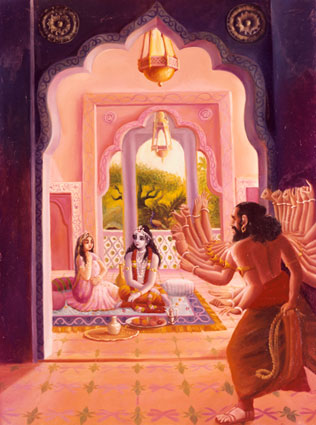
Emperor Banasura discovered his daughter secretly co-habiting with
Aniruddha, he arrested the latter and imprisoned him.
When
the four months of the rainy season passed and still Aniruddha had not
returned home, all the members of the Yadu family became much
perturbed. They could not understand how the boy was missing.
Fortunately, one day the great sage Narada came and informed the family
about Aniruddha's disappearance from the palace. He explained how
Aniruddha had been carried to the city of Shonitapura, the capital of
Banasura's empire, and how Banasura had arrested him with the nagapasha,
even though Aniruddha had defeated his soldiers. This news was given in
detail, and the whole story was disclosed. Then the members of the Yadu
dynasty, all of whom had great affection for Krishna, prepared to
attack the city of Shonitapura. Practically all the leaders of the
family, including Pradyumna, Satyaki, Gada, Samba, Sarana, Nanda,
Upananda and Bhadra, combined together and gathered eighteen akshauhini
military divisions into phalanxes. Then they all went to Shonitapura
and surrounded it with soldiers, elephants, horses and chariots.
Banasura heard that the soldiers of the Yadu dynasty were attacking the
whole city, tearing down various walls, gates and nearby gardens.
Becoming very angry, he immediately ordered his soldiers, who were of
equal caliber, to go and face them. Lord Shiva was so kind to Banasura
that he personally came as the commander-in-chief of the military
force, assisted by his heroic sons Karttikeya and Ganapati. Seated on
his favorite bull, Nandishvara, Lord Shiva led the fighting against
Lord Krishna and Balarama. We can simply imagine how fierce the
fighting was—Lord Shiva with his valiant sons on one side and Lord
Krishna, the Supreme Personality of Godhead, and His elder brother, Sri
Balaramaji, on the other. The fighting was so fierce that those who saw
the battle were struck with wonder, and the hairs on their bodies stood
up. Lord Shiva was engaged in fighting directly with Lord Krishna,
Pradyumna was engaged with Karttikeya, and Lord Balarama was engaged
with Banasura's commander-in-chief, Kumbhanda, who was assisted by
Kupakarna. Samba, the son of Krishna, was engaged in fighting with the
son of Banasura, and Banasura was engaged in fighting with Satyaki,
commander-in-chief of the Yadu dynasty. In this way the fighting was
waged.
News of the fighting spread all over the universe. Demigods such as
Lord Brahma, from higher planetary systems, along with great sages and
saintly persons, Siddhas, Charanas and Gandharvas—all being very
curious to see the fight between Lord Shiva, Lord Krishna and their
assistants—were hovering over the battlefield in their airplanes. Lord
Shiva is called the bhuta-natha [Lord of
ghosts and hobgoblins], being assisted by various types of
powerful ghosts and denizens of the inferno—bhutas, pretas,
pramathas, guhyakas, dakinis, pishachas, kushmandas, vetalas, vinayakas
and brahma-rakshasas. (Of all kinds of ghosts, the brahma-rakshasas
are very powerful.
Brahmanas transferred to the role of ghosts become brahma-rakshasas.)
The Supreme Personality of Godhead Sri Krishna simply drove all these
ghosts away from the battlefield, beating them with His celebrated bow,
Sharngadhanu. Lord Shiva then began to release all his
selected weapons upon the Personality of Godhead. Lord Sri Krishna,
without any difficulty, counteracted all these weapons with
counter-weapons. He counteracted the brahmastra, similar to the
atomic bomb, by another brahmastra, and an air weapon by a
mountain weapon. When Lord Shiva released a particular weapon bringing
about a violent hurricane on the battlefield, Lord Krishna presented
just the opposing element, a mountain weapon which checked the
hurricane on the spot. Similarly when Lord Shiva released his weapon of
devastating fire, Krishna counteracted it with torrents of rain.
At last, when Lord Shiva released his personal weapon, called pashupatastra,
Krishna immediately counteracted it by the narayanastra. Lord
Shiva then became exasperated in fighting with Lord Krishna. Krishna
then took the opportunity to release His yawning weapon. When this
weapon is released, the opposing party becomes tired, stops fighting,
and begins to yawn. Consequently, Lord Shiva became so fatigued that he
refused to fight anymore and began to yawn. Krishna was now able to
turn His attention from the attack of Lord Shiva to the efforts of
Banasura, and He began to kill his personal soldiers with swords and
clubs. Meanwhile, Lord Krishna's son Pradyumna was fighting fiercely
with Karttikeya, the commander-in-chief of the demigods. Karttikeya was
wounded, and his body was bleeding profusely. In this condition, he
left the battlefield and, without fighting anymore, rode away on the
back of his peacock carrier. Similarly, Lord Balarama was smashing
Banasura's commander-in-chief, Kumbhanda, with the strokes of His club.
Kupakarna was also wounded in this way, and both he and Kumbhanda fell
on the battlefield, the commander-in-chief being fatally wounded.
Without guidance, all of Banasura's soldiers scattered here and there.
When Banasura saw that his soldiers and commanders had been defeated,
his anger only increased. He thought it wise to stop fighting with
Satyaki, Krishna's commander-in-chief, and instead directly attacked
Lord Krishna. Now having the opportunity to use his one thousand hands,
he rushed towards Krishna, simultaneously working 500 bows and 2,000
arrows. Such a foolish person could never measure Krishna's strength.
Immediately, without any difficulty, Krishna cut each of Banasura's
bows into two pieces and, to check him from going further, made his
chariot horses lay on the ground. The chariot then broke to pieces.
After doing this, Krishna blew His conchshell, Pañchajanya.
There was a demigoddess named Kotara who was worshiped by Banasura, and
their relationship was as mother and son. Mother Kotara was upset that
Banasura's life was in danger, so she appeared on the scene. With naked
body and scattered hair, she stood before Lord Krishna. Sri Krishna did
not like the sight of this naked woman, and to avoid seeing her, He
turned His face. Banasura, getting this chance to escape Krishna's
attack, left the battlefield. All the strings of his bows were broken,
and there was no chariot or driver, so he had no alternative than to
return to his city. He lost everything in the battle.
Being greatly harassed by the arrows of Krishna, all the associates of
Lord Shiva, the hobgoblins and ghostly bhutas, pretas and kshatriyas,
left the battlefield. Lord Shiva then took to his last resort. He
released his greatest death weapon, known as Shivajvara, which destroys
by excessive temperature. It is said that at the end of this creation
the sun becomes twelve times more scorching than usual. This
twelve-times-hotter temperature is called Shivajvara. When the
Shivajvara personified was released, he had three heads and three legs,
and as he came toward Krishna it appeared that he was burning
everything into ashes. He was so powerful that he made blazing fire
appear in all directions, and Krishna observed that he was specifically
coming toward Him.
As there is a Shivajvara weapon, there is also a Narayanajvara.
Narayanajvara is represented by excessive cold. When there is excessive
heat, one can somehow or other tolerate it, but when there is excessive
cold, everything collapses. This is actually experienced by a person at
the time of death. At the time of death, the temperature of the body
first of all increases to 107 degrees, and then the whole body
collapses and immediately becomes as cold as ice. To counteract the
scorching heat of the Shivajvara, there is no other weapon but
Narayanajvara.
When Lord Krishna saw that the Shivajvara had been released by Lord
Shiva, He had no other recourse than to release Narayanajvara. Lord Sri
Krishna is the original Narayana and the controller of the
Narayanajvara weapon. When the Narayanajvara was released, there was a
great fight between the two jvaras. When excessive heat is
counteracted by extreme cold, it is natural for the hot temperature to
gradually reduce, and this is what occurred in the fight between
Shivajvara and Narayanajvara. Gradually, Shivajvara's temperature
diminished, and Shivajvara began to cry for help from Lord Shiva, but
Lord Shiva was unable to help him in the presence of the Narayanajvara.
Unable to get any help from Lord Shiva, the Shivajvara could understand
that he had no means of escape outside surrendering unto Narayana, Lord
Krishna Himself. Lord Shiva, the greatest of the demigods, could not
help him, what to speak of the lesser demigods, and therefore
Shivajvara ultimately surrendered unto Krishna, bowing before Him and
offering a prayer so that the Lord might be pleased and give him
protection.
By this incidence of the fight between the ultimate weapons of Lord
Shiva and Lord Krishna it is proved that if Krishna gives someone
protection, no one can kill him. But if Krishna does not give one any
protection, then no one can save him. Lord Shiva is called Mahadeva,
greatest of all demigods, although sometimes Lord Brahma is considered
the greatest of all demigods, because he can create, whereas Lord Shiva
can annihilate the creations of Brahma. But both Lord Brahma and Lord
Shiva act only in one capacity. Lord Brahma can create, and Lord Shiva
can annihilate, but neither of them can maintain. Lord Vishnu, however,
not only maintains, but He creates, and annihilates also. Factually,
the creation is not effected by Brahma, because Brahma himself is
created by Lord Vishnu. Lord Shiva is created, or born, of Brahma. The
Shivajvara thus understood that without Krishna or Narayana, no one
could help him. He therefore rightly took shelter of Lord Krishna and,
with folded hands, began to pray as follows.
"My dear Lord, I offer my respectful obeisances unto You because You
have unlimited potencies. No one can surpass Your potencies, and thus
You are the Lord of everyone. Generally people consider Lord Shiva to
be the most powerful personality in the material world, but Lord Shiva
is not all-powerful; You are all-powerful. This is factual. You are the
original consciousness or knowledge. Without knowledge or
consciousness, nothing can be powerful. A material thing might be very
powerful, but without the touch of knowledge or consciousness it cannot
act. A material machine may be very gigantic and wonderful, but without
the touch of someone conscious and in knowledge, the material machine
is useless for all purposes. My Lord, You are complete knowledge, and
there is not a pinch of material contamination in Your personality.
Lord Shiva may be a powerful demigod because of his specific power to
annihilate the whole creation, and similarly, Lord Brahma may be very
powerful because he can create the entire universe, but actually
neither Brahma nor Lord Shiva is the original cause of this cosmic
manifestation. You are the Absolute Truth, the Supreme Brahman, and You
are the original cause. The original cause of the cosmic manifestation
is not the impersonal Brahman effulgence. That impersonal Brahman
effulgence is resting on Your personality."
As is confirmed in the Bhagavad-gita, the cause of the
impersonal Brahman is Lord Krishna.
"This Brahman effulgence is likened to the sunshine which emanates from
the sun globe. Therefore, impersonal Brahman is not the ultimate cause.
The ultimate cause of everything is the supreme eternal form of
Krishna. All material actions and reactions are taking place in the
impersonal Brahman, but in the personal Brahman, the eternal form of
Krishna, there is no action and reaction. My Lord, Your body is
therefore completely peaceful, completely blissful and is devoid of
material contamination.
"In the material body there are actions and reactions of the three
modes of material nature. The time factor is the most important element
and is above all others, because the material manifestation is effected
by time agitation. Thus natural phenomena come into existence, and as
soon as there is the appearance of phenomena, fruitive activities are
visible. As the result of these fruitive activities, a living entity
takes his form. He acquires a particular type of nature which is packed
up in a subtle body and gross body formed by the life air, the ego, the
ten sense organs, the mind and the five gross elements. These then
create the type of body which later becomes the root or cause of
various other bodies, which are acquired one after another by the
transmigration of the soul. All these phenomenal manifestations are the
combined actions of Your material energy. Unaffected by the action and
reaction of different elements, You are the cause of this external
energy, and because You are transcendental to such compulsions of
material energy, You are the supreme tranquillity. You are the last
word in freedom from material contamination. I am therefore taking
shelter at Your lotus feet, giving up all other shelter.
"My dear Lord, Your appearance as the son of Vasudeva in Your role as a
human being is one of the pastimes of Your complete freedom. To benefit
Your devotees and to vanquish the nondevotees, You appear in
multi-incarnations. All such incarnations descend in fulfillment of
Your promise in the Bhagavad-gita that You appear as soon
as there are discrepancies in the system of progressive life. When
there are disturbances by irregular principles, my dear Lord, You
appear by Your internal potency. Your main business is to protect and
maintain the demigods and spiritually inclined persons and maintain the
standard of material law and order. Simultaneous to the maintenance of
such law and order, Your violence to the miscreants and demons is quite
befitting. This is not the first time You have incarnated; it is to be
understood that You have done so many, many times before.
"My dear Lord, I beg to submit that I have been very greatly chastised
by the release of Your Narayanajvara. It is certainly very cooling yet
at the same time very severely dangerous and unbearable for all of us.
My dear Lord, as long as one is forgetful of Krishna consciousness,
driven by the spell of material desires and ignorant of the ultimate
shelter at Your lotus feet, one who has accepted this material body
becomes disturbed by the three miserable conditions of material nature.
Because one does not surrender unto You, he therefore continues to
suffer perpetually."
After hearing the Shivajvara, Lord Krishna replied, "O three-headed
one, I am pleased with your statement. Be assured there is no more
suffering for you from the Narayanajvara. Not only are you now free
from fear of Narayanajvara, but anyone in the future who simply
recollects this fight between Shivajvara and Narayanajvara will also be
freed from all kinds of fearfulness."
After hearing the Supreme Personality of Godhead, the Shivajvara
offered his respectful obeisances unto His lotus feet and left.
In the meantime, Banasura somehow or other recovered from his setbacks
and, with rejuvenated energy, returned to fight. This time Banasura
appeared before Lord Krishna, who was seated on His chariot, with
different kinds of weapons in his one thousand hands. Banasura was very
much agitated. He began to splash his different weapons, like torrents
of rain, upon the body of Lord Krishna. When Lord Krishna saw the
weapons of Banasura coming at Him, like water coming out of a strainer,
He took His sharp-edged Sudarshana disc and began to cut off the
demon's one thousand hands one after another, just as a gardener trims
the twigs of a tree with sharp cutters. When Lord Shiva saw that his
devotee Banasura could not be saved even in his presence, he came to
his senses and personally came before Lord Krishna and began to pacify
Him by offering the following prayers.
Lord Shiva said, "My dear Lord, You are the worshipable object of the
Vedic hymns. One who does not know You considers the impersonal brahmajyoti
to be the ultimate Supreme Absolute Truth, without any knowledge that
You are existing behind Your spiritual effulgence in Your eternal
abode. My dear Lord, You are therefore called Parambrahman. This word,
Parambrahman, has been used in the Bhagavad-gita to
identify You. Saintly persons who have completely cleansed their hearts
of all material contamination can realize Your transcendental form,
although You are all-pervading like the sky, unaffected by any material
thing. Only the devotees can realize You, and no one else. In the
impersonalists' conception of Your supreme existence, the sky is just
like Your navel, the fire is Your mouth, and the water is Your semina.
The heavenly planets are Your head, all the directions are Your ears,
the Urvi planet is Your lotus feet, the moon is Your mind, and the sun
is Your eye. As far as I am concerned, I act as Your ego. The ocean is
Your abdomen, and the King of heaven, Indra, is Your arm. Trees and
plants are the hairs of Your body, the cloud is the hair on Your head,
and Lord Brahma is Your intelligence. All the great progenitors, known
as Prajapatis, are Your symbolic representatives. And religion is Your
heart. The impersonal feature of Your supreme body is conceived of in
this way, but You are ultimately the Supreme Person. The impersonal
feature of Your supreme body is only a small expansion of Your energy.
You are likened to the original fire, and the expansions are Your light
and heat."
Lord Shiva continued: "My dear Lord, although You are manifested
universally, different parts of the universe are the different parts of
Your body, and by Your inconceivable potency You can simultaneously be
both localized and universal. In the Brahma-samhita we
also find it stated that although You always remain in Your abode,
Goloka Vrindavana, You are nevertheless present everywhere. As stated
in the Bhagavad-gita, You appear to protect the devotees,
which indicates good fortune for all the universe. All of the demigods
are directing different affairs of the universe by Your grace only.
Thus the seven upper planetary systems are being maintained by Your
grace. At the end of this creation, all manifestations of Your
energies, whether in the shape of demigods, human beings or lower
animals, enter into You, and all immediate and remote causes of cosmic
manifestation rest in You without distinctive features of existence.
Ultimately, there is no possibility of distinction between Yourself and
any other thing on an equal level with You or subordinate to You. You
are simultaneously the cause of this cosmic manifestation and its
ingredients as well. You are the Supreme Whole, one without a second.
In the phenomenal manifestation there are three stages: the stage of
consciousness, the stage of semiconsciousness in dreaming, and the
stage of unconsciousness. But Your Lordship is transcendental to all
these different material stages of existence. You exist, therefore, in
a fourth dimension, and Your appearance and disappearance do not depend
on anything beyond Yourself. You are the supreme cause of everything,
but for Yourself there is no cause. You Yourself cause Your own
appearance and disappearance. Despite Your transcendental position, my
Lord, in order to show Your six opulences and advertise Your
transcendental qualities, You have appeared in Your different
incarnations—fish, tortoise, boar, Nrisimha, Keshava, etc.—by Your
personal manifestation; and You have appeared as different living
entities by Your separated manifestations. By Your internal potency,
You appear as the different incarnations of Vishnu, and by Your
external potency You appear as the phenomenal world.
"Because it is a cloudy day to the common man's eyes, the sun appears
to be covered. But the fact is that because the sunshine creates the
cloud, even though the whole sky is cloudy, the sun can never actually
be covered. Similarly, the less intelligent class of men claims that
there is no God, but when the manifestation of different living
entities and their activities is visible, enlightened persons see You
present in every atom and through the via media of Your external and
marginal energies. Your unlimited potential activities are experienced
by the most enlightened devotees, but those who are bewildered by the
spell of Your external energy identify themselves with this material
world and become attached to society, friendship and love. Thus they
embrace the threefold miseries of material existence and are subjected
to the dualities of pain and pleasure. They are sometimes drowned in
the ocean of attachment and sometimes taken out of it.
"My dear Lord, only by Your mercy and grace can the living entity get
the human form of life, which is a chance to get out of the miserable
condition of material existence. However, a person who possesses a
human body but who cannot bring the senses under control is carried
away by the waves of sensual enjoyment. As such, he cannot take shelter
of Your lotus feet and thus engage in Your devotional service. The life
of such a person is very unfortunate, and anyone living such a life of
darkness is certainly cheating himself and thus cheating others also.
Therefore, human society without Krishna consciousness is a society of
cheaters and the cheated.
"My Lord, You are actually the dearmost Supersoul of all living
entities and the supreme controller of everything. The human being who
is always illusioned is afraid of ultimate death. A man who is simply
attached to sensual enjoyment voluntarily accepts the miserable
material existence and thus wanders after the will-o'-the-wisp of sense
pleasure. He is certainly the most foolish man, for he drinks poison
and puts aside the nectar. My dear Lord, all the demigods, including
myself and Lord Brahma, as well as great saintly persons and sages who
have cleansed their hearts of this material attachment, have, by Your
grace, wholeheartedly taken shelter of Your lotus feet. We have all
taken shelter of You, because we have accepted You as the Supreme Lord
and the dearmost life and soul of all of us. You are the original cause
of this cosmic manifestation, You are its supreme maintainer, and You
are the cause of its dissolution also. You are equal to everyone, the
most peaceful supreme friend of every living entity. You are the
supreme worshipable object for every one of us. My dear Lord, let us
always be engaged in Your transcendental loving service, so that we may
get free from this material entanglement.
"Lastly, my Lord, I may inform You that this Banasura is very dear to
me. He has rendered very valuable service unto me; therefore I want to
see him always happy. Being pleased with him, I have given him the
assurance of safety. I pray to You, my Lord, that as You were pleased
upon his forefathers King Prahlada and Bali Maharaja, You will also be
pleased with him."
After hearing Lord Shiva's prayer, Lord Krishna addressed him also as
lord and said, "My dear Lord Shiva, I accept your statements, and your
desire for Banasura is also accepted by Me. I know that this Banasura
is the son of Bali Maharaja, and as such I cannot kill him because that
is My promise. I gave a benediction to King Prahlada that all the
demons who would appear in his family would never be killed by Me.
Therefore, without killing this Banasura, I have simply cut off his
arms to deprive him of his false prestige. The large number of soldiers
which he was maintaining became a burden on this earth, and I have
killed them all in order to minimize the burden. Now he has four
remaining arms, and he will remain immortal, without being affected by
the material pains and pleasures. I know that he is one of the chief
devotees of your lordship, so you can now rest assured that
henceforward he need have no fear from anything."
When Banasura was benedicted by Lord Krishna in this way, he came
before the Lord and bowed down before Him, touching his head to the
earth. He immediately arranged to bring Aniruddha along with his
daughter Usha, seated on a nice chariot, and presented them before Lord
Krishna. After this, Lord Krishna took charge of Aniruddha and Usha,
who had become very opulent materially because of the blessings of Lord
Shiva. Thus, keeping forward a division of one akshauhini of
soldiers, Krishna began to proceed toward Dvaraka. In the meantime, all
the people at Dvaraka, having received the news that Lord Krishna was
returning with Aniruddha and Usha in great opulence, decorated every
corner of the city with flags, festoons and garlands. All the big roads
and crossings were carefully cleansed and sprinkled with sandalwood
pulp mixed with water. Everywhere there was the flavor of sandalwood.
All the citizens, accompanied by their friends and relatives, welcomed
Lord Krishna with great pomp and jubilation. At that time, there was a
tumultuous vibration of conchshells and drums and bugles to receive the
Lord. In this way the Supreme Personality of Godhead Krishna entered
His capital, Dvaraka.
Shukadeva Gosvami assured King Parikshit that the narration of the
fight between Lord Shiva and Lord Krishna is not at all inauspicious
like ordinary fights. On the contrary, if one remembers the narration
of this fight between Lord Krishna and Lord Shiva in the morning and
takes pleasure in the victory of Lord Krishna, he will never experience
defeat anywhere in his struggle of life.
This episode of Banasura's fighting with Krishna and later on being
saved by the grace of Lord Shiva is confirmation of the statement in
the Bhagavad-gita that the worshipers of demigods cannot
achieve any benediction without its being sanctioned by the Supreme
Lord, Krishna. Here, in this narration, we find that although Banasura
was a great devotee of Lord Shiva, when he faced death by Krishna, Lord
Shiva was not able to save him. But Lord Shiva appealed to Krishna to
save his devotee, and it was thus sanctioned by the Lord. This is the
position of Lord Krishna. The exact words used in this connection in
the Bhagavad-gita are mayaiva vihitan hi tan.
This means that without the sanction of the Supreme Lord, no demigod
can award any benediction to the worshiper.
Thus
ends the Bhaktivedanta purport of the Second Volume, Eighth Chapter, of
Krishna, "Lord Krishna Fights with Banasura."

 from
KRSNA,
The Supreme Personality of Godhead, Volume 2, 1970 edition
from
KRSNA,
The Supreme Personality of Godhead, Volume 2, 1970 edition