 Krishna Books What is Hare Krishna? The Founder-Acharya Hare Krishna Mantra Sankirtan Movement Personality of Godhead Lord Chaitanya A.C.Bhaktivedanta Swami Prabhupada Hansadutta das Events: Kirtan Festival World Sankirtan Party Submit News © 2004 - Hansadutta das |
Krishna's Prescription for Good Governance
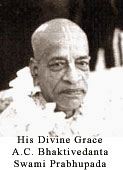
by His Divine Grace A.C.
Bhaktivedanta Swami Prabhupada
|
 Army
Times, November 4, 2006 -
Army
Times, November 4, 2006 - 
|
Model
for Human Society
|
The historical perspective by HANSADUTTA DAS The standard for human thought and action in every field, whether government, military and politics, health, mathematics, agriculture, astronomy, poetry, music, art, philosophy—practically every branch of knowledge and human endeavor—is the Vedas. Vedic culture, Vedic knowledge and Vedic religion are the foundation of human civilization, just looking at it from a historical perception. more |
Prabhupada: ...If things are going nicely,
people will be happy. They will not revolt. You have to keep the
citizens satisfied in all respects. You must know the necessity how
people are satisfied. You have to arrange the government in that way.
Then there will be no revolution. Mass of people, if they are
satisfied, they will not revolt. But they do not know the process. The
"demoncracy," the common man is allowed to vote. He has no knowledge
and he's voting. This is most condemned process. Chamara-bhangi,
a sweeper, he is voted to become Minister of Defense. His business is
to cleanse the street, and now he's voted to become because he has got
number of votes. So many bhangis, they vote, "Yes, he is our
leader. He should be Defense Minister." You have to do that. This is
democracy. His business is to sweep, and he's voted a defense minister.
Hari-sauri: But in, say in
America, they argue that everybody's educated now. In America...
Prabhupada: What educated?
Educated means hippies. That's all. This is their education. They do
not know what is meant by education. Education... University student
was informed that "Next birth you may become a dog," so he said, "What
is the wrong there?" This is education. Is that education, that he
agrees to become a dog very happily? There is no education. Simply
waste of time.
Satsvarupa: But at least if
there is extreme exploitation by a king or dictator it can't be
changed. But the people...
Prabhupada: There cannot be
exploitation if things are made in order. Just like
kshatriya[1] should
be trained up as kshatriya. Then he is
king. Not that a bhangi by vote becomes a king. This is
education.
shauryam tejo dhritir dakshyam
yuddhe chapy apalayanam
danam ishvara-bhavash cha
kshatram karma svabhava-jam
[Bhagavad-gita
18.43]: "Heroism, power, determination,
resourcefulness, courage in battle, generosity and leadership are the
natural qualities of work for the kshatriyas."] He must be very
powerful, very strong, strongly built. You have seen the
picture—Ramachandra? Sturdy body. You see. Lakshmana. Because kshatriya.
They should be trained up as kshatriya.
Therefore the varnashrama[2] college is required to train people
who is able to become a brahmana, who is able to become a kshatriya,
who is able to become... In this way division must be. And according to
the quality and work there must be division for cooperation. There is a
big scheme. They have lost. They do not know. All bhangis, chamara,
shudras, they are simply given vote. That's all. Where is the
training?
Hari-sauri: But what is the
use of having big strong body if now they're using airplanes and tanks
and guns?
Prabhupada: That is your
useless waste of time. Why? Therefore the war does not stop,
unnecessary war, and such a big war, Kurukshetra [3],
in eighteen days it is finished. This is
decision. And this is going on: continually war, strain, politics,
diplomacy, lecture, Parliament. There is no finishing of war. There is
no finishing. It will go on. Just like same example: If you keep the
dogs as dogs, they'll going on barking. It will never finish. So this
is the civilization of dog work. It is not human civilization.
Therefore it is going on. War is not stopped. Where is stop? War is
stopped? No. Going on. And it will go on because they are dogs. You
cannot stop their barking. There are so many things. If we follow the
instruction of Bhagavad-gita, then whole world will be...
This is a fact. Now, how to implement it, that is another thing. It is
a fact.
Hari-sauri: Because even the yavanas
and mlecchas [non-aryans, or people
living outside the brahminical culture] were following the kshatriya
system in
Krishna's time. Just like Jarasandha. He had all the chivalrous respect
of a kshatriya even though he was a demon. But nowadays
everybody's... No one is...
Prabhupada: Everybody's shudra.
Nobody's brahmana, nobody's...
Hari-sauri: No.
Prabhupada: Shudra is
to be controlled only. They are never given to be freedom...That is
best, to keep them under control...but give them sufficient food,
sufficient cloth, not more than that. Then they will be satisfied.
Model for human society
Hari-sauri: If that's done
then how will those who have some potential to be educated, how will we
recognize them?
Prabhupada: Either educate
them or control them. Give them facility of education. But now there is
no education at all... So we are stressing on the point of education.
You educate certain section as brahmana, certain section as kshatriya,
certain section as vaishya. In that education we don't
discriminate because he's coming of a shudra family. Take
education. Be qualified. Then you talk. Not by votes.
Satsvarupa: Lord Chaitanya[4], when Ramananda Raya
brought this up, He said
it was not possible in
this age to introduce this.
Prabhupada: Yes. Not... He
did not say possible. Iha bahya. [From
Chaitanya-charitamrita Madhya 8.59: "The Lord replied, 'This is
external. You had better tell Me of some other means.'"] Chaitanya
Mahaprabhu was interested only on the spiritual platform. He had no
idea of material side. He rejected material side.
Satsvarupa: But don't we do
that also?
Prabhupada: No. Our position
is different. We are trying to implement Krishna consciousness in
everything. And Chaitanya Mahaprabhu personally took sannyasa [renounced order of life].
He rejected completely material. Nishkinchana ["one who has
nothing to do with this material world"]. But we are not going to be nishkinchana.
We are trying to cement the troubled position of the [society at
large]... That is also in
the prescription of Bhagavad-gita. We are not rejecting
the whole society. Chaitanya Mahaprabhu rejected everything, iha
bahya. Rejected meaning, "I do not take much interest in this." Bahya.
"It is external." He was simply interested in the internal, the
spiritual.
But our duty is that we shall arrange the external affairs also so
nicely that one day they will come to the spiritual platform very
easily, paving the way. And Chaitanya Mahaprabhu, personality like
that, they have nothing to do with this material world. But we are
preaching. We are preaching. Therefore we must pave the situation in
such a way that gradually they will be promoted to the spiritual plane,
[in] which [varnashram] is not required.
Satsvarupa: Varnashrama
is not required.
Prabhupada:
Not required.
Chaitanya Mahaprabhu denied, "I am not brahmana, I am not kshatriya,
I am not this, I am not this." He rejected. But in the Bhagavad-gita,
the
chatur-varnyam maya srishtam. [ [Bg. 4.13]: "According to the
three modes of material nature and the work associated with them, the
four divisions of human society are created by Me..."] So we are
preaching Krishna consciousness. It must be done.
Hari-sauri: But in Chaitanya
Mahaprabhu's practical preaching He only induced them to chant [the holy names of God, viz. Hare Krishna maha-mantra:
Hare Krishna, Hare Krishna, Krishna Krishna, Hare Hare/ Hare Rama, Hare
Rama, Rama Rama, Hare Hare].
Prabhupada: That is not
possible for ordinary man.
Hari-sauri: What, to simply
induce people to chant?
Prabhupada: Hm?
Hari-sauri: He only
introduced just the chanting.
Prabhupada: But who will
chant? Who'll chant?
Satsvarupa: But if they won't
chant, then neither will they train up in the
varnashrama. That's the easiest.
Prabhupada: The chanting will
be there, but you cannot expect that people will chant like Chaitanya
Mahaprabhu. They cannot even chant sixteen rounds. [Sarcastically:]
These rascals
are going to be Chaitanya Mahaprabhu.
Satsvarupa: No. But if they
at least will chant and take some prasada [food
which has been offered to Krishna]...
Prabhupada: Chanting will go
on. That is not stopped. But at the same time the varnashrama-dharma
must be established to make the way easy.
Hari-sauri: Well, at least my
own understanding was that the chanting was introduced in the age of
Kali[5] because varnashram
is not possible.
Prabhupada: Because it will
cleanse the mind. Chanting will not stop.
Hari-sauri: So therefore the
chanting was introduced to replace all of the systems of varnashram
and like that.
Prabhupada: Yes, it can
replace, but who is going to replace it? The... People are not so
advanced. If you imitate Haridasa Thakura[6] to chant, it is not possible.
Satsvarupa: We tell them go
on with your job but chant also.
Prabhupada: Yes. Thakaha
apanara kaje [From song by Bhaktivinoda Thakura: "...Go on with
your prescribed duty, and chant Hare Krishna."] Bhaktivinoda Thakura. Apanara
kaja ki. Chaitanya Mahaprabhu recommended, sthane sthitah
["remaining in the varnashram-dharma"] And if they do not
remain in the sthana, then the sahajiya's[7] chanting will
come. Just like the sahajiyas also have got the beads and...,
but they have got three dozen women. This kind of chanting will go on.
Just like our [name withheld]. He was not fit for sannyasa but
he was given sannyasa. And five women he was attached, and he
disclosed.
Therefore varnashram-dharma is required. Simply show-bottle
will not do. So the varnashram-dharma should be introduced all
over the world, and...
Satsvarupa: Introduced
starting with ISKCON community [International
Society for Krishna Consciousness]?
Prabhupada: Yes. Yes. brahmana,
kshatriyas. There must be regular education.
Hari-sauri: But in our
community, if the..., being as we're training up as Vaishnavas [devotees of the Supreme Lord Vishnu, or Krishna]...
Prabhupada: Yes.
Hari-sauri: ...then how will
we be able to make divisions in our society?
Prabhupada: Vaishnava is not
so easy. The varnashram-dharma should be established to become
a Vaishnava. It is not so easy to become Vaishnava.
Hari-sauri: No, it's not a
cheap thing.
Prabhupada: Yes. Therefore
this should be made. Vaishnava, to become Vaishnava, is not so easy. If
Vaishnava, to become Vaishnava is so easy, why so many fall down? It is
not easy. The sannyasa is for the highest qualified brahmana.
And simply by dressing like a Vaishnava, that
is... fall down.
Hari-sauri: So the varnashram
system is like for the kanishthas, kanishtha-
adhikari [neophytes]. [From Srimad-Bhagavatam
11.2.47, see below.]
Prabhupada: Kanishtha?
Hari-sauri: When one is only
on the platform of neophyte.
Prabhupada: Yes. Yes. Kanishtha-adhikari,
yes.
Hari-sauri: Varnashram
system is beneficial.
Work
according to qualities
and qualifications
Prabhupada: Kanishtha-adhikari means he must be a brahmana. That is kanishtha-adhikari. The spiritual life, kanishtha-adhikari, means he must be a qualified brahmana. That is kanishtha. What is esteemed as very high position in the material world, brahmana, that is kanishtha-adhikari:
archayam eva haraye
pujam yah shraddhayehate
na tad-bhakteshu chanyeshu
sa bhaktah prakritah smritah
[SB
11.2.47: "A devotee who faithfully engages in the worship of the
Deity in the temple but does not behave properly toward other devotees
or people in general is called a prakrita-bhakta, a
materialistic
devotee, and is considered to be in the lowest position."] The brahmana
means from the material stage gradually he is elevated to the spiritual
stage. And below the brahmana there is no question of
Vaishnava.
Hari-sauri: No question
of?
Prabhupada: Vaishnavism.
shrinvatam sva-kathah krishnah
punya-shravana-kirtanah
hridy antah-stho hy abhadrani
vidhunoti suhrit satam [SB 1.2.17]
[SB 1.2.17: "Sri Krishna, the Personality of Godhead, who is the Paramatma [Supersoul] in everyone's heart and the benefactor of the truthful devotee, cleanses desire for material enjoyment from the heart of the devotee who has developed the urge to hear His messages, which are in themselves virtuous when properly heard and chanted."]
By becoming a brahmana, hearing, hearing, hearing... Or by hearing, hearing, hearing, he becomes a brahmana. The other qualities, shudra quality, kshatriya, vaishya, means finished. So then next stage is shrinvatam sva-kathah krishnah punya-shravana-kirtanah, hridy antah... [SB 1.2.17]. Nashta-prayeshv abhadreshu. [From SB 1.2.18] By this process, hearing... Without becoming a brahmana nobody is interested to hear. Then, by hearing, nashta-prayeshv abhadreshu, then abhadra... means the base qualities, means ignorance and passion... These are the base qualities. So nashta-prayeshv abhadreshu. When these base qualities are finished almost, not complete, nityam bhagavata-sevaya, by hearing from Bhagavata or by serving the spiritual master and Krishna consciousness movement—
nashta-prayeshv abhadreshu
nityam bhagavata-sevaya
bhagavaty uttama-shloke
bhaktir bhavati naishthiki [SB 1.2.18]
[ SB 1.2.18: "By regular attendance in classes on the Bhagavatam and by rendering of service to the pure devotee, all that is troublesome to the heart is almost completely destroyed, and loving service unto the Personality of Godhead, who is praised with transcendental songs, is established as an irrevocable fact."]
Then he becomes fixed up in devotional... This devotional service is the first-grade quality of sattva-guna.
nashta-prayeshv abhadreshu
nityam bhagavata-sevaya
bhagavaty uttama-shloke
bhaktir bhavati naishthiki [SB 1.2.18]
Tada rajas-tamo-bhavah. [SB 1.2.19: see below] When one is situated as a devotee, then this base quality—rajas, tamah, ignorance and passion, the symptoms: kama-lobhadayash cha ye. Kama, lusty desires, and greediness. Sex desire, strong sex desire or satisfy the senses, eating too much, lobha, greediness—these things go. Nityam bhagavata-sevaya bhagavaty uttama... When one is situated in devotional service, tada rajas-tamo- bhavah. These are rajas-tamo... These are the symptoms of rajas-tamo-bhavah.
tada rajas-tamo-bhavah
kama-lobhadayash cha ye
cheta etair anaviddham
sthitam sattve prasidati [SB 1.2.19]
[SB 1.2.19: "As soon as irrevocable loving service is established in the heart, the effects of nature's modes of passion and ignorance, such as lust, desire and hankering, disappear from the heart. Then the devotee is established in goodness, and he becomes completely happy."]
The
mind is no more disturbed with all these things. Sthitam sattve
prasidati. Then he is to be understood... He's in the
sattva-guna. That is perfect brahminical life. Then he'll be
pleased. Prasidati. In this way, gradual step...
So it is very difficult to bring, introduce varnashram, but at
least there must be some idea. Just like in the university, nobody is
going to study higher mathematics, higher English literature. Nobody
goes even in your country. The classes are almost vacant. But still,
the government does not close it. The expenditure is high, but there is
no student, no income. Therefore the professors coming to us, "Give us
some student." You know that?
Satsvarupa: Religion
professors.
Prabhupada: Whatever it may
be, higher studies...
Satsvarupa: Yes. "Send us
some of your men."
Prabhupada: Nobody is
interested with higher study. They want some technological
understanding so that they can earn money. That's all. This is only
interest.
Satsvarupa: In our ISKCON,
one becomes a brahmana after a year. It's not very hard.
Everyone becomes a brahmana.
Prabhupada: That is due to
chanting. That lifts very easily.
Hari-sauri: Where will we
introduce the varnashram system, then?
Prabhupada: In our society,
amongst our members.
Hari-sauri: But then if
everybody's being raised to the brahminical platform...
Prabhupada: Not everybody.
Why you are misunderstanding? Varnashram, not everybody brahmana.
Hari-sauri: No, but in our
society practically everyone is being raised to that platform. So then
one might ask what is...
Prabhupada: That is...
Everybody is being raised, but they're falling down.
Hari-sauri: So then we should
make it more difficult to get...
Prabhupada: Yes.
Hari-sauri: ...brahminical
initiation. After four or five years.
Prabhupada: Not necessary.
You remain as a kshatriya. You'll be ...
Hari-sauri: No need for even
any brahmana initiation, then...
Prabhupada: No, no.
Hari-sauri: ...unless one
is...
Prabhupada: No, brahmana
must be there. Why do you, say, generalize?
Hari-sauri: Unless one is
particularly...
Prabhupada: Yes.
Hari-sauri: ...inclined.
Perfect what you are rather than seek promotion to something you aren't
Prabhupada:
Not that a shudra
man is by force become a brahmana. You cannot improve. That is
not possible. But even if he remains a shudra and does
accordingly, he will get the same position as devotee. Sva-karmana
tam abhyarchya sam... [From Bg. 18.46: "{By worship of the Lord,
who is the source of all beings and who is all-pervading} a man can
attain perfection through performing his own work."] He'll get the
perfection. At the present moment the idea is: if one remains a shudra,
then he cannot get perfection. No. Even a shudra can get
perfection provided he does the work of a shudra perfectly.
Hari-sauri: For Krishna.
Prabhupada: Therefore why a shudra
artificially should be a brahmana? Let them, let him remain a shudra,
and if he follows strictly the rules and regulation of shudra,
he'll also be as good as a brahmana. The same example: Just
like head is as important as my leg. It is not that because it is leg,
it is less important than my head. And if you ask the head, "Do the
work of a leg," it is impossible. And if you ask the leg to work as a
brain, that is impossible. Let him remain brain, let him remain leg,
and do your duty and you become perfect.
Satsvarupa: Today you've been
saying that the Vaishnava is the highest, above the brahmana.
But then we've also understood that everyone in ISKCON is a Vaishnava.
Prabhupada: Yes. Vaishnava
everyone, even if he's not brahmana: jivera 'svarupa'
haya-krishnera 'nitya-dasa' [Cc. Madhya 20.108]: "It is the
living entity's constitutional position to be an eternal servant of
Krishna because he is the marginal energy of Krishna and a
manifestation simultaneously one and different from the Lord, like a
molecular particle of sunshine or fire. Krishna has three varieties of
energy."] But you have to gradually bring him to that pure
consciousness that "I am servant of Krishna." Here the bodily
conception is going on—"I am American," "I am Indian," "I am this," "I
am that."
Satsvarupa: If in our society
we say, "Srila Prabhupada wants some to be shudra..."
Prabhupada: No, no, no. I
don't want. I want everyone to become Vaishnava. But because he's a shudra,
it is not possible to bring him immediately to the platform of brahmana,
or Vaishnava. Therefore falling down. Therefore system must be. But
even if he remains a shudra, he's a Vaishnava.
Hari-sauri: So we'd have to
completely revise the whole system that we have now.
Prabhupada: No. Whatever we
have, that is all right. But we see by experience that they're falling
down. There must be systematic. Why falling down? Because he was not
fit for the position, therefore he has fallen. Better remain in his
position and become perfect. Why artificially bring them? There is no
need. Krishna says. Bring that Bhagavad-gita. Sve
sve karmany abhiratah?
Hari-sauri: [reads:]
sve sve karmany abhiratah
samsiddhim labhate narah
sva-karma-niratah siddhi
myatha vindati tach chrinu
"By following his qualities of work, every man can become perfect. Now please hear from Me how this can be done." [Bg. 18.45]
Prabhupada: Yes. He is shudra,
clerk. He can... As a shudra, he can get the perfection. Why he
should artificially become a brahmana and sannyasi and
fall down? This has to be checked.
Hari-sauri: So that depends
upon our men who are giving recommendations.
Prabhupada: So that
recommendation is not good. Bible is giving so many recommendation.
He's also not following them. [laughs]
Hari-sauri: Following them.
So how will we implement? Right now we have... Every temple president
can...
Prabhupada: That is supposed.
Where there is no tree, a castor seed tree is very big tree. That is
going on.
Satsvarupa: If there's no
tree?
Prabhupada: You know castor
seed tree, a plant? It does not grow [here]?
Satsvarupa: Small.
Prabhupada: Small. So there
is no banyan tree. It is taken—"Oh, it is very big."
Hari-sauri: I don't follow
the analogy.
Satsvarupa: In the complete
absence of trees, then a small tree is considered big.
Hari-sauri: Oh. [laughs]
Well, say, like here in Mayapura now we have a situation...
Prabhupada: No, no. Why? Why
one should stress to become big tree? Here it is clearly said even if
you are small tree, you can get perfection. So we should take that.
Hari-sauri: So in Mayapura
here now we have that situation, that so many...
Prabhupada: Everywhere,
wherever, Mayapura or anywhere. Question is that here it is clearly
said, sve sve karmany abhiratah. Brahmana has his
duty, kshatriya has his duty, vaishya has his duty, shudra
has his duty. And if he performs his duty nicely, then he also becomes
perfect. So why artificially he should be called a brahmana?
Let them do, according to shastra, the work of shudra,
or vaishya. He'll get the perfect. Perfection is not checked.
But why artificially he should be made a brahmana or he should
be made a sannyasi and fall down and become a ludicrous? That
is the point. Better let him live in his position and become perfect.
That's good. That looks very nice. And that is. That is possible. Varnashrama
charavata purushena parah puman vishnur aradhyate [Cc. Madhya
8.58]. [From Parashara Muni in Vishnu Purana (3.8.9):
"The Supreme Personality of Godhead, Lord Vishnu, is worshiped by the
proper execution of prescribed duties in the system of varna
and ashrama. There is no other way to satisfy the Lord."]
Vishnu, Lord Vishnu, can be worshiped if you perfectly follow the rules
and regulation of four varnas and four ashramas. Here
it is also said, sve sve karmani. You work as a perfect brahmana
or a perfect kshatriya, perfect shudra; you get
perfection. The perfection is available in your natural life. Why
should artificially you become unnatural and fall down and become
ludicrous? Perfection is not checked.
Satsvarupa: But in most of
our temples, the duties are either Deity worship, brahmana...
Prabhupada: Brahmanas
are available. Why you are bothering about this? Brahmanas are
also available, shudras are also available. Why shudra
should be artificially become a brahmana?
Re-present the ideal
Satsvarupa: What will the shudras
do in the big city temple, in all the temples?
Prabhupada: Why you are
bringing our temples? I am talking of the principle.
Satsvarupa: Oh.
Hari-sauri: The principle we
follow. We're just thinking how it can be implemented. You were saying
that it should be started in our society.
Prabhupada: Yes, that is a
very broad idea. Now we are speaking of some of them, training them.
That is another thing. That is small scale.
Hari-sauri: The principle
we're following.
Prabhupada: Yes. In the...
For the big scale, this is the required. In big scale you cannot make
all of them as brahmanas or sannyasis. No. That is not
possible. This is a small scale. How many percentage of people of the
world we are controlling? Very insignificant. But if you want to make
the whole human society perfect, then this Krishna consciousness
movement should be introduced according to the Krishna's instruction,
if you want to do it in a large scale for the benefit of the whole
human society.
Now we are picking up some of them, best. That is another thing. But
Chaitanya Mahaprabhu said para-upakara. [From Chaitanya-charitamrita
Adi 9.41: "{One who has taken his birth as a human being in the land of
India (Bharata-varsha) should make his life successful and} work for
the benefit of all other people."] Why a certain section should be
picked up? The whole mass of people will get the benefit of it. Then it
is required, systematic.
Sve sve karmany abhiratah samsiddhim
labhate narah. [From Bg. 18.45: "By following his qualities of
work, every man can become perfect..."] Para-upakara
means mass benefit, not there is certain section. Then we have to
introduce this varnashram-dharma. It must be done perfectly,
and it is possible and people will be happy...
Just like Prahlada Maharaja. He said that "I am quite happy. I have no
problem. But I am thinking of these rascals."
Tato vimudha-chetasa indriyartha: "They have made the whole aim
of life sense gratification." Indriyartha. "And for that
purpose, a few years, they're making huge arrangement, how we shall
become happy?" And next life a dog. It is risky. So as Krishna
conscious men, we should try to save them. That is the duty. But this
civilization as it is going on is very risky. They do not know how
nature's law is working, how he's going to be a dog next life. He does
not know. Mudho nabhijanati. To save the mass people from
falling down to the repetition of birth and death, that is welfare
activity. To save them by Krishna consciousness, we have to keep this
ideal at least, varnashram, that "Here is the position."
Hari-sauri: At this time
should we try to introduce it in our centers or not?
Prabhupada: Always we shall
try. Human society will be always there. We have to serve them, para-upakara.
We have to keep them in the right position.
Hari-sauri: I just remember
two or three years ago there was a thing... A pamphlet came out about
introducing the varnashram system in the society, but actually
nothing came of it.
Prabhupada: Yes. That time
was not right. Now you can do something.
Satsvarupa: That was the
beginning of emphasis on farms when Prabhupada said that, when more and
more farms start, the idea of the vaishya. But nothing else
happened.
Prabhupada: Every business is
important. brahmana business is important, kshatriya...
Just like the body. Head is important; the arm is important; the belly
is important. They must be kept in order. Just like I am in trouble
because my belly is not working. Digesting power is not good. So in
spite of brain, hand, and leg, I am diseased.
If any part of the society remains diseased, the whole society will
suffer. Therefore they must be maintained in correct order. You cannot
say if there is some trouble in the leg, "Neglect the leg. Take care of
the brain." No. Brain will be taxed due to the pain in the leg. This is
nature. Therefore everyone should be kept in order. Then things will go
on. That is varnashram. They do not know that. Sometimes they
are giving stress... That communist is giving stress to the shudra
class, and the capitalist are giving to the belly class. And what about
the head? What about the arms? And therefore topsy-turvied. Everything
is disorder. There are two classes of men now—capitalist and communist.
The communist is giving stress, "No. Simply the legs shall be taken
care." What is called? Proly?
Hari-sauri: Proletariat.
Prabhupada: What is that
proletariat?
Satsvarupa: The laborers.
Prabhupada: That's all. These
rascals are giving stress on the legs. And the capitalists, they are
giving stress on production. And where is the kshatriya and brahmana?
Hari-sauri: Well, they're all
giving stress to accumulation of weapons. They're all giving stress
to...
Prabhupada: That is not kshatriya's
business. That is... That is... No, that is described. Krishna said...
He arranged the battlefield, because the kshatriyas, they
became very powerful by individual military strength as it is now...
Hari-sauri: Accumulation.
Prabhupada: Ha. So Krishna
arranged: "All right, you come together and finish yourselves." So this
arrangement will be done that all atomic bomb will come in
warfield—one, next, third war, finished. All these, all these demons
will be finished. That is not kshatriya. This is demonic. Kshatriyas'
business is to see that the four orders of life are maintained
properly, not increasing military strength only, overburdened. Everyone
is spending 75% of the revenue for military. Huh? Paritranaya
sadhunam vinashaya cha dushkritam. [Bg. 4.8]: To deliver the
pious and} to annihilate the miscreants, {as well as to reestablish the
principles of religion, I Myself appear, millennium after
millennium.}"] So they are demons. Why so much money should be spent
for military? They are not kshatriyas. They are not kshatriyas.
They are demons. So demons... As soon as there will be number of demons
increased, there will be war and finish all.
Hari-sauri: So at least if we
successfully introduce the varnashram system in our own
society, then when all the demons finish themselves...
Prabhupada: At least... At
least... At least they will see, "This is the ideal."
Hari-sauri: Yes. Then if
there is a war after that, it will be all right.
Prabhupada: At least ideal
must be there. That we are doing.
Hari-sauri: This will more or
less revolutionize the way we're running our centers. If we introduce
it, it will more or less revolutionize the way we're running our
centers.
Prabhupada: Why? Why
revolution?
Hari-sauri: Because right now
our only emphasis is just to simply produce brahmanas .
Prabhupada: So why you are
taking "we"? Why not others? This is kanishtha-adhikari. You
are thinking of "we." That is kanishtha-adhikari. It is not
that "we." Na tad-bhakteshu chanyeshu. [SB 11.2.47: see
above.] You have to think for others also.
Satsvarupa: But the people
are not at our disposal to organize.
Hari-sauri: We are thinking
of "we" because actually we only have our own society at the moment to
organize.
Satsvarupa: We cannot
approach the masses to organize.
Hari-sauri: It can't be
implemented on such a big scale.
Prabhupada: I do not follow
what you say.
Satsvarupa: Just like...
Prabhupada: Ideal. We are
giving the ideal.
Satsvarupa: But no one's
listening and no one's taking it up except a few...
Prabhupada: But you take. You
show them.
Hari-sauri: That's why we
say, "we."
Prabhupada: That "We said"
means not we are going to take them, but we are simply giving the
ideas. We are not going to be a shudra. But to show the... Just
like you play in a drama. You are playing the part of a king. You are
not a king.
Hari-sauri: No.
Prabhupada: So similarly,
just to give them idea, we have to play like that.
Hari-sauri: Well, again,
that's...
Prabhupada: Not necessarily
that we are going to be shudra. So that is it. That is the
thing. We are servant of Krishna. That's all. And as servant of
Krishna, we have to execute the order of Krishna.
Satsvarupa: So we can ideally
organize ourselves and then for the rest of the people all we can do is
hope that they'll follow it.
Prabhupada: Yes.
Bhavananda: Set the example.
Prabhupada: Example. Just
like Bhavananda, when there was no commode here. He was taking my stool
and urine. Does it mean he is a sweeper? He's a sannyasi
Vaishnava. Similarly, naham vipro na cha nara-patir napi...
[From Padyavali 74: "I am not a brahmana, I am
not a kshatriya, I am not a vaishya or a shudra.
Nor am I a brahmacari, a householder, a vanaprastha or
a sannyasi..." cited in Chaitanya-charitamrita
Madhya 13.80] Chaitanya Mahaprabhu said, "I am not a sannyasi."
But He took sannyasa. Actually He is God, so what is the
benefit of becoming a sannyasi, for God? But He became that. In
order to serve the mass of people, to bring them to the ideal position,
we should try to introduce this varnashram, not that we are
going to be candidates of varnashram. It is not our business.
But to teach them how the world will be in peaceful position we have to
introduce... Here is a very nice institution for the benefit of the
whole society human.
1. kshatriyas—class of men who
administrate
government for the protection of the society—kings, prime ministers,
magistrates,
military men, police force. [back to text]
2. varnashrama, also varnashrama-dharma—organization
of society into social and spiritual orders: 4 varnas—brahmanas,
kshatriyas, vaishyas and shudras; and 4 ashrams—brahmacharya,
grihastha, vanaprastha and sannyasa.
As the intelligent class of men, the brahmanas function
as the
head of the social body, giving spiritual direction and counsel to the
other classes, especially the kshatriyas. The kshatriyas
are the government leaders, administrators such as king, prime
minister, president, judges, and military men, policemen, etc. They
function as the arms of the social body, enforcing law and order and
giving protection to the citizens of the land, and are supposed to be
men of ideal character, possessed of virtues such as strength,
righteousness, courage, honesty, etc. The kshatriyas depend on
the brahmanas for good counsel, and the brahmanas
likewise depend on the kshatriyas for all protection and
facility to perform their religious duties. The vaishyas,
or
the class of men who contribute to the economy and provide the
necessities of life—traders, merchants and the farmers, are regarded as
the belly of the social body. Finally, the shudras, or
the
laborer class of men, function as the legs of the social body, carrying
out work under the direction of the other 3 classes. In this varnashram
system, the 4 classes are interdependent on each other, working
cooperatively for the happiness of the whole society, not only to meet
their material needs but ultimately to progress forward in spiritual
self-realization. The varnashrama-dharma is spoken of in Bhagavad-gita
and elsewhere in Vedic literatures as the foundation of all human
society and was in ancient times prevalent all over the world, but by
the influence of time it has degraded, and the brahminical culture has
been practically lost. India's much maligned caste system of the last
two thousand years or so is a perversion of the varnashrama-dharma,
where a person's occupation was determined according to the qualities
or abilities he exhibited, not merely by birthright.
[back to text]
Kurukshetra War, also Mahabharat
War—the first world war spoken of in the Mahabharat lore. The war,
which took place some 5,000 years ago at Kurukshetra, lasted just 18
days, during which 64 million lives were lost, but the outcome was
decisive: the Pandavas (King Yudhisthira at the head) were installed
as the rulers of the world, then called Bharata-varsha. The great war
was the backdrop for the famous Bhagavad-gita, spoken by
Krishna to Arjuna. [back to text]
Lord Chaitanya—Sri Krishna
Chaitanya, also known as Chaitanya Mahaprabhu, appeared in the 15th
century (just over 500 years ago) at Navadvipa in Bengal. He is an
incarnation of Krishna (avatar) who descended for the purpose of
introducing the congregational chanting of the Hare Krishna maha-mantra
as the yuga-dharma, or method of spiritual enlightenment and
realization for the modern age. [back to text]
Age of Kali, also Kali-yuga—the
"age of quarrel", the fourth and last age in the cycle of a maha-yuga.
We are now living in Kali-yuga, which is supposed to last 432,000
years, of which 5,000 years have already passed. [see also Description of the Age of Quarrel] [back to text]
Haridasa Thakura—devotee and
associate of Chaitanya Mahaprabhu, who gave him the title "Namacharya",
or the Acharya of the Holy Names, for he chanted the holy name on his
beads 300,000 times daily, throughout the day and the night. [back to text]
sahajiya—disregard for the
prescribed rules and regulations of devotional service, and
instead concocting ideas and practices such as representing one's self
to be Krishna or Radha or Their intimate associates, even indulging in
illicit sex life in the name of the supreme love of God. [back to text]
Krishna's Prescription for Good Governance/ WORLD SANKIRTAN PARTY ©2004 - Hansadutta das
Home | About | Events | World Sankirtan Party | Inside Nam Hatta
eBooks | Site Map | Store
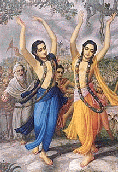
Sri Guru and Gauranga
Related Articles
The Founder Acharya
Krishna's Socio-Economic Solution
Spiritual Communism - Talks with Professor Kotovsky in Moscow
What is the Matter with the World?
Talks with Stilson Judah
Body Without Head and Arms
Related Topics
World Community - Government, Economy, Politics
Back to Top
Back to Top
Back to Top
Back to Top
Back to Top
Back to Top
Back to Top
Back to Top
Back to Top
Back to Top
Back to Top
Back to Top
Back to Top
Back to Top
Back to Top
Back to Top
Back to Top
Back to Top
Back to Top
Back to Top