You
may stop one kind of willing, but you will adopt another
kind of willing and another kind of satisfaction. We must understand
that behind the whimsical will is the spirit soul.
When that spirit soul understands his real identification as the
eternal servant of Krishna, his will is purified.
Get Srila
Prabhupada's original, unrevised books. Beware
of imitations. More than 160 titles published! Learn more.
[Posted
October 9, 2006]
Transcending Addiction: Engagement, Not Suppression
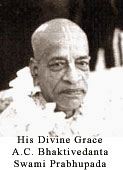
His Divine Grace A.C.
Bhaktivedanta Swami Prabhupada
Der Spiegel
- 6 October 2006 - BRUNO SCHREP: "I Hate My Desires - They Make Me Sick" Ralf P. is plagued by sexual fantasies of the kind he
would rather not have -- he's pedophile and struggling to resist his
own impulses. Berlin's Charité hospital now offers a new program
combining counseling and hormone therapy for men in his situation.
"It's a nightmare for all of them," says Christoph Joseph Ahlers, the
psychologist who is coordinating the project in addition to running two
of the therapy groups. The sexologist is a tall, reserved and yet
friendly man. He knows from countless conversations that pedophile men
want nothing more than to hide their urge from the world and from
themselves. But he also knows that if those men don't acknowledge who
they are, no progress can be made: "If I accept something as a part of
me, I can control it in a reliable way," Ahlers says.
And control is what it's all about. There is one question at the heart
of the therapy program: What should I do when my urges overpower me?
go to story
The
German philosopher Arthur Schopenhauer (1788–1860) took some of his
ideas from the Indian Vedic literature but many more from Buddhist
writings, and he ended up espousing an atheistic and pessimistic
doctrine. Srila Prabhupada shows how his idea of nirvana,
extinguishing one’s will, is self-defeating and
ultimately impossible to achieve.
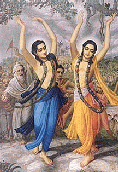
This
chanting of Hare Krishna, Hare Krishna, Krishna Krishna, Hare Hare/
Hare Rama, Hare Rama, Rama Rama, Hare Hare is directly enacted from
the spiritual platform, surpassing all lower states of
consciousness--namely sensual, mental and intellectual. There is no
need of understanding the language of the mantra, nor is there
any need of mental speculation nor any intellectual adjustment for
chanting this Maha Mantra. It springs automatically from the
spiritual platform, and as such, anyone can take part in this
transcendental sound vibration, without any previous qualification, and
dance in ecstasy. more
Disciple: For Schopenhauer, happiness meant
inactive satisfaction—nirvana. Since he thought that the will to
enjoy the material world is the irrational urge that brings about all
suffering, he advocated the extinction of the will. In his main book, The
World as Will and Idea, he wrote, “The Indian Vedas and Puranas
have no better simile than a dream for the actual [material] world,
which they call ‘the web of maya,’ and they use none more
frequently.” From this Schopenhauer concluded, “Life is a long
dream....What is this world of perception but my idea?” He goes on to
conclude that life is a projection of the will.
Srila Prabhupada: Yes,
material life is a projection of the material will, or material desire.
And nirvana means that material desires are finished. But the
living entity cannot be desireless, because he is an eternal spiritual
being. Thus, even when he finishes his material desires, he still has
spiritual desires. In the materially conditioned state, these spiritual
desires are covered by material desires, but in any case desire is the
constant companion of the soul, or living entity.
The soul transmigrates in this material world from one body to another,
and he creates desires according to the type of body he gets. God’s
supreme will affords the living entity various bodies so that he can
fulfill his minute will, which is made up of material desires. In other
words, the living entity wills something, and the supreme will (God, or
Krishna), understanding the finite will of the living entity, gives him
facilities to fulfill his particular desire. In this way, the will of
the living entities is the cause of this material existence.
However, Schopenhauer was wrong in thinking that you can become happy
by extinguishing your will. Since you are a living being, you must
always have desires. If your desires are stopped, you become like a
stone. So instead of trying to put an end to all desire, you should try
to cleanse the diseased form of desire (sarvopadhi-vinirmuktam).
That cleansing process is Krishna consciousness (bhakti).
Presently our desires are desires of the body. When the living entity
acquires the body of an American, a European, a Chinaman, or whatever,
he desires like a human being. When he changes his body to that of a
dog, he spends his time barking. According to his desires, he has
received a particular type of body. But these desires are temporary,
and thus the living entity moves from one body to another. Because he
is materially covered, he considers the temporary world to be reality;
but because it is constantly changing, it is not. Therefore, in one
sense, this material world is all a dream.
Disciple: And trying to enjoy
this dream is the source of frustration?
Srila Prabhupada: Yes,
because it is a fact that we cannot fulfill our material desires, which
come and go like dreams. All material activities, subtle or gross, are
manifestations of various dreamlike desires. Therefore, the
impersonalist Mayavadi philosophers say brahma satyam,
jagan mithya: “The dreamer is a fact, but the dream is false.”
Our Vaishnava philosophy agrees that the dreamer is the factual living
entity; but we say that the dream of this material world is not
false—but temporary. Therefore the dreamer has to come to the real,
eternal spiritual platform so that his flickering material dreams can
be extinguished. As explained in the Narada-pancharatra,
“Bhakti,
or devotional service, means engaging all our senses in the service of
the Lord, the Supreme Personality of Godhead, the master of all the
senses. When the spirit soul renders service unto the Supreme, there
are two side effects: he becomes free from all false material
designations, and his senses become purified.” When one abandons the
dream and awakens to reality, that is Krishna consciousness, or bhakti.
Disciple: Then will, or
desire, can never be annihilated?
Srila Prabhupada: No, not
even for a second. It is stated in the Bhagavad-gita
[3.5] that we cannot live for a second without desires.
Because we are living, we must will and desire.
Disciple: What about the
Buddhists? They advocate a state of desirelessness.
Srila Prabhupada: They
believe that if you dismantle this material body, there will no longer
be will, desire, or suffering. But this is not a fact. The fact is that
you are an eternal spirit soul; you do not die after the destruction of
the body. Consequently, thinking, feeling, and willing are actually
carried from this body to another body in the process of
transmigration. When the body dies, the living entity’s will carries
him away, and according to the quality of his will, he receives another
body. That body may be the body of a demigod, a dog, a human, or
whatever. In any case, will or desire is the carrier.
Disciple: Schopenhauer was
greatly influenced by some of the Vedic writings. He wrote, “Every keen
pleasure is an error and an illusion, for no attained wish can give
lasting satisfaction.... All pain rests on the absence or passing away
of such illusory pleasure. Thus both pain and pleasure arise from
defective knowledge. The wise man, therefore, holds himself equally
aloof from joy and sorrow, and no event disturbs his composure.”
Srila Prabhupada: In this
material world people say, “This is good, and that is bad.” But
actually there is no question of good and bad, because everything
material is on the temporary platform. Also, the Bhagavad-gita
states that the pains and pleasures experienced in the material world
do not touch the spirit soul. When a spirit soul is under the illusion
that he is his material body, he becomes concerned with the body’s
pains and pleasures—because he thinks that those pains and pleasures
are his. But this is not a fact. Therefore Krishna advises,
matra-sparshas
tu kaunteya shitoshna-sukha-duhkha-dah
agamapayino ‘nityas tams titikshasva bharata
“O son of Kunti, the nonpermanent appearance of happiness and distress,
and their disappearance in due course, are like the appearance and
disappearance of winter and summer seasons. They arise from sense
perception, O scion of Bharata, and one must learn to tolerate them
without being disturbed.” [Bhagavad-gita 2.14]
Since
pleasures and pains come and go in due course, they are not the
reality. So why bother about them? If I feel pain, let me tolerate it
and go about my business of serving Krishna.
Disciple: Schopenhauer saw
happiness in the world as at best a negative state—simply a momentary
suspension of suffering.
Srila Prabhupada: Yes, that
is explained by Chaitanya Mahaprabhu. Sometimes when a man is to be
punished, he is held under water to the point of suffocation. Then he
is let up, and when he can finally breathe, he thinks, “Ah! Happiness
at last!” But he is then immersed in the water for another period of
suffering. So the point is that real happiness means to be relieved of
suffering permanently, not for just a few moments.
Disciple: Schopenhauer felt
that the greatest crime of man was that he was ever born.
Srila Prabhupada: That’s all
right, but when you understand that there is a crime, you must
understand that there is someone to punish you for that crime. If you
suffer because of that crime, you must understand that there is someone
who has judged you to be a criminal.
Disciple: Schopenhauer would
disagree. He wrote, “Human life must be some kind of mistake.” And
because he thought the world mad or irrational, he concluded that it
could not possibly have an author. He believed that if there were a
God, He would have set the world in order.
Srila Prabhupada: We have
certainly experienced that there are madmen in the world, but there are
also hospitals where such men can be treated. The world may be mad, but
God is providing hospitalization and treatment—the process of Krishna
consciousness. Unfortunately, Schopenhauer had no knowledge of the
hospital or the treatment. He speaks of sinful life, but he does not
accept the judge who gives the punishment for sinful life. He sees that
the world is mad, but he does not know the treatment for madmen.
Disciple: In The World
as Will and Idea, Schopenhauer wrote, “If we narrowly analyze
the reality of our body and its actions... we find nothing in it except
the will; with this the body’s reality is exhausted.” He goes on to
state that “the genitals are the focus of the will.”
Srila Prabhupada: As I said
before, one wills in accordance with his body. We should understand
that we have nothing to do with this material world, which is the
production of the material will. We are spiritual, and when we will
spiritually, we are Krishna conscious. When we will materially, we get
different types of material bodies. It is true that the basis of
material life is sex. Yan maithunadi-grihamedhi-sukham hi
tuccham: “The basic principle of those who are addicted to the
material world is the pleasure that comes from maithuna, sexual
intercourse.” The strong desire for sex will continue as long as we are
in material existence, because sex is the center of all material
pleasure. However, when we get a taste of spiritual pleasure—pleasure
in Krishna consciousness—we can give up sex. Param drishtva
nivartate: by experiencing a superior pleasure, we can give up
an inferior one.
Disciple: Schopenhauer
considered sex to be selfishness, whereas real love means sympathy.
Srila Prabhupada: Sex is
animalistic. It is not love but lust. Sex simply means the mutual
satisfaction of the material senses, and that is lust. All this lust is
taking place under the name of love, and out of illusion people mistake
this lust for love. One who has real love—love for Krishna and for all
living entities—
thinks, “People are suffering from a lack of Krishna consciousness. Let
me do something for them so that they can understand the value of life.”
Disciple: Schopenhauer
considered that immoral acts result from a sense of egoism.
Srila Prabhupada: Yes, that
is so. To be immoral means to avoid surrendering to the will of
Krishna. Immoral people think, “Why should I surrender to Krishna?
Krishna is a person, and I also am a person.” Such thinking is demonic.
Rascals cannot understand that by surrendering unto the supreme will
and satisfying the supreme will, they can attain salvation.
Disciple: Schopenhauer felt
that it is possible to crush egoism and desire by love.
Srila Prabhupada: Yes—but we
must direct that love toward Krishna. If I do not love Krishna, I
cannot surrender to Him, and if I do not surrender to Krishna, my false
egoism will continue. So the more you love Krishna, the more your
surrender is perfect. But when there is a lack of love, the mentality
by which you can surrender will not develop. For instance, if you have
some love for me, you will carry out my orders. There is no question of
forcing you to surrender. Or take the example of a child: a small child
naturally surrenders to his parents because there is love for the
parents. In the same way, the living entity is free to love Krishna or
to reject Him. Without freedom, there cannot be love. Therefore Krishna
consciousness means learning to love Krishna.
Disciple: Schopenhauer looked
on love as compassionate sympathy for one who is suffering. Through
this compassionate love we can lose our selfish desire.
Srila Prabhupada: Why should
we love those who are suffering but not those who are enjoying?
Disciple: Schopenhauer saw
everyone as suffering.
Srila Prabhupada: We agree
that everyone within the material nature is suffering. Therefore
Krishna descends and speaks the Bhagavad-gita
to deliver all fallen souls. Similarly, a Vaishnava takes sannyasa,
the renounced order, out of compassion for others—because a sannyasi’s
only duty is to preach the message of Krishna consciousness. People in
this world are suffering because of ignorance. They think, “Oh, now I
have a nice car, an apartment, and a girlfriend; therefore I am happy.”
Actually, this is not happiness but suffering. Because the Vaishnava
loves Krishna and understands that he is part and parcel of Krishna, he
realizes that the conditioned living entities are suffering for want of
Krishna consciousness. Therefore, out of compassion the Vaishnava takes
sannyasa and goes forth to preach.
Disciple: Schopenhauer saw
the pleasures of this world as ultimately frustrating.
Srila Prabhupada: If he had
taken his frustration seriously, it might have made him successful. I
receive many letters from frustrated students who understand that
frustration is hell. Eventually they come to understand that they
should seek the real shelter—Krishna consciousness. So frustration is
really not so bad. If you are put into a dangerous position and you
know how to save yourself from it, that very danger can become a source
of pleasure for you.
Disciple: In The World
as Will and Idea, Schopenhauer wrote, “Eternal becoming, endless
flux, characterizes the inner nature of will. Finally, the same thing
shows itself in human endeavors and desires, which always delude us by
presenting their satisfaction as the final end of will. As soon as we
attain our desired objects, they no longer appear the same; therefore,
they soon grow stale or forgotten, and we throw them aside as vanished
illusions.”
Srila Prabhupada: Yes, all
this is going on, and therefore the living entity acquires one body
after another.
Disciple: Schopenhauer saw
everyone going through a constant transition from desire to
satisfaction, and from satisfaction to a new desire. For Schopenhauer,
it is this flux from desire to satisfaction that characterizes the
will’s activities in the phenomenal world. Outside this flux, he
thought, there is only nirvana, extinction of the will.
Srila Prabhupada: That is not
a fact. One has to understand that behind the will and its satisfaction
is a person who is willing. Schopenhauer did not take that person into
consideration; he considered only the will and its satisfaction. It is
the individual soul who is willing. If the soul succeeds in stopping
this flickering willing, what next? Even the stopping of the will is
temporary. You may stop one kind of willing, but you will adopt another
kind of willing and another kind of satisfaction. We must understand
that behind the whimsical will is the spirit soul. When that spirit
soul understands his real identification as the eternal servant of
Krishna, his will is purified. One should not be satisfied by simply
annihilating the whimsical will. One should understand the real will of
the real person. That is the beginning of spiritual life.
It will not help simply to negate the temporary material will. One has
to will in reality, and that is his eternal willing
—that is Krishna consciousness. In the material world, the living
entity directs his will toward sense satisfaction because he has
forgotten the spiritual field of willing. When the same will is
directed toward satisfying the senses of the Supreme
—Krishna—that is the eternal willing of the living entity. Jivera
‘svarupa’ haya—krishnera ‘nitya-dasa’: “When one comes to the
platform of real knowledge, he understands that he is the eternal
servant of God.” When we concentrate our will on how to serve God, we
attain our real position of eternality, bliss, and knowledge.
Disciple: Schopenhauer
apparently believed in life after death. He wrote, “If a man fears
death as his annihilation, it is just as if he were to think that the
sun cries out at evening, ‘Woe is me! For I go down to eternal night.’”
Srila Prabhupada: Yes,
because the will is eternal, death is not the stoppage of life. One
simply gets another body. In the Bhagavad-gita Krishna
says, tatha dehantara-praptih: “When the body dies, the
soul transmigrates to another body.” This is proof that the life of the
person is eternal. And because the person is eternal, his desire and
will are also eternal. But Schopenhauer did not know what that eternal
willing is. The eternal will of every living entity is to serve Krishna
always.
Disciple: Schopenhauer looked
on Indian philosophy as a philosophy of the denial of the will...
Srila Prabhupada: But he did
not study Vedic philosophy and religion perfectly. He simply had some
idea of some portions of the impersonalist and Buddhistic philosophies.
Evidently he did not know about Vaishnavism. Although he touched the Bhagavad-gita,
he did not study
it thoroughly. In the Bhagavad-gita Krishna tells
Arjuna that if he simply tries to attain
knowledge of God—Krishna—his will and his life will be purified, and he
will return back to Godhead upon giving up his body. In the fourth
chapter of the Bhagavad-gita [4.9] Krishna says,
janma karma cha me divyam evam yo vetti tattvatah
tyaktva deham punar janma naiti mam eti so ’rjuna
“One who knows the transcendental nature of My appearance and
activities does not, upon leaving the body, take his birth again in
this material world, but attains My eternal abode, O Arjuna.”
Either
Schopenhauer did not study the Bhagavad-gita very
thoroughly, or he could not understand it for want of a real spiritual
master. According to the Gita itself, one should go to a
bona fide guru who
has actually
seen the truth. Schopenhauer simply speculated on the basis of his own
experience, and consequently, although everything is there in the Bhagavad-gita,
he could not see it.
Disciple: According to
Schopenhauer, the man of knowledge is imperturbable in any condition.
He wrote, “Such a man would regard death as a false illusion, an
impudent specter which frightens the weak but has no power over him who
knows that he is himself the will of which the whole world is the
objectification or copy, and that therefore he is always certain of
life....”
Srila Prabhupada: This is
contradictory. On the one side Schopenhauer has a desire for the
certainty of life, and on the other he says that nirvana,
annihilation, is the only answer. Which does he want? He simply tried
to adjust things to fit his theory. But he couldn’t understand the
philosophy behind purification of the will.
Disciple: Apparently he had
no other solution than the suppression of the will.
Srila Prabhupada: But that is
not possible. In order to be happy, you must change the quality of your
willing through purification. The purification process is bhakti—chanting
and hearing the name, qualities, and pastimes of the Lord (shravanam
kirtanam vishnoh). That purifies the will. Schopenhauer missed
the point. Although he accepted the fact that life is eternal, he
thought that its purpose is nirvana, putting an end to the
will. Unfortunately, he did not know what nirvana is. Nirvana
means putting an end to the whimsical will and coming to the platform
of willing in Krishna consciousness.
Disciple: For Schopenhauer,
there were three means of salvation—aesthetic, ethical, and religious.
Through aesthetic salvation—contemplation of the Platonic ideals—we
rise above passion through poetry, music, and art. Through the
contemplation of these higher ideals, we reach a plane of
desirelessness.
Srila Prabhupada: This is not
a new idea; it is mentioned in the Bhagavad-gita: param
drishtva nivartate. The students of
this Krishna consciousness movement have abandoned their abominable
living habits because they have received a better life—with superior
thoughts, philosophy, food, song, poetry, and art. When the mind is
filled with Krishna consciousness, there is no chance of its engaging
in the contemplation of nonsense.
Disciple: For Schopenhauer,
aesthetic salvation is a temporary experience. For instance, when one
looks at a beautiful painting, he transcends the lower levels of
consciousness and for a few moments becomes “will-less,” or desireless.
Srila Prabhupada: Yes, we
agree that this may be the case, but we wish to remain in that higher
consciousness continuously—not momentarily. This is possible if we
practice. By practice a child learns to read and write, and thus he
becomes educated. It is not a momentary thing. If we practice Krishna
consciousness daily, lower consciousness will automatically vanish. For
instance, we worship the Deities in the temple—that is actual aesthetic
salvation. But unless you apply the aesthetic sense with reverence and
respect, you cannot derive benefit from worshiping the Deities.
Disciple: According to
Schopenhauer, you achieve ethical salvation by attempting to satisfy
your will. When you satisfy your will, no new desires can arise, and
you experience happiness.
Srila Prabhupada: Apart from
the individual will, there is the supreme will. If we satisfy the
supreme will, we are happy. But we cannot know the supreme will
directly, and therefore we must approach a spiritual master. Our
philosophy is that by satisfying the spiritual master, the
representative of God, we satisfy the supreme will (yasya
prasadad bhagavat-prasadah).
Disciple: For Schopenhauer,
the third and most effective type of salvation is religious salvation.
He felt that by denying the will through asceticism, you can attain the
state of nirvana, nothingness.
Srila Prabhupada: But
Schopenhauer did not know that since the soul is eternal, willing is
also eternal—although the will may be suppressed for some time. For
instance, after death, when a living entity enters a mother’s womb, he
spends nine months developing his next body, and there is a temporary
suspension of the will. But when he emerges from his mother’s womb, he
resumes the willing process. Death simply means a suspension of the
will for a few months—that’s all. If you fail to train your willing
process properly you have to suffer, life after life, but if you train
your will properly—to serve Krishna’s supreme will—you can go to
Krishna’s supreme planet immediately after death.

 Der Spiegel
- 6 October 2006 - BRUNO SCHREP: "I Hate My Desires - They Make Me Sick"
Der Spiegel
- 6 October 2006 - BRUNO SCHREP: "I Hate My Desires - They Make Me Sick"