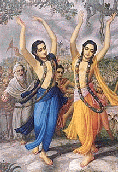
[Reading from Bhagavad-gita 2.62:]
dhyayato visayan pumsah
sangas tesupajayate
sangat sanjayate kamah
kamat krodho'bhijayate
Translation
While contemplating the objects of the senses, a
person develops attachment for them, and from such attachment lust
develops, and from lust anger arises.
Purport
One who is not Krishna conscious is subjected to material desires while
contemplating the objects of senses. The senses require real
engagements, and if they are not engaged in the transcendental loving
service of the Lord, they will certainly seek engagement in the service
of materialism. In the material world, everyone, including Lord Shiva
and Lord Brahma—to say nothing of other demigods in the heavenly
planets—is subjected to the influence of sense objects, and the only
method to get out of this puzzle of material existence is to become
Krishna conscious. Lord Shiva was deep in meditation, but when Parvati
agitated him for sense pleasure, he agreed to the proposal, and as a
result Kartikeya was born. When Haridas Thakur was a young devotee of
the Lord, he was similarly allured by the incarnation of Maya Devi, but
Haridas easily passed the test because of his unalloyed devotion to
Lord Krishna. As illustrated in the above-mentioned verse of Sri
Yamunacharya, a sincere devotee of the Lord shuns all material sense
enjoyment due to his higher taste for spiritual enjoyment in the
association of the Lord. That is the secret of success. One who is not,
therefore, in Krishna consciousness, however powerful he may be in
controlling the senses by artificial repression, is sure ultimately to
fail, for the slightest thought of sense pleasure will agitate him to
gratify his senses.
We have senses, and we have objects of the senses.
Senses means eyes, ears, nose, tongue and touch. Five kinds of senses.
And five kinds of sense objects: With eyes we see form. With ears we
catch sound. With the nose we catch some aroma. With the tongue we
taste, and with the hands we touch. So five senses and five sense
objects, which correspond to five material ingredients—earth, water,
fire, air, ether.
How is it possible to not enjoy sense gratification? We
have senses, and the world is made up of sense objects. So how do we
avoid sense gratification? I have to see, I have to hear. I can't help
but smell things. And to taste things is unavoidable. Touching is
unavoidable. So how do you not become entangled with sense objects?
That is the unique feature of devotional service.
Krishna does not encourage Arjuna or anyone to artificially repress the
senses. Krishna says, "One cannot stop acting even for a moment." (Bhagavad-gita
3.5) "What good can repression do?" (Bhagavad-gita 3.33)
We cannot repress. That will not last. Like a child… children are by
nature mischievous, so what to do? Do we tie them up so they can't
become entangled in our objects? Or make them inactive, stand in the
corner, don't speak, don't move? No. We give them a better engagement.
We engage their senses in positive things. They want to with a crayon
scribble on the wall. We have to give them better engagement with the
crayon—"Make A B C D E F G." Like that. So positive engagement, not
negative repression. Spiritual life is not negative. It is positive.
Not only is it positive; it's transcendental. It's actually above good
and bad or negative and positive. It's transcendental.
What does it mean? It means to understand myself as
living spirit soul, part and parcel of Krishna, the supreme spirit
whole, and to understand that this material world is also Krishna's
energy or property.
Krishna says there are two energies: the superior energy
and the inferior energy. The living entity, the soul, is of the
superior or para (para means superior) prakriti.
Prakriti means material nature. Para-prakriti.
Besides this superior nature, there is another nature, which is
inferior: earth, water, fire, air, ether. Both energies are Krishna's
property. One is conscious (I am conscious), but the material energy is
unconscious, inert, dull matter. All the sense objects are inferior
energy. My body is also inferior energy. So with the instrument of my
body, I can use any object of this world for the service of Krishna.
Just like this apartment. It is nothing but cement and bricks and wood
and other building materials. What is the difference between this
apartment and the apartment upstairs or below? The difference is we are
using it for Krishna.
And so the whole thing becomes spiritual. That is the
principle. Anything we accept and use for the service of Krishna
becomes immediately spiritualised. Everything can be used for Krishna.
Why? Because everything is His property. He is the master of the
material energy, and He is the master of the living entities. When the
living entities act in devotional service, using the things of this
world which are ordinarily considered material or mundane or sense
gratification or maya, as soon as we use the same thing for
Krishna's service, it becomes spiritual. This is the principle of
devotional service.
"Whatever you do," Krishna says, "as work, whatever you
give away in charity, whatever you perform as penance, that should be
done as an offering unto Me. By this principle of work, you will be
freed from sinful reaction, and you will come to Me." (Bhagavad-gita
9.27-28)
In this way, my tongue wants to taste something pleasant, some nice
food. So our principle is to prepare nice prasadam, offer to
Krishna and after Krishna is finished, then we take the remnants. That
is called prasadam. We want to see beautiful things. All
beautiful things can be offered to Krishna, just like this nice altar,
nice flowers. There are so many beautiful cloths, and they can be
offered to Krishna. A man is attracted to a beautiful woman.
Ordinarily, that attraction is maya. That is the greatest maya.
But still, we can apply even that for Krishna. The beautiful woman is
Krishna's servant. Bring the beautiful woman to serve Krishna, and I am
free, I remain pure. I do not become contaminated.
But if we just try to avoid the beautiful woman, or we
try to avoid nice things to eat, or we try to avoid nice music, we will
become frustrated, bored, and at some point, everything will come out.
Like damming up a river. You cannot dam up. It will overflood,
overspill, go around. Somehow it will run down to the ocean. So we
cannot stop the senses from acting. We cannot stop the mind from
thinking. We simply have to know the principle how to think and how to
use everything for the service of Krishna. A person likes to enterprise
and earn, make profit, money, lots of money. No problem. Earn and spend
for Krishna as much as you like, to your heart's content. You can make
profit and spend for Krishna. Arjuna was a warrior. He had the fighting
spirit. Hanuman was a monkey. The fighting spirit also can be applied
for Krishna. If you are inclined to be angry, you can be angry with
those that are demonic and against Krishna. Everything can be used for
Krishna, and that is Krishna consciousness. In this way, we don't
become artificially stuck up in some false meditation or false
renunciation. Everything we accept, and we use for Krishna. That is the
principle of Krishna consciousness. Sometimes pseudo-spiritualists say
we should become inactive and become void, make the mind blank. The
mind cannot be blank. And I cannot be void, because I am a living
being, and living being means action. Life means thinking, feeling,
willing. How can I become void? And we never find Krishna suggesting to
Arjuna or to anyone, "Be void." He never says, "Be void. Be inactive."
He never says. In fact, He says the opposite: "Work for Me. Think of
Me. Become My devotee, bow down to Me. Give your love to Me. Surely you
will come to Me." (Bhagavad-gita 18.65) He never suggests,
"Be zero."
It is a very simple philosophy, and by this one simple
principle, the whole world can be transformed into Vaikuntha. It can be
transformed from matter to spirit. It is possible. At least, we can
transform our apartment, which is our world, generally… our apartment.
It can be transformed. It can be spiritualised. Simply by worshiping
Krishna, it automatically becomes a temple, and all the things of the
household used for Krishna. This is not difficult to do, and we are
doing it every night. It is very pleasing, very enlivening. And simply
by doing this, we advance spiritually more and more. Thank you very
much. Hare Krishna.
Any questions?
HANSA AVATAR DAS: You say we can make profit and
spend for Krishna, right?
HANSADUTTA DAS: Yes.
HANSA AVATAR: What about those people who are
working in the stock exchange, and some of them they just gamble, and
they say, "If I make a profit, I'll spend it on Krishna"? Is that okay?
HANSADUTTA: Yes, [laughing] provided they make it
that far. But generally they lose their money. But strictly speaking,
stock market is gambling, and we don't gamble. But someone who doesn't
know about Krishna and he is in the stock market… naturally [there] no
one knows of Krishna—they're doing all kinds of things which are
forbidden, but if a person happens to be attracted to Krishna and he
spends that money for Krishna, that will purify him and the whole
situation. Gradually, he will give up the gambling and whatever.
The whole principle is as we come nearer to Krishna,
everything becomes purified in our life. Krishna accepts everyone,
"Come on!" Just like a father says to his children, "Come on!" The
children may be filthy dirty. Sometimes they put their hands on him,
but it doesn't matter; [the father says,] "Come on," because he's
teaching the child how to love the parent. This is a father's duty, to
attract his children—"Come on, bring it to me." Krishna says, "Whatever
you do, you just do it for Me. Come on." And gradually, as we become
purified, we realise there are some things we shouldn't do. But it's
not a prerequisite. You just chant Hare Krishna and come to Krishna.
Everyone is imperfect. In this material world, everyone is sinful.
Otherwise, we would not be here. Anyone born in this world is a sinful
person, just as everyone who is incarcerated in prison is a criminal;
otherwise, he wouldn't be there. He must have committed some crime. So
every one of us is sinful. Krishna says, "Never mind. Just come to Me."
And by that coming towards Krishna, we are purified. That is the
principle. Sometimes people say, "Nah… I'm too impure. I can't go to
the temple." No, that's not good. That's like saying, "I'm too sick. I
can't go to the hospital." No, the hospital is meant for sick people.
The process is meant for impure people, which are all people. Some
people say, "No, no, I'm so impure, I can't go there." This is not an
argument.
Everyone, chant Hare Krishna, see Krishna, offer
something to Krishna. Krishna says, "Anything… if you offer Me with
love and devotion, a leaf, a flower, a fruit, a little water, I will
accept it." (Bhagavad-gita 9.26) Suppose you have some
friend who says, "Come with me, and I will introduce you to Lee Kwan
Yew. You just bring a flower for him." Would you go? Yes, of course you
would, because it [would be] a great honour. Simply by being able to
offer him a flower, you would become very prominent. All your friends
you could tell, "I offered him a flower, and he accepted it." "Oh? He
did? Really? How was that?" So Krishna is inviting us, "Just come on.
Offer Me something, even a leaf, a flower, a fruit, anything. You offer
Me." This is devotional service. Krishna says, "Come on. Why are you
avoiding Me? Offer Me something." He wants us. "In that proportion,"
Krishna says, "as one surrenders to Me or offers to Me, I reveal Myself
to him."
Okay, even if you cannot offer a leaf, a flower or a
fruit or a little water, chant Hare Krishna. You cannot chant Hare
Krishna? Why not? Hare Krishna, Hare Krishna, Krishna Krishna, Hare
Hare/ Hare Rama, Hare Rama, Rama Rama, Hare Hare. Everyone can do it.
Just that, and Krishna will respond. Krishna responds. It's not that we
are chanting like some fool in the madhouse talking to ourselves.
Krishna is responding. Otherwise, why are we chanting for years and
years together? Because we feel Krishna is responding. That
transcendental reciprocal relationship with Krishna we want. That we
want. And material things… we do what we have to do, basically, but
actually we want to develop our love for Krishna. We are practicing
love of Krishna. It's not a ritual—chanting. It is not a ritual, just
doing blindly. No, it is actually communicating with Krishna. Krishna
hears us, and He reciprocates. Someone will ask, "I don't feel Krishna
reciprocating." Because we are not attentive. We don't know how to be
attentive. But by practice it will come.
HANSA AVATAR: I believe when I read the Bhagavad-gita
and the Srimad Bhagavatam as knowledge coming from the
spiritual master, but it's very difficult to explain to some of the
people who are not Krishna conscious, who might be Christians and they
say there's no other true book. The Bhagavad-gita we say
that Krishna has spoken 5,000 years ago, but they always ask the
question, "How can you prove it?"
HANSADUTTA: You cannot prove anything.
HANSA AVATAR: We cannot prove to them, and we
cannot explain to them. But they say that their book is the real book
and ours is just a myth.
HANSADUTTA: Okay. Then you say, "That's fine. So
you read your book. We will read our book." Some people cannot be and
should not be bothered to make them understand, because they are so
deeply rooted in their religious doctrines and teachings that they
cannot accommodate anything new or something with which they are not
familiar. And that's okay. If someone is following Jesus, fine. The
only thing you can say is, "But you should follow what he actually
said." Which generally they don't do.
But as far as "How can you prove the book is so many
years old?" Because there is disciplic succession. Just like how do you
know such and such is your grandfather or great-great grandfather? How
do you know? You don't know. But you have received this information
from your father, who has received from his father. It is called guru-parampara,
the chain of disciplic succession. That is the authority. Everything we
learn from higher authority. You want to know who is your mother? How
do you know? You cannot know. You cannot prove it. You can only accept
the words of your father. You want to know who is your father? You have
to accept the authority of your mother. And if you reject that, then
you are in the dark. Then you have no way to know. Everything is known
from higher authority. You read newspapers. Why? Because they are
authority. You go to the university. The professor gives us
instructions. How do you know they are bona fide? Because he's
authority. In every field… if you have a medical problem, you go to the
doctor, because he's authority. If you have a legal problem, you go to
the lawyer, because he's authority. Authority comes. If we want to
understand shastra, or scriptures, the question will be, "How
do you know that this book was spoken by Krishna 5,000 years ago?" The
answer is we have received it through the authority of the guru-parampara.
And there is no other way to know anything. Even like I said, your
father you cannot know. If someone says, "Prove that this man is your
father," you cannot prove it. "My mother says so. That's all,
finished." That's all. That is our position. We are in darkness. So
everything we learn from higher authority. We come out of the womb and
we know nothing. We cannot speak, we cannot eat, we cannot walk. We are
helpless, but we are constantly being trained and educated and
enlightened and guided by higher authority—first parents, then teacher,
then friends, then political leaders, then scientists. There is no end.
So Krishna is saying, "I am the highest authority." When we want to
know the highest truth, we must approach the highest or the most
perfect authority, Krishna.
Krishna is explaining Himself, and in Bhagavatam,
the great acharyas, the mahajanas are giving us
knowledge of Krishna. And they are giving us the method. Not only they
are giving us knowledge of Krishna, but they give us the method whereby
which we can realise the same conclusion. So it is not a blind thing.
Just as the student in the university… when he studies chemistry or
whatever, he gets the knowledge, but he also gets the method whereby
which he can confirm that hydrogen and oxygen combine to produce water.
He does it, and he sees water, and he says, "Oh, okay."
So our process is twofold. Tad viddhi
pranipatena pariprashnena sevaya/ upadekshyanti te jñanam
jñaninas tattva-darshinah. (Bhagavad-gita
4.34)
Darshinah. First of all, we approach the bona fide spiritual
master. We inquire from him submissively. Then we render service. This
inquiry and service… the service will bring us to the confirmation of
the truth. Not that he simply says like this and we accept it, that's
all. No. There is a method. That method is bhakti-yoga, and in
the beginning stage it is called sadhana-bhakti. Sadhana
means practice. As a student in the law school or in the medical
college, he has to practice. He hears the lesson, and then he has to do
some practical work to see how the thing is a fact, to see it confirmed
by following the procedures, the experiment or whatever it is. Our
process is not simply we say it and we accept it and we believe it. No.
We must practice, so that those things which are given to us we
realise, "Oh, it is true." We say, "You're not this body." How do I
know? Krishna says, "Bow down to Me, worship Me, give your love to Me."
And by doing, we realise, we can actually see it. We see it everywhere
around us how people are acting in ignorance, in the bodily concept.
Our process is not exactly what people loosely call
religion. It is not a religion. In Bhagavad-gita, Krishna
consciousness is described as raja-vidya. Vidya means
knowledge, and raja means king. So it is the king of knowledge,
or the highest type of education that one can have. What is it? It is
the education to know myself, to know what is this world, to know what
is God, to know what is my relationship, to know how to reestablish the
relationship. It is not religion where we just believe something, ring
some bells and wave incense and repeat what we heard blindly. No. We
actually realise it. Religion is a worn-out word. It has been worn out,
misused. So people are thinking, "I don't want this religious thing
here." It is not a religion. It is a philosophy. It is a science. It is
an education. Hare Krishna.
Anything else? Does that answer your question? And as
far as… I wanted to add this one thing, because I know you're a very
enthusiastic preacher, and you like to explain to people—and that's
natural, it's very good to do, because by trying to explain to people,
you yourself will realise Krishna consciousness. It takes practice also
to explain and make them understand. And it is based on what you hear.
You see? You hear, and then you repeat. Just like children. They hear,
and they repeat. They hear, and the father says, "Very good." And then
they go to school, they hear, and they repeat. We hear… just like we
are giving a talk. We hear from the spiritual master and his
representative. We hear from Krishna. And then we try to explain it. As
best, as closely as possible, try to repeat what you have heard.
Gradually, you will see, "Oh, if I repeat the words of Krishna, they
are very powerful." If we quote what Krishna has said, if we repeat
what the spiritual master has said, it will be very powerful. And when
we become persistent, experienced, we will learn the art of saying the
things in our own words. But in the beginning, it is good to repeat
what we have heard, because then we can see, "Oh, the result is very
good." And gradually, like when we go to school, we learn to write. We
must do it exactly like the teacher. If not, the teacher will be angry
with us and make us again do it. But later on, when we become
practiced, we develop our own style of hand writing. Something like
that. In the beginning, best to repeat what I have heard, and then
later it will come naturally.
BHIMA: What about scientists using DNA testing to
verify who is the father?
HANSADUTTA: That's humbug. If you don't know,
then you can test every man in the world. It's an absurd proposal.
Isn't it? If no one tells you and you have no idea, then how will you
know? You can test every man on the planet. [Laughs] But if you say,
"Well, it may be… " that means you have accepted some authority.
Someone has suggested, and then you investigate. But you begin with
authority, isn't it? It may be this man or that man. Which one? I don't
know. Test. Okay. But someone has suggested.