What is the Matter with the World?
by A.C. Bhaktivedanta Swami Prabhupada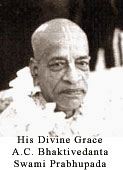
New York Daily News, Tuesday, July 11, 2006 - by MICHAEL GOODWIN - It's WWIII, and U.S. is out of ideas
Last week's headlines prove the point: North Korea fires
missiles, Iran talks of nukes again, Iraq carnage continues, Israel
invades Gaza, England observes one-year anniversary of subway bombing.
And, oh, yes, the feds stop a plot to blow up tunnels under the Hudson
River.
The feeling that the wheels are coming off the world has only one
recent comparison, the time when America's head-butt with communism
sprouted hot spots from Cuba to Vietnam. Yet ultimately the policy of
mutual assured destruction worked because American and Soviet leaders
didn't want their countries hit by nuclear bombs.
Such rational thinking is quaint next to the ravings of North Korean
nut Kim Jong Il and Iranian President Mahmoud Ahmadinejad. They both
seem to be dying to die - and set the world on fire.
And don't forget Osama bin Laden's declaration that it is the duty of
every Muslim to acquire a "Muslim bomb." Is there any doubt he would
use it if he had it?
I sound pessimistic because I am. Even worse than the problems is the
fact that our political system is failing us. Democratic Party leaders
want to pretend we can declare peace and everything will be fine, while
President Bush is out of ideas. Witness Bush now counseling patience
and diplomacy on North Korea. This from a man who scorned both for five
years.
But what choice does he have now that the pillars of his post-9/11
foreign policy are crumbling? As Harvard Professor Joseph Nye argues in
Foreign Affairs magazine, Bush's strategy of "reducing Washington's
reliance on permanent alliances and international institutions,
expanding the traditional right of preemption into a new doctrine of
preventive war and advocating coercive democratization as a solution to
Middle Eastern terrorism" amounted to a bid for a "legacy of
transformation."
On
the 16th of February 1957 a meeting was held at the Bharatiya Vidya
Bhavan to discuss the above subject matter. Distinguished gentlemen
from different categories spoke on the subject, but practically nobody
could give us a definite direction as to what actually the matter was
that was troubling the whole situation.
This feeling of pinching in the existence of our life is a good sign
for progress. It is an urge for enquiry what is the wrong in the world
that gives us trouble? This trouble is not a new thing but it is a
matter of permanent settlement in all the days of life, but it may be
felt at different times in different colour. The troubles are in
varieties in relation with our mind and body, in relation with our
dealings with other living beings and in relation with natural
phenomenons.
The present pinching trouble of our political leaders in the matter of
Kashmir affairs is a trouble in relation with our other friendly
nations. Kashmir is a part of India, not only at present but it is so
from a time immemorial but the Kashmir problem has arisen as a matter
of course because the world is so created that must there exist some
sort of trouble, may be it is in relation with the body or other living
beings or the natural phenomenon.
These troubles are like the forest fire. Fire takes place in the dense
forest without any attempt by any living being. Nobody in the forest do
want such fire, but it takes place without any demand. When there is
fire, the living beings in the forest are put into trouble and
sometimes it so happens that most of the forest creatures die in that
havoc. There is no fire brigade in the forest or on the top of a forest
mountain and there is no hope for of extinguishing the fire by any
human attempt. It takes by the natural laws, and it is extinguished by
natural laws also, that is, when there is torrent of rains in the
forest. That is the natural law and these laws are so rigid and stern
that no human brain, however it may be powerful, can solve these
problems of natural laws.
An intelligent person, who has actually developed some finer qualities
of human consciousness, can understand that every law is made by an
intelligent brain and behind every law there is the lawmaker who makes
the law. So for all these natural laws, there is the Supreme Lawmaker,
who is the Absolute Personality of Godhead. In the Bhagavad-gita
we have, therefore, information that natural laws are so stringent that
they cannot be overcome by anybody. But whoever surrenders unto the
Supreme Lord can overcome them.
The king is the lawmaker and if he likes he can forgive a law-breaker
by special prerogative of the king—by the 'king's mercy,' but the king
can do no wrong even if he sometimes breaks the law. That is, an
experience of a common man in the phenomenal world and the same thing
is applicable in the matter of Supreme laws also.
The natural laws are like police actions by the agents of Godhead. Men,
who are too much captivated by the glamour of material beauty and tries
to enjoy it falsely without acknowledgement of its Creator, are called
demons. The stringent natural laws are meant for the criminals but not
for the law-abiders. Therefore, the perfect answer to the question
"What is the matter with the world?" is that men have become demons by
breaking laws of God, and therefore they are being punished by the
police action of material nature. That is the verdict of all scriptures
and that is our day-to-day life's experience.
In the Bhagavad-gita a vivid description of the
law-breaker demoniac men are given in the 16th chapter and such men are
punished by the laws of God—are also maintained.
Human civilizations are conducted in two ways. One type of civilization
can make every human being as much qualified as God is. And the other
type of civilization can make every man no less than a jungle beast and
thereby making this world unfit for human habitation.
A human being is called a rational animal. When rationality is
destroyed, the human being is left an ordinary animal. The difference
between a human being and an animal is based on the strength of human
being's being above the animal propensities. The animal part of a human
being necessarily require food to eat, shelter to live in, protection
from fear and gratification of senses. These four principles of life
are common both to the man and the animals. But there is another thing
which is specially meant for the human being. This is
God-consciousness. This God-consciousness is conspicuous by absence in
the animal life, while in the human life this God-consciousness is in
dormant stage even in the society of the aborigines. This
God-consciousness develops in different grades of human civilization in
terms of particular place, time and persons. This God-consciousness is
called Religion or Culture of Life without which no civilization can
stand.
The present day civilization is trying to avoid this God-consciousness
of human life by artificial method of material science and forcible
atheism. It is learnt from reliable sources that in an atheistic state,
the village people were called in a meeting and were asked to pray in
the church for daily bread. The innocent villagers prayed in the church
for daily bread, and when the prayer was over the state officers asked
them whether breads were supplied. The village men replied that there
was no bread. The atheist politicians asked them again to pray for
bread from them (the statesmen) and bread was at once supplied. And by
this method the innocent villagers were made victims of propaganda by
atheistic politicians with the result that all the villagers became
gradually faithless in God, because wrongly they accepted that the
bread was supplied by the politicians and not by God.
The poor victims of such propaganda did not understand that the breads
supplied by the politicians were not made by the father of the
politicians but actually they were sent by God. No politician can
manufacture bread without wheat. No wheat is produced without sun rays
or rains from the sky. No rains are possible without obedience to God.
No atheist can live and decry God without eating bread. And therefore
whoever eats bread without acknowledging in gratitude of his
indebtedness to God is certainly a demon and for such demons the
stringent natural laws are meant for punishment. A time is nearing when
there will be no wheat paddy in the field and no politician will be
able to make a quick supply of bread. The food problem is already acute.
The atheistic civilization is to be troubled more and more with the
progress of materialism. We have such foretellings in the pages of Srimad-Bhagavatam
[Go to Description
of the Age of Quarrel]. The more the people are turning to
the atheistic, the more things of disturbing elements do appear before
us. And that is the thing which matters at present. This is a wrong
type of civilization.
A.C. Bhaktivedanta
What is the Matter with the World?/ WORLD SANKIRTAN PARTY ©2004 - Hansadutta das
Home | About | Events | World Sankirtan Party | Inside Nam Hatta
eBooks | Site Map | Store