[Posted
March 28, 2007]
The
Case for Teaching Krishna Consciousness in Schools
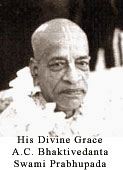
A.C. Bhaktivedanta Swami |
 Let Bhagavad-gita be taught in schools. |
Time magazine (USA edition) - Thu 22 March 2007 - DAVID VAN BIEMA The Case for Teaching The Bible
TOWARD THE BEGINNING OF THE COURT'S string of school-secularization cases, the most eloquent language preserving the neutral study of religion was probably Justice Robert Jackson's concurring opinion in the 1948 case McCollum v. Board of Education: "One can hardly respect the system of education that would leave the student wholly ignorant of the currents of religious thought that move the world society for ... which he is being prepared," Jackson wrote, and warned that putting all references to God off limits would leave public education "in shreds." In the 1963 Schempp decision, the exemption for secular study of Scripture was explicit and in the majority opinion: "Nothing we have said here indicates that such study of the Bible or of religion, when presented objectively as part of a secular program of education, may not be effected consistently with the First Amendment," wrote Justice Tom C. Clark. Justice Arthur Goldberg contributed a helpful distinction between "the teaching of religion" (bad) and "teaching about religion" (good). Citing these and subsequent cases, Marc Stern, general counsel for the American Jewish Congress, says, "It is beyond question that it is possible to teach a course about the Bible that is constitutional." For over a decade, he says, any legal challenges to school Bible courses have focused not on the general principle but on whether the course in question was sufficiently neutral in its approach. go to story
This is the time to learn
|
School
|
Enough School Already—I'm Ready to Learn Something Useful Hansadutta das They are simply teaching the students all of these things except the most important single piece of information, which is to know what I am. If I don't know what I am, then what do I know? Real education means to draw out what is already inside each of us. It comes from the Latin word educere, educe, like reduce, produce, induce, seduce, etc. So to bring out my identity—what am I? What distinguishes me from you? What makes me unique? more |
David Lawrence: [reading from report about
a booklet he is publishing] "...used to be involved heavily with that.
The booklet itself is to be produced in color, black and white by means
of one of the most modern printing systems in the world, and the color
plates should be of very good quality."
You know, I was thinking about the beautiful pictures of the Bhagavad-gita.
[Continues reading:] "It's hoped to market the thirty-page booklets for
about thirty pence. The publisher, Marshall's Educational, is a
long-established publishing house which is Marshall, Morgan &
Scott, specialized in theological and devotional books. They are now
turning their attention to the production of much-needed religious
education books. Financial basis of the series: David Lawrence has
undertaken the commission with the agreement that they must be produced
as cheaply as possible. The author receives no expenses and is
receiving payment on the lowest rate of royalty only."So it means I've
just about covered my expenses.
"The purpose of the series of booklets: to offer the opportunity for
students to see the spiritual way as relevant today, 2.) to show how
God loves and how we should respond with devotion, 3.) to produce a
booklet so cheaply that it will easily be available in schools and to
any other interested inquirers, to the latter by means of national
outlets such as W.H. Smith." [Speaking of W.H. Smith:] They're an
enormous chain of booksellers throughout the country. "4.) to allow
each movement to speak for itself so that at every point the
representatives will feel that they themselves are behind the booklet.
This will give the youngsters full opportunity to make up their own
minds as to the bona fide nature or not of a devotional organization."
Your specific booklet: "An essential part of the Krishna consciousness
booklet and a revolutionary concept in religious education publishing
will be the production of the teacher's pack. The aims of producing
this pack are 1.) to arm the normally conservative R.E. teacher with
such a battery of audio-visual aids that he will feel fully dressed to
embark upon a series of lessons on Krishna consciousness, 2.) to give
the teacher..." [interruption due to people coming in and out of room]
Prabhupada: Yes, go on.
David Lawrence: "2.) to give
the teacher all the information he or she may need to find out more
than the booklet can include, for example, to satisfy the really
interested inquirer, 3.) by a total sense experience, the cultural gap,
which may unnecessarily alienate the students and therefore hamper a
worthwhile consideration of the movement, 4.) by offering a wide
variety of approaches, the student will not feel that he is simply
studying another textbook, 5.) a booklet on Krishna consciousness
without the Hare Krishna maha-mantra in a living form would be
an absurdity, so the contents of the teacher's pack: A.) the forty-five
r.p.m. record of the Hare Krishna maha-mantra, B.) a glossy
poster of Arjuna and Krishna, C.) a map of the devotional centers of
Krishna, D.) a list of additional films, filmstrips and records likely
to help the student, both from the center and from elsewhere, E.)
sample literature from the organization, e.g. Back to Godhead,
F.) a pack of Spiritual Sky incense, G.) a filmstrip,"—the enclosure of
the filmstrip depends on the costing; R.E. departments are always very
poor in this country—"H.) recipes and notes on the meaning of arati,
I.) several sheets of objections to Krishna consciousness and the
rebuttals of these objections, J.) suggestions for the teaching of the
subject."
Then I've gone on to say a little bit about the structure of the
booklet. "Hopefully, the first section would establish the claims of
the relevance of the spiritual life in 1973, and then the claims of
Krishna consciousness to be the true pathway to the eternal. This we
would like to do by means of holding up a respected example of somebody
who is already walking the path, e.g. an ideal way would be by the
examination of the beliefs of George Harrison, and more especially of
those expounded on living in the material world."
Then go on to the history of the movement: "Lord Chaitanya, Sri
Sarasvati,..." Apologies for the way I pronounce the names. "Sri
Prabhupada's commission to the western world, the growth of ISKCON, the
establishment of the London center," you know, to bring it locally, if
you like, then on to "a typical devotee, his day..." This, I've said,
will help to personalize the whole idea, you know. They can relate to
the person concerned with this.
Then "a section on the sacred scriptures of the Vedas, a
background, and then quotations of frequently used texts. Then onto the
beliefs of the devotees, based mainly upon the eight principles of
ISKCON, and the Introduction of the Bhagavad-gita As It Is."
Our hopes are to, you know, work very hard from that section because
it's, that introduction has got everything. I've been working on it a
week, and I think, uh, I've gone back over...
Prabhupada: The Bhagavad-gita?
David Lawrence: Oh, yes. I've
gone back over it about forty times now already. So I think I'm
beginning to get hold of it. And then there would be lastly a reference
section which would include all addresses that they would find useful,
a glossary of the terms used, and an index, etc.
Prabhupada: Very good. This...
David Lawrence: That...
Prabhupada: ...synopsis is
very nice.
David Lawrence: You like the
idea, do you?
Prabhupada: Oh yes, very nice.
David Lawrence: The thing
that I felt strongly about really was the teacher's pack. You see, in
this country, being an R.E. teacher of long standing, there is so
little that really communicates an experience, and I think the
teacher's pack can help, through the senses, for these young people to
experience something, you know, so that, perhaps, if they feel
alienated...
Prabhupada: We have, we have
got a verse in Srimad-Bhagavatam:
kaumara acharet prajño
dharman bhagavatan iha
durlabham manusham janma
tad apy adhruvam arthadam [Srimad-Bhagavatam 7.6.1]
From
the very childhood, kaumara... Kaumara is the age from five to
fourteen years, or fifteen years. This is kaumara age.
David Lawrence: Yes.
Prabhupada: So Prahlada
Maharaja, he was a devotee when he was only five years old. And his
father was atheist number one. So there was a great misunderstanding
between the father and the son. The father was insisting the son that
"You give up this line of Krishna consciousness. You become politician.
You have to control over the kingdom and so on, so on..." But he could
not give up. This is the misunderstanding between the father and the...
So at, at the age of five years only, he was preaching. But how he was
preaching? He was preaching... Because the father instructed the
teachers, "Just look over this boy that he may not take to Krishna
consciousness. Strictly. That is my order." So teachers were not
allowing him. But he was taking opportunity in their tiffin hour.
Recess. When the teachers are gone and students are free to move. So he
was calling his class friends and other, and he was preaching Krishna
consciousness.
Syamasundar: Tiffin hour?
Prabhupada: So... We call
"tiffin hour" in India. Because we, we take some tiffin in the school,
and we eat during that...
David Lawrence: Hm hm.
Prabhupada: So he was
preaching that kaumara achare... The other boys, they were
insisting, "Prahlada, why you are so much anxious about preaching
Krishna consciousness? Let us play. It is our time to play." So "No,
no." He said, "No, no. This is the time to learn Krishna
consciousness." Because you are teaching, therefore
...
David Lawrence: Yes.
Prabhupada: ...I am relating.
"That kaumara age, from five years to fifteen years, that is
the right age for educating Krishna consciousness." This is the word
of... kaumara acharet prajño dharman bhagavatan iha,
durlabham manusham janma [SB 7.6.1]. He says that "This human
form of body is very rarely gotten, and it is a rare opportunity for
awakening our Krishna consciousness."
Krishna consciousness, or God consciousness, is there in every human
being, especially in civilized... So it is not an artificial thing.
Just like my, all my students, they are Europeans, Americans. Four or
five years ago, they did not know anything about Krishna, neither they
knew the name of Krishna. But now you can see how they're absorbed in
Krishna consciousness. So it is not an artificial thing.
David Lawrence: No.
Prabhupada: If it had it been
artificial, they would not have been so serious, but it is a dormant
consciousness. I have simply awakened. I have awakened. Otherwise...
That is the statement in Chaitanya-charitamrita that
everyone is Krishna conscious; some way or other, it is now snuffed
out, they have forgotten. But if an opportunity is given, then it can
be awakened. So this movement is giving opportunity to arouse that
dormant Krishna consciousness which is already there in everyone. So if
you take that process and allow this Krishna consciousness among the
students, oh, it will be great service to the humanity. As a teacher,
you will give the greatest service.
David Lawrence: Yes, I agree.
Prabhupada: Kaumara
acharet prajño dharman bhagavatan iha [SB 7.6.1]. And
this is the only opportunity of awakening our Krishna consciousness. So
if we do not give that opportunity to the human beings from the
childhood, it is a jealous... Jealousy means that you have got some
opportunity, but if I do not allow you to take that opportunity, this
is called jealous. So every human being has got the potency of
awakening his God consciousness, or Krishna consciousness, in this
human form of body. So if we do not give that opportunity, it is
jealousy. Therefore students must be educated, and if you're writing
such nice book, I think you will get, give a great service to your
nation and to the human society in England.
Because durlabham manusham janma, this human form of life...
Unfortunately, people do not understand what is the distinction between
this human form of life and animal form of life. That is another...
David Lawrence: They offer
nothing, is it, in the material world.
Prabhupada: So you give...
Yes. That is the... The only difference is that in human form of life
you can awaken your Krishna consciousness. In the animal form... Here
we are sitting with all human form of life, gentlemen, civilized men. I
cannot call cats and dogs and sit here, and to understand what is
Krishna consciousness. That is not possible. Therefore this opportunity
should be given. This opportunity should be given.
And especially, you are English nation, recognized, great nation,
respectful, you are respected... Especially in India, we have got very
good respect for English nation. We had connection for so many years.
And the politicians, they spoiled. Otherwise, we liked the British
Empire. Means unity of the human beings all over the world. That can be
revived again. That can be revived again. If you come to this Krishna
consciousness movement, your Queen comes to that,... There is process.
There is process. You can revive your British Empire. It is not story.
If you people take little advice from me, I can help you. Yes. You are
intelligent nation. So kindly do this service to the students and
awaken their dormant Krishna consciousness. It will be a great service.
And we are meant for helping you all. So you can inquire. You are at
liberty to come at any time and inquire.
David Lawrence: You give an
audience.
Prabhupada: You question.
David Lawrence: We're working
predominantly with the older age group, of course. And, uh... Fourteen,
fifteen [year olds].
Platform of common sense
Prabhupada: But first thing is, our Krishna
consciousness movement is based directly on the instruction of Krishna.
Our Krishna consciousness movement is nothing but to accept Krishna's
instruction as it is. That is the...
David Lawrence: Yes.
Prabhupada: So Krishna's
instruction is there. It is open to everyone. It is not only open to
us. Everyone. Bhagavad-gita. It is widely-read literature
in the world. But unfortunately, they have been misinterpreted.
David Lawrence: It was very
interesting to read one of the very western versions, that of Professor
Zeiner of Oxford. And on one or two points of contention between
yourself and other translators of the
Bhagavad-gita, in fact, he, nearly always, went with you. Now,
he's reckoned to be one of the foremost western Sanskrit scholars. And
he every time emphasized the devotional tone of your translation.
Nearly every time. I was very impressed by that.
Syamasundar: We talked with
Professor Zeiner, and he may come. He's trying... He's going to see...
Prabhupada: That is only
interpretation. Krishna and Arjuna. Krishna is speaking to Arjuna. He
is plainly speaking that "I am speaking to you this Bhagavad-gita
because You are My devotee." Bhakto 'si priyo 'si me rahasyam hy
etad uttamam [Bg. 4.3]. So first condition to understand Bhagavad-gita
is to become a devotee of Krishna. So in the Bhagavad-gita,
the only talk is about devotion. There is no other talk. There are
other talks, but they are subordinate. They are not principal talks.
The principal talk is to understand Krishna through bhakti-yoga.
Bhaktya mam abhijanati yavan yash chasmi tattvatah [Bg.
18.55]. You understand Sanskrit? You...?
David Lawrence: Yes, yes, I'm
there.
Prabhupada: So if He says,
"One can understand Me only through bhakti,"... He has spoken
about jñana, karma, yoga, everything, but if anyone
wants to know Krishna, then He says, it is His direct order, bhaktya
mam abhijanati yavan yash chasmi tattvatah [Bg. 18.55]. Tattvatah,
"In truth, what I am, if anyone wants to know, that can be known
through bhakti-yoga. No other method."
David Lawrence: I was very
interested this last week to be reading a book which really was trying
to defend orthodox Christianity, and it was by a very devotional
Christian writer, and he, in fact, was making exactly the same points
as yourself about the God consciousness of Jesus. I read the
Ratha-yatra magazine, and saw how, I think it was a nun that asked you
about the position of Jesus on this, and you quite rightly said, "Well,
of course, Jesus never claimed to be God." I do wish that some
Christians would realize that. He was God conscious, wasn't he?
Prabhupada: Yes.
David Lawrence: The churches
in this land seem to have forgotten that. He never claimed to be God.
Prabhupada: No, how he could
claim? He's a devotee of God, he's servant of God. How he can claim? Of
course, there is no difference between God and His servant. Yes. That
we say. Sakshad-dharitvena samasta-shastrair uktas tatha
bhavyata... [1].
Because
a devotee, like Lord Jesus Christ, means confidential servant of God,
there is no difference between God and himself. Just like any political
representative or business representative, he's, if he's a confidential
representative, there is no difference between the king or the
proprietor of the firm, so long he represents rightly. Similarly,
anyone who represents God or the cause of God, he's not different from
God. We should offer respect to such person exactly like God. That is
our instruction of the acaryas. Sakshad-dharitvena
samasta-shastrair uktah.... In every shastra [scripture] the spiritual master is recognized
as personally the Supreme Lord. Why he is recognized? Kintu
prabhor yah priya eva tasya. Because he's the most dear servant
of the Lord. And that is natural. Suppose some representative of some
firm comes, and if I know that he is the most confidential
representative, I must respect him very nicely so that he may be
impressed and he may report, "These people are very nice." [laughter]
Oh. So this is the ordinary etiquette, what to speak of the actual
representative of God. Sakshad-dharitvena samasta-shastrair
uktah.... Uktah means "it is already said." Tatha
bhavyata eva sadbhih. Those who are advanced in devotional
service, they accept this principle. But why? Kintu prabhor yah
priya eva tasya. Because he is the most confidential servant,
representative. Vande guroh sri-charanaravindam. This is,
we pray, offer our prayers to our spiritual master.
So it is very nice. You are attempting. I am very glad. So you can
inquire from me anything. The first thing I shall request you, the
first principle of Krishna consciousness, or the first ABCD of
spiritual education, is to understand the constitutional position of
the living entity. He is, he is spirit soul. He's not this body. The
spirit soul is living within this body, but the, the body's not the
spirit soul. This thing must be understood very clearly. You know, in
the Bhagavad-gita, it is said, dehino 'smin yatha
dehe [Bg. 2.13]. Dehinah, the proprietor of the body, is
within this body. Dehinah asmin dehe yatha. And the body
is changing, from childhood to boyhood, boyhood to youthhood, like
that. So when this body will be useless, we will take another body. Tatha
dehantara-praptih. This first education of spiritual life should
be understood first. Then one can make progress. Then one can
understand what is the constitution of God, what is our relationship
with Him. But if, so long we shall remain under the bodily concept of
life, this subject matter will remain difficult.
David Lawrence: Hm. There's
one matter that I'd love to ask you about which is I found personally
difficulty because perhaps I haven't had the Bhagavad-gita As It
Is as long as I should have done, is to really feel that I've
got to grips with the idea of the spiritual sky. I couldn't quite
understand there was any form, any form at all of symbolism coming into
the idea of the various stages of planets and so on, or whether, in
fact, this was a very physical...
Prabhupada: [Aside, to
disciple:] Bring Bhagavad-gita.
Syamasundar: Here.
Prabhupada: Find out this
verse: paras tasmat tu bhavo 'nyo... [Bg. 8.20]. Why not
call Pandit Mahashaya (Pradyumna)?
David Lawrence: Paras
tasmat...?
Prabhupada: [Again requesting
the disciples to call Pradyumna:] Pandit Mahashaya.
Srutakirti: [Speaking to
someone else:] Can you get Pradyumna?
Prabhupada: Yes. We have got
nice index in this book.
David Lawrence: Yes, indeed.
Prabhupada: You can find out
any verse. Parah tasmat tu bhavah anyah avyaktah avyaktat
sanatanah.
Srutakirti: [Looks up text,
reads:]
paras tasmat tu bhavo 'nyo
'vyakto 'vyaktat sanatanah
yah sa sarveshu bhuteshu
nashyatsu na vinashyati [Bg. 8.20]
Prabhupada: Translation?
Srutakirti: "Yet there is
another nature which is eternal and is transcendental to this
manifested and unmanifested matter. It is supreme and is never
annihilated. When all in this world is annihilated, that part remains
as it is."
Prabhupada: So that is
spiritual world. This material world is created. The spiritual world is
not created; it is eternal.
David Lawrence: Yes.
Prabhupada: So we have given
an idea of the picture.
Hansadutta: He's [Pradyumna]
coming.
Prabhupada: So there is
another nature, which is called spiritual nature. Paras tasmat
tu bhavah anyah [Bg. 8.20]. Parah. That is also admitted
by all the acharyas. Just like Shankaracharya... You have heard
the name of Shankaracharya?
David Lawrence: Hm-hm.
Prabhupada: He also says, narayanah
parah avyaktat. Narayanah parah. So there is parah.
Parah means superior. Narayana belongs to that superior nature.
That means spiritual nature. Yes.
David Lawrence: This is a
knowing habit of the western mind, you know, to think in spatial terms,
and it's possibly hang-ups from Christian theology, in a sense, that I
wanted to persist with this questioning even further about, you know,
the real nature, as far as the Bhagavad-gita gives it to
us.
Prabhupada: No, you have to
become little free from the biased ideas of Christian philosophy.
David Lawrence: This is what
I thought, yes. This is what I thought.
Prabhupada: Otherwise you
cannot make progress.
David Lawrence: Yes, yes.
Prabhupada: Otherwise it is
impossible.
David Lawrence: Yes. It's
humility...
Prabhupada: You have to come
to the platform of general, common sense.
David Lawrence: Yes.
Prabhupada: If you become
biased, then it will be impossible.
David Lawrence: Yes.
Prabhupada: Yes. Then you
cannot make progress. You have to come to the platform... Now, the
common sense is that can you distinguish between matter and spirit? Can
you distinguish?
David Lawrence: In what, in
what respect?
Prabhupada: That I was
speaking, that the distinction between matter and spirit: the spirit is
the vital force...
David Lawrence: Yes.
Prabhupada: ...or you call
spirit soul or atma. That you can distinguish. As soon as the
vital force is off from this body, this body is a lump of matter.
Therefore even if you do not know the spirit soul, any sane man can
guess that something is missing in this body. Therefore this body is
called dead. Now, that something is described definitely, is soul. So
we can distinguish between the spirit and body, some way or other. So
as there is material world, there must be some spiritual world.
Otherwise how the spirit is there? The spirit is there, the soul is
there. That is spiritual. So two things we are experiencing: spirit and
matter. So as we are experiencing this material world, so similarly
there must be a spiritual world. There must be a spiritual world.
Otherwise wherefrom the spirit comes?
David Lawrence: Yes, yes.
Prabhupada: Now, this spirit
is eternal. That is the first understanding. Tatha
dehantara-praptih [Bg. 2.13]. This spirit is occupying a
material body at the present moment. And the next, when this... Just
like I am in this apartment. If I find some inconvenience, I go to
another apartment. Or the lease is expired, I have to leave it. Some
way or other, I change. Similarly... You can change your coat. So these
are explained in the Bhagavad-gita. Vasamsi
jirnani yatha vihaya [Bg. 2.22]. Very nicely exemplified. So we
are changing this apartment or dress and accepting another. This is
going on. This is the material world. But I, the spirit soul, eternal. Nityah
shashvato 'yam purano na hanyate hanyamane sharire [Bg. 2.20].
Find out this verse.
Na jayate mriyate va kadachit. Na jayate mriyate va kadachit.
Second Chapter.
Everything is there in the Bhagavad-gita. If you can
introduce, study some Bhagavad-gita among the students,
oh, it will, it will be a great service.
David Lawrence: I think it
would be a great deal more popular than studies of the Bible.
Prabhupada: Yes.
David Lawrence: Because there
isn't the [indistinct]
Prabhupada: No, there is
psychology. There is philosophy.
David Lawrence: Yes, indeed.
Prabhupada: Everything is
there. And religion without philosophy is sentiment. And philosophy
without religion is mental speculation. Two things must be combined.
David Lawrence: Yes, yes.
Prabhupada: That is Bhagavad-gita.
Yes.
Srutakirti: "For the soul
there is never birth or death"?
Prabhupada: Hm? First of all
find out the verse.
Srutakirti: Na
jayate...
Prabhupada: Read it. Read it.
Srutakirti: Na jayate
mriyate va kadachin.
Prabhupada: [Refers to
Pradyumna:] Let him.
Pradyumna: [Reads:]
na jayate mriyate va kadachin
nayam bhutva bhavita va na bhuyah
ajo nityah shashvato 'yam purano
na hanyate hanyamane sharire [Bg. 2.20]
Prabhupada: Yes. Now read the meaning,
translation.
Pradyumna: "For the soul
there is never birth nor death..."
Prabhupada: This, this is the
nature of the soul.
Pradyumna: "Nor having once
been, does he ever cease to be. He is unborn, eternal, ever-existing,
undying and primeval. He is not slain when the body is slain."
Prabhupada: This thing first
of all must be understood, immortality of the soul, transmigration of
the soul. Then other things will be easier. And because this is
eternal, therefore there is another spiritual world which is also the
same nature, eternal. That is explained. What is that verse? Find out. Paras
tasmat tu bhavo 'nyo... sarveshu nashyatsu na vinashyati [Bg.
8.20]. The spiritual world existing eternally. This material world
being annihilated, dissolved, that is not dissolved. Exactly like this
body being annihilated, the soul is not annihilated. Similarly, the
material world, it is bhutva bhutva praliyate [Bg. 8.19].
It takes place at a certain date, and it is annihilated at a certain...
Exactly like this body. Anything material. It has got a date of
creation, and it has got a date of annihilation. But as the spirit soul
is not annihilated even after the annihilation of the body, similarly
there is another spiritual world which is never annihilated even after
annihilation of this material world. Hm. What is that?
Pradyumna: [Reads:]
paras tasmat tu bhavo 'nyo
'vyakto 'vyaktat sanatanah
yah sa sarveshu bhuteshu
nashyatsu na vinashyati [Bg. 8.20]
Prabhupada: Hm. Sarveshu bhuteshu
nashyatsu na vinashyati. What is the meaning?
Pradyumna: "Yet there is
another nature which is eternal and is transcendental to this
manifested and unmanifested matter. It is supreme and is never
annihilated. When all in this world is annihilated, that part remains
as it is."
Prabhupada: This matter which
you are seeing, this is manifested. But there is material stock,
unmanifested. A stock of water, stock of fire, stock of earth. Layer.
This universe is covered by different layers, and each layer is ten
times bigger than the other layers. That is unmanifested. That is
unmanifested. Therefore
vyakto 'vyaktat. This, what we see, this is manifested, but the
stock... Just like from the stock of your, I mean to say, stone and
lime and cement and brick, you make a skyscraper building, manifested.
But the stock is also there. Stock is also there. Similarly this
manifested material world is there. It is taken from the stock. The
stock is, a huge stock there is. We get information. Layer, the
universe. And penetrating all these layers, we have to go to the
spiritual world.
David Lawrence: Yes.
Prabhupada: In the Bhagavata
there is that Krishna took Arjuna, His friend, penetrating the layers
to the spiritual world. He, He took him. You have read that in the
Krishna Book? There is... You have read?
David Lawrence: Yes.
Prabhupada: He could take. So
Arjuna was fortunate to go in this body, to go to the spiritual world
and see it and come back again.
David Lawrence: One other
thing that interested me was the idea that Arjuna was in some way ...
Prabhupada: Friend.
David Lawrence:
...deliberately, if you like, deliberately misguided, planned almost to
be misguided in the Bhagavad-gita. How, how is this work,
like...?
Prabhupada: If he does not
be... He was purposefully misguided so that he could put question like
a misguided man...
David Lawrence: Yes.
Prabhupada: ...and the right
answer may come from Krishna. It is for our benefit. He's not misguided.
David Lawrence: No.
Prabhupada: But he played the
part of misguided.
David Lawrence: Yes. What we
would say and...
Prabhupada: Yes. Just like a
person is playing in the stage as a fool, but he may be very educated
man. So... But for the dramatic expression of talks, he might play as a
fool. Similarly Arjuna's position is... How...? He cannot be misguided;
he's personal friend of Krishna.
David Lawrence: Yes.
Prabhupada: He cannot be
misguided.
David Lawrence: But it was
for our benefit.
Prabhupada: But... And nobody
can talk with Krishna also. Nobody is so qualified. So somebody who
would talk with Krishna who must be very qualified, but he's playing
the part of a befooled man. Otherwise, he's not misguided. He knows
everything. Yes.
Not a question of East and West
David Lawrence: One other point, and again
a practical point really, this one. This is about the nature of the
book. I suggested early on that I hoped that I might get the
cooperation of somebody like George Harrison. What would you think
about this? Do you think, with your knowledge of the young mind,
particularly the young western mind, that this might be a good means
through to the young people...?
Prabhupada: It is not the
question of western mind, eastern mind. Any sincere student will take
to.
David Lawrence: No, I was
thinking in terms of the western mind with its culture, more than of
philosophy.
Prabhupada: Hm. Western
mind... I, I do not find any difference between western mind and
eastern mind. Because so many western mind is changed. Yes. So there
was no difficulty. Two, two plus two equal to four is to be understood
by the western mind and the eastern mind. You cannot say, because you
are western mind, you'll say, "No, two plus two equal to five." You
cannot say that. So there may be some influence of the culture, but
that is superficial. When you speak the real truth, science, that is
equally applicable to the western mind and eastern mind. There is no
difference. If you speak the real truth... Two plus two equal to four,
mathematical calculation, nobody will deny, either western mind or
eastern mind. Yes. So he must be reasonable. That's all.
David Lawrence: Yes. That's
it.
Prabhupada: So we expect
every human being, rational... Eastern, western, there is no difference.
David Lawrence: As you see
from my plans, really what we hoped to do was to, if there was any
cultural difference, to some extent eliminate that cultural difference.
Prabhupada: Then the first
thing is therefore you have to understand that "I am not this body."
The cultural difference is on account of this bodily conception of life.
David Lawrence: Yes. Yes.
Prabhupada: But if we
transcend the position of our bodily concept of life, we come to the
spiritual platform. So there is no difference.
David Lawrence: The
difference is irrelevant then.
Prabhupada: No. There is no
difference. Just like we are talking. You have got a coat. I have no
coat. That does not make any difference. We are talking as gentlemen.
That's all. The last time when I was in Calcutta I was invited by the
Indo-American Cultural Society, and they gave me the subject matter:
"East and West." So I talked, "We don't find any such distinction,
'East and West,' when we come to the spiritual platform. This is all
material platform."
David Lawrence: We find when
we're teaching, you know, really secular youngsters that it's terribly
difficult to get off this cultural veneer, you know.
Prabhupada: Therefore one has
to understand first that "I am not this body."
David Lawrence: That's it.
And you've got to believe... The teacher... This is the big thing,
isn't it? The teacher has got to be God conscious.
Prabhupada: Yes.
David Lawrence: So he
believes that there is the God conscious experience.
Prabhupada: He must realize
that he's not this body. He is different from body. "But I am encaged
now in this body under certain condition." So at least this... This is
called jñana. Jñana. So long one is in the bodily
concept of life, he is affected with so many things. So many things. So
this bhakti-yoga begins when one is purified from the bodily
concept of life. Sarvopadhi-vinirmuktam tat-paratvena nirmalam
[Chaitanya-charitamrita Madhya 19.170]. Now, these boys,
they are coming from different nations. But they never think that one
is Englishman, another is American, another is Indian, another is
African. No, we don't think like that.
David Lawrence: No.
Prabhupada: At least, we have
surpassed that stage. If we have not advanced in any other way,
[laughter] at least we have advanced in this respect. We don't consider
on the bodily concept of life. What do you think?
Syamasundar: Yes.
Prabhupada: That is our
qualification. Yes.
David Lawrence:
Unfortunately, as we find, the youngsters that, certainly that I teach,
have got such materialistic views of their...
Prabhupada: If you keep the
students as English boys or American boys, then it will be difficult.
Then the cultural question will come up.
David Lawrence: Yes, yes. We
try to bring in as much... In fact, now we have a new course... This is
the sort of thing that's happening. [Break] ...the Jewish-Christian
scriptures which do not, you know, just don't lend themselves in any
way to the right sort of feelings being created and the right sort of
experience being created. We found that this year's course—it's the
first year—has been tremendously helpful. We brought the boys up to the
London temple, and...
Prabhupada: Here?
David Lawrence: Yes. Well,
no, in the Bury Place. And they were thrilled to bits. We had one or
two who made the usual silly comments, you know, which you'd expect.
But they were embarrassed, you know. Everything that came over, which
was interesting, was that they found that all the devotees were very
kind, very loving and very sincere. This, this came from even really
the most secular of boys with a very, very low intelligence. He could
see and perceive and understand that this was how it was.
Prabhupada: That is our
general certificate, everywhere. Even the Americans, they are
surprised. They inquire, "Are you Americans?" [laughter]
David Lawrence: Yes.
Prabhupada: The, the priest
also, he's surprised, that "They are our boys. They did not come to
church, never cared for religion. And now they are after God, mad after
God. What is this?" They are surprised.
David Lawrence: Well, I think
a lot of our boys could understand it, having been to a service, you
know, attended arati, and they...
Prabhupada: So that is, that
is due to our strict following the principles. That is making them
stout and strong in spiritual platform.
David Lawrence: Yes. This is
surely it, that so much, so many other movements, as such, and
sectarian groups have compromised so much, haven't they? They, they...
If one goes past the average English church which is these boys'
experience of religion, they pass the biggest cars in the neighborhood
on a Sunday morning. This is, this is what they see. And, of course,
when they came to the temple, they found people living out a lifestyle,
which, even though was so totally alien from their own, they could feel
that it was worthwhile.
Prabhupada: Yes.
David Lawrence: It was
tremendous. In fact, one boy we found listening to the George Harrison
record. You can tell George this if you like. He was listening to the
record quietly in the music room that we have at our school with the
big speakers, you know. Lots of noise. And he was reading these words.
And he put the words down. And I was watching him...
Prabhupada: "I am in material
world."
David Lawrence: Yes. "Living
in the material world."
Prabhupada: That is a very
nice song.
David Lawrence: And he sat
there, and he was praying. And I didn't interfere. And he came out of
the room after having turned the record player off. I said, "Well, you
know, what were you doing in there?" And he said, "This, this record
has been a complete experience to me." And that, if George could know
that... It was tremendous, really tremendous to see this happening.
George's record is so devotional, you know. It's really beautiful.
Prabhupada: I talked with him
about this material world in his house... When?
Syamasundar: Oh, it was last
August, I think. Or July.
Prabhupada: Last... I went to
his house at Henley on the Thames. He's a nice boy, very nice boy. His
wife is also very nice. Patty?
David Lawrence: Patty, yes.
Prabhupada: She's also
devotee.
David Lawrence: Pass that on,
please, to George. He should be very excited, I think, about that. This
is very good. I'd like to thank you very much for giving of your time.
Prabhupada: You are welcome
because you are sincere student searching after... I am prepared to
help you any time.
David Lawrence: I do hope
that anything I produce will...
Prabhupada: Yes.
David Lawrence: ..., you
know, very adequately represent the movement.
Guardians are responsible
Prabhupada: Your, these students, they'll
be benefited if you...
David Lawrence: I think so.
Prabhupada: They will
benefit. Yes, actually.
David Lawrence: I hope so.
Prabhupada: And it is the
duty of the guardians to see that the children are actually spiritually
benefited. There is a verse... Pita na sa syat gurur na sa syat.
You have got Bhagavata?
Pradyumna: It's upstairs.
Prabhupada: Bhagavata?
Find out that. Fifth Canto, Fifth Chapter. How it is instructed. If you
introduce these literatures in the schools for study—because you are
religious teacher-oh, it will play...
David Lawrence: I think so.
And, you know, we hope to...
Prabhupada: ...revolution in
the spiritual ideas.
David Lawrence: We hope to
produce it so cheaply that schools will buy it readily. You know.
Almost be, well, you know, not free, but handed out...
Prabhupada: No, we can give
you paperback, cheap edition.
David Lawrence: Yes.
Prabhupada: Yes. We can... If
you... We can... A very cheap edition. Or we'll print here, cheap.
David Lawrence: The Krishna
Books? Krishna Books?
Prabhupada: Yes.
David Lawrence: I have an
order that I have to get to on those...
Prabhupada: Krishna Books?
David Lawrence: Yes. Some of
my boys saw my copy, and they were reading it and er...
Syamasundar: How old are they?
David Lawrence: These are
fourteen-year-olds, these ones.
Syamasundar: Fourteen.
David Lawrence: And I've got
an order for Back to Godhead and... besides this.
Prabhupada: Hm. And here is a
verse, the guidance to the guardians: pita na sa syat...
What is? Gurur na sa syat.
Pradyumna: [Flipping pages]
Is it, is that in Fifth Canto?
Prabhupada: Yes, Fifth Canto,
Fifth Chapter. Na mochayed yah samupeta-mrityum.
Pradyumna: [Reads:]
gurur na sa syat sva-jano na sa syat
pita na sa syaj janani na sa syat
daivam na tat syan na patish cha sa syan
na mochayed yah samupeta-mrityum
Prabhupada: Samupeta-mrityum. So
the idea is one should not become spiritual master. Gurur na sa
syat. Then?
Pradyumna: Sva-jano na
sa syat.
Prabhupada: One should not
become his kinsman. This is negative side, going on. One should not
become a spiritual master, one should not pose himself as kinsman... Gurur
na sa syat sva-jano na sa syat. Then?
Pradyumna: Pita na sa
syat.
Prabhupada: One should not
become a father. And pita na sa syat, janani na sa syat.
One should not claim to become mother. Then?
Pradyumna: Daivam na
tat syan.
Prabhupada: One should not...
Because somebody worships some forms of God. So that gods should also
not be worshiped. Then? Go on.
Pradyumna: Na pitash
cha sa syan.
Prabhupada: Na pita?
Pradyumna: Oh... na
patish cha sa syan.
Prabhupada: Ah, na patih.
And one should not become husband also. Because husband is supposed to
be instructor to the wife. Husband is the guardian of the wife. So he's
responsible for her spiritual advancement. As much as the father is
responsible for the spiritual advancement of his child, the spiritual
master is responsible... Anyone who is claiming to be superior, he
should be responsible for the inferior's spiritual advancement of life.
So the conclusion is that they should not claim to become such and such
unless they are able to save the subordinate from the imminent danger
of death. Because death is there so long one is not spiritually
advanced. As soon as one is spiritually advanced, he goes to the
spiritual world, transferred. Mad-yajino 'pi yanti mam
[Bg. 9.25]. Spiritually advancement means to be transferred to the
spiritual world. So this is the main business of the father, of the
husband, of the spiritual master, of the king, of the guardian, of
kinsmen. Everyone should be alert: "Whether I am helping my subordinate
in the spiritual advancement of life." Because that will save him from
the repetition of birth and death. And otherwise, what benefit you can
do? If he's under the laws of karma, if he's going to become a
cat or dog in next life, what help you have given to him? If he's under
the laws of karma, then your help is no use. Your help is no
use.
David Lawrence: It's a
tremendous responsibility.
Prabhupada: Yes. Tremendous
responsibility. So everyone should be responsible to save his
subordinate from the laws of karma. So laws of karma
can be broken. Karmani nirdahati cha bhakti-bhajam [Brahma-samhita
5.54]. One who has taken to Krishna consciousness, bhakti,
devotion, bhakti-yoga, he's no longer under the laws of karma.
And that is also... Take Bhagavad-gita.
mam cha yo 'vyabhicharena
bhakti-yogena sevate
sa gunan samatityaitan
brahma-bhuyaya kalpate [Bg. 14.26]
Find
out this verse.
Pradyumna: [Reads:]
mam cha yo 'vyabhicharena
bhakti-yogena sevate
sa gunan samatityaitan
brahma-bhuyaya kalpate [Bg. 14.26]
"One who engages in full devotional service, who does not fall down in any circumstance, at once transcends the modes of material nature and thus comes to the level of Brahman."
Prabhupada: Simply by devotion. Anyone who is always engaged in devotional service, he's not in this material platform. He's in the spiritual platform. This is the technique. You remain always Krishna conscious; you are no longer living in the material world. Brahma-bhuyaya kalpate [Bg. 14.26].
brahma-bhutah prasannatma
na shocati na kankshati
samah sarveshu bhuteshu
mad-bhaktim labhate param [Bg. 18.54]
So
study this Bhagavad-gita thoroughly and be benefited and
do good to others. This should be the mission.
David Lawrence: I say this to
some of my teaching colleagues who say, "You'll never achieve anything
in teaching." And I say, "If it is one person, the job has been done."
Prabhupada: Yes.
David Lawrence: "Because the
service has been rendered."
Prabhupada: They do not know
how much they are suffering in this material condition of life. So if
somebody is saved, then it is a great service.
sakshad-dharitvena samasta-shastrair
uktas tatha bhavyata eva sadbhih
kintu prabhor yah priya eva tasya
vande guroh sri-charanaravindam
"The spiritual master is to be honored as much as the Supreme Lord, because he is the most confidential servitor of the Lord. This is acknowledged in all revealed scriptures and followed by all authorities. Therefore I offer my respectful obeisances unto the lotus feet of such a spiritual master, who is a bona fide representative of Sri Hari [Krishna]." (Sri Sri Gurv-ashtaka - Eight Prayers to the Guru, by Srila Vishvanatha Chakravarti Thakur) Back to Text
The Case for Teaching Krishna Consciousness in Schools/ WORLD SANKIRTAN PARTY ©2007 - Hansadutta das
Home | About | Events | World Sankirtan Party | Inside Nam Hatta
eBooks | Site Map | Store