 [Posted April 5, 2007] [Posted April 5, 2007]
Thou
Shalt Not Kill
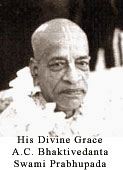
A.C. Bhaktivedanta Swami |
  Above: The view of Sunnis, voiced at www.islamicthinkers.com. Right: Shi'ites in Iraq. The two factions are at war in Iraq, each confident that "God is on our side". |
What Is Man? (1906) by Mark Twain
O Lord our Father, our young patriots, idols of our hearts, go forth to battle-be Thou near them! With them, in spirit, we also go forth from the sweet peace of our beloved firesides to smite the foe. O Lord our God, help us to tear their soldiers to bloody shreds with our shells; help us to cover their smiling fields with the pale forms of their patriot dead; help us to drown the thunder of the guns with the shrieks of their wounded writhing in pain; help us to lay waste their humble homes with a hurricane of fire; help us to wring the hearts of their unoffending widows with unavailing grief; help us to turn them out roofless with their little children to wander unfriended the wastes of their desolated land in rags and hunger and thirst, sports of the sun flames of summer and the icy winds of winter, broken in spirit, worn with travail, imploring Thee for the refuge of the grave and denied it-for our sakes who adore Thee, Lord, blast their hopes, blight their lives, protract their bitter pilgrimage, make heavy their steps, water their way with their tears, stain the white snow with the blood of their wounded feet! We ask it, in the spirit of love, of Him Who is the Source of Love, and Who is the ever-faithful refuge and friend of all that are sore beset and seek His aid with humble and contrite hearts. Amen.
Lecture on Srimad-Bhagavatam 1.15.24, Los Angeles, December 3, 1973
|
Bloodthirst
|
Food for Life Hansadutta das "Of what use are all your sacrifices to Me? I have had enough of the roasted carcasses of rams and of the fat of fattened beasts. I take no pleasure in the blood of calves, lambs and goats . . . When you spread out your hands, I close My eyes to you; despite however much you pray, I will not listen. Your hands are full of blood! Wash yourselves clean! Put away your misdeeds from before My eyes and stop doing evil." (Isaiah 1:11, 1:15-16) more |
Pradyumna: [reads:]
Translation
"Factually, this is all due to the supreme will of the Lord, the Personality of Godhead. Sometimes people kill one another, and at other times they protect one another."
Prabhupada: Now read the purport also. [SB
1.15.24]
Pradyumna: [reads:]
"According to the anthropologists, there is nature's law of struggle for existence and survival of the fittest. But they do not know that behind the law of nature, there is the supreme direction of the Supreme Lord Personality of Godhead. In the Bhagavad-gita it is confirmed that the law of nature is executed under the direction of the Lord. Whenever therefore there is peace in the world, it must be known that it is due to the good will of the Lord, and whenever there is upheaval in the world, it is also due to the supreme will of the Lord. Not a blade of grass moves without the will of the Lord. Whenever, therefore, there is disobedience of the established rules enacted by the Lord, there is war between men and nations. The surest way to the path of peace is, therefore, dovetailing everything to the established rule of the Lord. The established rule is that whatever we do, whatever we eat, whatever we sacrifice, whatever we give in charity, must be done to the full satisfaction of the Lord. No one should do anything, eat anything, sacrifice anything, or give anything in charity against the will of the Lord. Discretion is the better part of valor, and one must learn how to discriminate between actions which may be pleasing to the Lord and those which may not be pleasing to the Lord. An action is thus judged by the Lord's pleasure or displeasure. There is no room for personal whims. We must always be guided by the pleasure of the Lord. Such action is called yoga-karmasu kaushalam, or actions performed which are linked with the Supreme Lord. That is the art of doing a thing perfectly."
Prabhupada: So the Fifteenth Chapter of the Bhagavad-gita, the statement is there by Krishna,
sarvasya chaham hridi sannivishto
mattah smritir jñanam apohanam cha
vedaish cha sarvair aham eva vedyo
vedanta-krid veda-vid eva chaham [Bg. 15.15]
Actually,
everyone is suffering or enjoying. There is no enjoyment, only
suffering. But the struggle for existence, to counteract the suffering,
we take it as enjoying. Actually there is no enjoying.
In the Bhagavad-gita you know... In the Bhagavad-gita
Enjoying and suffering. Bhagavad-gita, Krishna says that
"This place..." The supreme authority says, "This place, this material
world, is duhkhalayam ashashvatam: [Bg. 8.15] it is the place
for suffering." That is a fact. One person is trying to accept
suffering as enjoying, and another person is trying to end actually
suffering. This is the difference between sane and insane person. I'll
give you a practical example, that in the prison, government prison
house, there are some prisoners who are called first-class prisoners.
They are given special favor by the government. So... And there are
third-class prisoners also. But both of them are prisoners. And prison
is not meant for comfortable life. It is meant for suffering. The
Bhaktivinoda Thakura therefore sings, anadi karama-phale parii'
bhavarnava-jale taribare na dekhi upaya. One who is sane person,
he knows that "I may be first-class prisoner, that does not mean I am
not prisoner. I am prisoner." The suffering of the prison house, that I
have no independence to do anything, that is prison life.
We are, everyone is thinking that we are independent, but that is not
the fact.
prakriteh kriyamanani
gunaih karmani sarvashah
ahankara-vimudhatma
kartaham iti manyate [Bg. 3.27]
Actually,
everybody is being carried by the laws of material nature, but a
foolish person is thinking that he is doing himself. So here it is said
that prayena etad bhagavata ishvarasya vicheshtitam. We
cannot do anything without the will of the Supreme Personality of
Godhead. Just like in state you cannot do anything without the sanction
of the government, similarly the supreme state, the supreme
order-giver, Krishna or God, without His sanction we cannot do
anything. But here it is said that mitho nighnanti bhutani
bhavayanti cha yan mithah. Sometimes by His will we kill one
another, and sometimes we give protection one another. So does it mean
that in different time Krishna is giving different intelligence? No.
Krishna's action is daiva, superior. Just like the high-court,
the judge is... Somebody condemning somebody that "This man should be
hanged," and other man, "Yes, he must get the degree. He will get the
millions of dollars from that person." Now, is he partial? He is giving
somebody millions of dollars and somebody is ordered to be hanged. Is
he partial? No. He is not partial. He is simply administering the law.
That's all. This man has created such a situation that he should be
condemned to death, and this man has created such situation that he
will be rewarded by ten thousand and millions of dollars. It is his
action.
Karmana daiva-netrena [SB 3.31.1]. We are acting,
and daiva-netrena, by superior administration,
daiva-netrena, we are getting different types of body, and
suffering or enjoying the consequence. This is our position. It is said
in the Bhagavad-gita, samo 'ham sarva-bhuteshu:
[Bg. 9.29] "I am equal to everyone." Otherwise how He is God? God is
not partial, that somebody should be killed and somebody should be
rewarded with ten thousand dollars. No. It is our own work, we create
such situation. That you should know. We forget. Now, somebody I kill
in my last life. Just like here, if I kill somebody, then I shall be
killed also, by the law, nature or law of God. Similarly, I forget that
because I kill somebody, now that somebody is killing me. So forget.
But Krishna reminds, "Now this person killed you," or "This child
killed you last life. Now you can kill in the womb. Now you kill." Vicheshtitam.
He reminds. Because Krishna is described: anumanta. Anumanta
upadrashta. He is witness. Now this man has killed this man. Now he
gets the opportunity to kill him again. And Krishna reminds you, "Kill
him. Here is opportunity." This is the position. Don't think when it is
said that ishvarasya vicheshtitam, it is by the will, that
will, because He is equal to everyone, so everyone should get chance to
retaliate. That is going on.
So God is not partial, He is impartial. Samo 'ham sarva-bhuteshu
na me dveshyo 'sti na priyah [Bg. 9.29]. Nobody in the material
world... Just like jail superintendent or the government. The
government is not partial. Government is equal to everyone, but
everyone is enjoying or suffering according to his own work. So that is
reminded. That is reminded and sanction given that "This body, this
being, killed you in your last life. Now I give you sanction, you can
kill him." This is called nighnanti. Mitho nighnanti. And "This
man gave you protection, so you give him protection." So what is the
wrong there? There is nothing wrong. It is equal justice. Because...
Don't think that because God or Krishna gives sanction, vicheshtitam,
therefore He is partial. No. He is always impartial. We are suffering
our own activities. Karmana daiva-netrena [SB 3.31.1]. We are
getting different types of bodies, suffering.
Now therefore we should always try to understand the will of God. That
is our duty. That will of God we can understand in the human form of
life. That is an opportunity. Will of God is expressed very clearly. Sarva-dharman
parityajya mam ekam sharanam vraja [Bg. 18.66]. That is said
already. Nobody can say "What is the will of God? I do not know." No,
you know. He says, God says, Krishna says, sarva-dharman
parityajya mam ekam sharanam vraja [Bg. 18.66]. "You give up all
other business. You just become surrendered to Me." [posing objection for sake of argument] "And
then how shall I pull on?" [Krishna says:]Aham
tvam sarva-papebhyo mokshayishyami: "I shall give you
protection. I will give you protection and I shall release you from the
effects of all sinful activity."
Because we suffer on account of sinful activities. And we enjoy by
pious activity. That is the law. If you become nicely educated,
cultured, then you get good position in the society. But if you are a
rascal, then you suffer. Similarly, we are creating our position. But
that... That is called karma-bandhana. Karma-bandhana means so
long we do not know what is our duty, we create our position
differently and therefore sometimes we suffer, sometimes we enjoy.
Therefore we must know what is our duty. That we have forgotten. Na
te viduh svartha-gatim hi vishnum [SB 7.5.31]. In this material
condition of life we have forgotten what is our actually aim of life.
Therefore Krishna comes. Yada yada hi dharmasya glanir bhavati
bharata, tadatmanam srijamy aham [Bg. 4.7]. Our duty, when we
forget our dharma, that is called dharmasya glanih. Dharma
is not a religious sentiment. Dharma means our occupational
duty, real meaning. I think I have given in Srimad-Bhagavatam.
So when we forget our duty, that is called
dharmasya glanih. Glanih means deterioration of our real
occupational duty.
So our real occupational duty is to serve the Supreme. That is our real
occupational duty. We are meant for serving. But when we forget serving
Krishna and we try to serve so many other things... That means... "So
many other things" means our lust, our greediness, our illusion, our so
many problems we serve. We have to serve. That is our position. Nobody
can be free from service. That is not possible. But we do not know
where to give our service. That is forgetfulness. Kamadinam kati na
katidha na palita durnideshah. Here, the human being in ignorance,
they are serving the kama, lust, greediness, moha,
anger—so many things they are serving. They are serving. A man is
killing another body by lust, lusty desires. Or by illusion. So many
other reasons. So we are serving. There is no doubt about it. We are
serving. But we are serving our kama, krodha, lobha, moha, matsarya.
Lust, desire, avarice, like that.
Now we have to learn that we have been frustrated by serving so many
things. Now we have to turn that service attitude to Krishna. That is
Krishna's mission. Sarva-dharman parityajya mam ekam sharanam
vraja: [Bg. 18.66] "You are serving already. You cannot be free
from service. But your service is misplaced. Therefore you just turn
your service unto Me. Then you become happy." That is Krishna
consciousness movement. Kamadinam kati na katidha palita
durnideshah. Because we are greedy... Just like a greedy man, he
is suffering by eating more. There are so many diseases, just like
diabetes or dysentery. There are so many things. These are the diseases
for eating more. That's all. So we are suffering; at the same time, we
are eating more. Because we are greedy, we are lusty. This is the
cause. So therefore kamad... We are serving. We are serving our
lust, our greediness, and suffering. This is practical. If you have no
hunger, if you eat... If you have no appetite, if you eat, then you
suffer. If you infect some disease, you'll suffer. That is practical.
So we are associating in, being infected by lust, greediness, illusion,
fearfulness, so many things. Sada samudvigna-dhiyam asad-grahat
[SB 7.5.5]. If you steal, then you will be under fearfulness: "Oh, I
may not be arrested; I may be arrested." Because you have done that, asad-grahat,
you have done something wrong, therefore you are under the influence of
fearfulness. It is very easy to understand.
So we are creating our situation and serving a different type of
desire. That's all. Kamadinam katidha na... And sometimes we
are doing something which we should not do. Still, we are doing. But
doing so, tesham karuna jata. Although we have done so
much for to serve the lust, greediness, but they are not merciful. They
are still dictating, "Go on doing this, go on doing this, go on doing."
He is suffering; still, he is following the dictation of lust and
desire. We are creating our own karma. Therefore any sane man
will see that "I have served so long, so much, our desires, but I am
not happy. I am not happy, neither the desire is happy." The desire is
never satiated that "You have killed so many animals. Now you don't..."
No, he will go on, go on killing, killing, killing, killing, killing,
killing. He is never satisfied, "Now I have killed so many. No more,
stop." No, there is no stoppage. That will go on. Kamadinam kati na
katidha. The injunction is "Thou shalt not kill," but he will kill
and kill and kill and kill, and still, he wants to be satisfied. Just
see. The Bible says, "Thou shalt not kill," and they are simply engaged
in killing business, and still they want to be happy. Just see the fun.
Therefore Krishna says, "Yes, you be killed by occasional world war.
You must be killed. You have created this situation. You must be
killed. You may be American or Englishman or German or this or that.
You may be very proud of your nationality. But you must be killed."
This is the position. Ishvarasya vicheshtitam. "You have
killed so many animals. Now wholesale killing, one bomb. One atom bomb.
Be killed."
So these rascals they do not know how things are going on. Ishvarasya
vicheshtitam. "Tit for tat." There must be. If in ordinary laws,
in the state laws, that if you have killed somebody you must be hanged,
so do you think you can simply bluff the Supreme Authority, Krishna,
that you are going, killing, killing, killing, and you will be saved?
No. You will be killed in pestilence, in famine. Even within your
mother's womb, you will be killed, where it is supposed to be good
protection, there also you will be killed. The human nation being
degenerated in such a way, the killing business is increasing daily,
daily, daily. Ishvarasya vicheshtitam.
So we therefore must submit to Krishna. Sarva-dharman
parityajya... [Bg. 18.66]. Because we cannot become free. We
cannot go out of the laws of God. That is not possible. Therefore we
must surrender that "Krishna, God, I have acted freely so many births.
I did not become happy. Neither I am happy at the present moment. So
now I surrender unto You. You say that 'I give you protection.' So
kindly give me protection." This is Krishna consciousness movement.
Thou Shalt Not Kill/ WORLD SANKIRTAN PARTY ©2007 - Hansadutta das
Home | About | Events | World Sankirtan Party | Inside Nam Hatta
eBooks | Site Map | Store