| Get Srila Prabhupada's original, unrevised books. Beware of imitations. More than 160 titles published! Learn more. |
Fire in the Forest
Human civilization means to make a solution to suffering
His Divine Grace A.C. Bhaktivedanta Swami Prabhupada
Founder-Acharya of the world-wide Hare Krishna Movement, Brahma Sampradaya Acharya
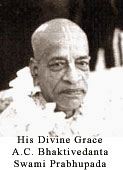
Morning walk with disciples, December 15, 1973, Los Angeles.
Stop the suffering
Svarup Damodar: The sky is quite clear.
Prabhupada: Yes. Can you
change it? Can you change it?
Svarup Damodar: No. [laughter]
Prabhupada: Then what kind of
scientist you are?
Svarup Damodar: A rascal
scientist. [Prabhupada laughs]
Candanacarya: Srila
Prabhupada, may I put a question?
Prabhupada: Yes.
Candanacarya: Yesterday I
made the acquaintance of a theologist, a professor from the University
of Montreal. He said that the Roman Catholic presentation of
Christianity is that God came to share the suffering of man.
Prabhupada: That is another
rascaldom. Why God should share the sufferings of man?
Candanacarya: I asked him
this, and he said, "So that man would accept more as reality,
suffering."
Prabhupada: Very good
theologician. A rascal number one. You are trying for becoming happy,
and his theory is that man will accept suffering. You see? The very
proposition is rascaldom. Everyone is trying for to become happy. That
is progress. Atyantika. In Sanskrit it is called atyantika-duhkha-nivrittih.
There is suffering, and our struggle for existence means to, I mean to
say, mitigate the suffering, to minimize or to make it nil. That is our
struggle. We are not submitting to suffering. Then what is the
civilization? What is human civilization: We don't want suffering. That
is our position. Why this rascal says that "We shall suffer"? Just see.
The theologician is a rascal. Therefore we say everyone rascal.
Prajapati: The same
theologician, Prabhupada, he calls himself an atheist theist.
Prabhupada: Eh?
Candanacarya: He said, "I am
an atheist theist."
Prabhupada: Atheist theist?
What is this?
Prajapati: Just rascal,
double talk.
Prabhupada: Another rascal.
Another rascal proposition.
Candanacarya: I asked him,
"How can a theologist be an atheist?"
Prabhupada: The whole thing
is that because the whole world is full of rascals, they are all
talking nonsense. No meaning. No meaning. It is only we, we have
pointed out that "You are a rascal. You speak all nonsense." Now,
taking this word atheist, what does he mean by atheist?
Candanacarya: Without theism?
Prabhupada: No, no, that is
not explanation.
Svarup Damodar: Atheist means
not believing in God.
Prabhupada: Yes. Say like
that. Don't say in a negative way. In a positive way. What does it
mean? Atheist.
Prajapati: He says there is
no God.
Prabhupada: There is no God.
Then what do you mean by God? Next question. Next question will be what
do you mean by God?
Candanacarya: So he'll say
the conception which has been presented by the different religions.
Prabhupada: What is your
conception? Why do you go to different religions? You are talking with
me. So you say, what do you mean by God? Next question will be this.
Don't go to others. Don't fly away. You are atheist. You are posing
yourself atheist. Atheist means one who does not believe in God. That's
all right. Now what do you mean by God? First of all the thing must be
there. Then you believe or not believe next. Just like here is a
person. He says, "I believe in him." I say, "I don't believe in him."
But the person is there.
Karandhara: Well, he'll say,
"God is just an idea."
Prabhupada: Idea?
Karandhara: Yes. But ideas
don't always represent facts.
Prabhupada: So idea is there.
You say that it is not fact, but others say it is a fact. So how it
will be mitigated? How it will be settled? "God" word is there. You say
that it is an idea.
Devotee: A "sky flower" is an
idea, but it's not fact.
Prabhupada: No, just like
God, let us stick on word, that God... You say it is an idea only. I
say it is not an idea. It is fact.
Karandhara: Well, then they
say, "By objective empirical analysis it has to be researched,
scientific."
Prabhupada: Oh, then let us
analyze, analyze. Let us analyze. That... We say that God means
Supreme, Supreme Being. So how you can say that Supreme Being is an
idea? How you can say? You accept Supreme Being. So how you can say it
is idea? It is fact.
Karandhara: Well, they say
there is no necessity for a Supreme Being.
Prabhupada: No, there's a
necessity. If you don't accept, then you will be beaten with shoes.
Because as soon as there is light, you have to accept supreme authority.
Karandhara: But that's an
authority we have imposed upon ourselves.
Prabhupada: Yes, because
there is need, therefore you have done it. There is necessity.
Karandhara: Well, some of
them say, because people are generally ignorant, therefore we need this
idea of God.
Prabhupada: But you are less
than ignorant. You are less than ignorant. You are less than rascal. If
I call you a rascal, then I give you some honor.
Karandhara: Lenin said that
God is just opiate of the people, just to keep them intoxicated.
Prabhupada: No, no, no, no.
That means Lenin wanted to become God. That's all. The God idea is
there, but he cannot be God. Because he was under the laws of God, he
died. He died. He could not save himself from death. Therefore he is
not supreme authority. He accepted supreme authority, but he wanted
himself to become the supreme authority. Now, when he died, he is not
supreme authority. He is forced to die. Then there is another supreme
authority.
Karandhara: Well, then they
can say ultimately death is meaningless anyway.
Prabhupada: Why meaningless?
Then why you are afraid of death when I come to kill you?
Karandhara: Well, that it's
meaningless doesn't mean I can't place some value on it at any given
point.
Prabhupada: Why meaningless?
It has meaning. Then why you are fighting? Why you fought for Russian
Revolution?
Karandhara: Well, they give
the example like numbers. Numbers are only useful for a purpose, but
actually they are meaningless.
Prabhupada: The purpose is
meaningless then. Then your purpose is meaningless.
Karandhara: Yes, they say
ultimately everything is meaningless.
Prabhupada: Then you are a
rascal. You are working for meaningless things. Then you are a rascal.
That's all. And that is my version, that you are a rascal number one.
Karandhara: Well, they say
everyone can introduce their own meaning to whatever they want.
Prabhupada: No, then why do
you try to get many followers? Let them do their own work.
Karandhara: No, to
proliferate your own meaning.
Prabhupada: No, no, you have
got own meaning. You be satisfied with your own meaning. I have got my
own meaning. Why do you bother me?
Karandhara: Well, my meaning
may be to bother you. That may be part of my meaning.
Prabhupada: Then my meaning
is to beat you with shoes. [laughter]
Karandhara: Lenin, no one
ever beat him. He was not beat. He beat everyone else.
Prabhupada: No, no. He was
also beaten—by death. He died also. That means even if he is beaten, he
will not accept it. He is such a rascal. He is such a rascal. He is
being beaten every moment. He is becoming old. He is becoming diseased.
He is dying. Still says, "I am not beaten. I am not beaten."
Candanacarya: Actually, he
still thinks that he's beating death because they put his body in a
tomb...
Prabhupada: Yes, he is being
beaten every moment, every second, and still, he will say, "I am not
beaten." That is rascal number one. One is accepting that "Yes, I am
being beaten." He is sane man. And one who says that "I am not beaten,"
he is getting old, and every moment he is being beaten, and still he
says, "I am not beaten."
Karandhara: Well they have a
philosophy called existentialism, that so long something exists, we can
place value on it, but when it ceases to exist, there is no remorse.
There is nothing to lament.
Prabhupada: There is no
nothing to lament, but why don't you exist? Why you struggle for
existence?
Karandhara: But they say if
you have money in your hand, as long as you have it you can utilize it,
but if you lose it, don't worry. It's nothing to lament.
Prabhupada: But they worry. I
have practically seen. They cry.
Karandhara: Well, they just
fall short of their philosophy, the philosophy they hold as ideal.
Prabhupada: So, these are all
no argument. No sane man will accept this argu...
Karandhara: Most western
people are so frustrated, they accept these philosophies wholeheartedly.
Prabhupada: Yes. That is
frustration. That is not real life. That is another thing.
Karandhara: But like you say
in Bhagavad-gita, they are so angry with all types of
speculation that they become frustrated and disgusted.
Prabhupada: Yes. Frustration
is not life. Frustration is frustration, disappointment. That is not
life.
Karandhara: They say that
frustration is the only reality.
Prabhupada: No. That's for
you.
Karandhara: Absurd, the
absurd philosophy.
Svarup Damodar: That means
they do not know the value of life.
Prabhupada: Yes, that's it.
That means rascaldom. That means rascaldom.
Karandhara: One of their
chief philosophers, his name was Camus. So after he was propounding
this philosophy and writing many books, one night he was driving in his
car, and he decided that "There's no meaning, so why not just drive my
car off a cliff?" So he just drove his car off a cliff, finished
himself off.
Prabhupada: Mad, madmen.
Karandhara: But his books are
in colleges especially. Millions and millions of students accept his
books as practically gospel.
Prabhupada: What is the
subject matter of the book?
Karandhara: Subject matter of
his books, that life is ultimately absurd. There is no real meaning to
it. We place our own meanings on it, but those are...
Prabhupada: So you are
trying... Why you are trying to explain it? Why you are trying to
explain it?
Karandhara: Yes, actually he
is trying to make reason out of the absurdity.
Prabhupada: To prove absurd
is his reason? That means absurd reason.
Karandhara: Well, that's what
he ultimately realized, that everything is absurd. There is no use
speaking, writing or even living.
Prabhupada: No, no, the thing
is that you are saying "absurd," I am saying, "not absurd." Who will
settle up this? That is the... If you settle your own affair. I settle
my own affair. So who will settle up, whether I am right, you are right?
Srutakirti: It will be
settled at death.
Prabhupada: That's all. Mrityuh
sarva-harash cha. The death is equally acceptable by you and me,
but... And it is also a fact you don't want to die; I also don't want
to die. Then there is authority.
Karandhara: No, but in his
case he didn't care. He died willingly.
Prabhupada: No, no. He didn't
care, but he always takes care. That is a fact. He always takes care.
Karandhara: No, but on this
instance, he died willingly. He wanted to die.
Svarup Damodar: But he might
be pretending. Might be died, but he was thinking that he'll not
[indistinct]
Karandhara: But he killed
himself.
Prabhupada: Yes, he did not
want to die, but just to keep prestige, he might have died. That's all.
Karandhara: I think he wanted
to die. [laughter]
Prabhupada: Then if you want
to die, let me kill you immediately. You will be happy.
Rupanuga: He wrote another
book called "Nausea" wherein he wrote how life made him sick to his
stomach.
Prabhupada: That means
madman. Sometimes madman commits suicide. He's a madman, that's all.
Karandhara: Practically, in
the last three hundred, or two hundred years, all the most famous
writers, and scholars and intellectuals, they all became madmen.
Prabhupada: Yes, they must
be, because they do not know what is to be known. Their knowledge is
imperfect.
Karandhara: Nietzsche, Freud,
they all died madmen.
Prabhupada: Madman means when
one becomes frustrated, he becomes mad. That is the...
Karandhara: But the people,
after them, they think that their lives were very great. They read
their books and accept their authority.
Prabhupada: There are two
classes of men. We don't say their life was great. So therefore I say,
who will settle? I am right or he is right? Always you will find the
madman will say, "I am right." Another man say, "You are not right; I
am right." Then who will settle up? That is the point. You will find
always these two classes of men. You say you are right, I say I am
right.
Candanacarya: But by
committing suicide, didn't he accept that finally death was the only
thing that was not absurd?
Prabhupada: Yes, for them the
death is the only solution.
Prajapati: Rascals like such
books, Prabhupada, because it requires no commitment on their part. To
read such men—"Oh, yes, that's very nice. I can read them and put them
down." But it doesn't require me to trust in God or to do anything for
the world.
Prabhupada: No. Books are
written in favor: "If you want to know more about us, then here is
book." Because from books, generally, we get knowledge. Otherwise book
is not required. Very brilliant light.
Srutakirti: It's an airplane.
Prabhupada: And if the light
is little more brilliant, that means finished. If the same light
becomes little more brilliant, that means finished, fall down
immediately. It is a big aeroplane? [break]
Prajapati: Several years ago
you gave a series of lectures in New York on atonement, that are very
famous, and devotees, they relish them very much. Prayashchitta.
And this is also in Christian theology to a large extent, plus another
concept called feeling very sorry for one's sinful activities.
Prabhupada: Repentant.
Repentant?
Prajapati: No so much
repentance. It is called...
Karandhara: The classic idea
is that one goes away and just lives in a state of remorse, solitude
and remorse, thinking how sinful and wretched he is, and performing
severe austerities.
Prabhupada: Huh?
Karandhara: Going away,
living in a monastery, performing severe austerities, and always
contemplating how sinful and wretched we are and how we must suffer.
Prabhupada: Everyone is
suffering. But one who knows that he is suffering, he is intelligent.
Everyone is suffering. If you are not suffering, why you have covered?
Why you have covered? Because you are suffering, is it not? Why you are
not naked body? Because we are suffering, therefore we have covered. It
is a fact. And if somebody says, "No, we are not suffering," then he's
a madman. So everyone is suffering. One who knows it, he is intelligent
man. That's all.
Rupanuga: They have no
positive philosophy. They stress guilt. They are always guilty. They
have no positive philosophy.
Prabhupada: Yes. No... Then
the next question is that "If there is a positive philosophy to
mitigate the suffering, why don't you accept it?" Just like when one
body is suffering, I say, "Take this blanket. Cover." If he says, "No,
I am not going to take it," is that sane man?
Svarup Damodar: Then he will
continue suffering if he doesn't accept.
Prabhupada: Yes, yes. Our
proposition that everyone is suffering and struggling, how to stop the
suffering. This is material world. Everyone is suffering. And the
struggle is called progress. So we are offering something also: "Here
is something, you accept it, and your sufferings will be mitigated."
Nobody can say, "No, we are not suffering." That is insanity. Everyone
is suffering.
Prajapati: This suffering
comes from our sinful activities?
Prabhupada: Yes. Therefore
Krishna says, aham tvam sarva-papebhyo mokshayishyami [Bhagavad-gita
18.66]. I shall give you protection from sinful reaction of your life
because you are suffering for sinful reaction. Suffering means if you
disobey the laws of the state, you suffer. That is sinful. Because you
have disobeyed the laws of the state, you are suffering.
Candanacarya: If one has
difficulty becoming Krishna consciousness, is that suffering?
Prabhupada: No, what is the
difficulty, first of all?
Candanacarya: You once said
if someone is not attracted to chanting, then he is being punished by
Yamaraja.
Prabhupada: Yes. So if you,
if by chanting Hare Krishna mantra, you can save your
suffering, what is the difficulty, not to accept it? Everyone is
suffering in this material world. And everyone is trying to get out of
the suffering. That is also a fact.
Prajapati: They try to get
out of suffering by committing more sins.
Prabhupada: Yes. Because they
do not know how to get out of the suffering. [break]
Candanacarya: ...to tell
people who think that they are not suffering that they are actually
suffering.
Prabhupada: That means it is
difficult to teach insane person. That's all. Therefore the best means
is, without teaching, "Please come here, chant Hare Krishna mantra,
and takes little prasadam and go home." Then his insanity will
be cured. Then he will be all right. This is our point. We don't
sermonize in the beginning. We simply request, "All right, you are very
good. Nobody is more intelligent than you. Yes. Please come here, sit
down, chant, dance. It is very nice, and takes little prasadam.
Go home." That is our program. Then we teach. When he comes to his
little sanity, then he will be cured. [break]
Prajapati: ...Srila
Prabhupada, the theologians call contrition. Means an actual thinking
about how sinful we are, actually meditating on our sinful condition.
Prabhupada: Yes, simply
meditating on sinful condition, that is also good. But what is the
counteraction? That we must know. Just like one man is suffering from
some disease. He knows that "I have infected this disease." So simply
thinking, "Oh, I have been infected by this disease," that is not good.
He must go to a physician to cure it. That is intelligence.
Karandhara: Yes. Or it's like
a criminal. If he commits a crime, it's nice that he laments, but he
can't just lament. He has to start working positively.
Prabhupada: Yes, he must go
to the state and offer, "Please kill me." Then state may consider. "I
have committed this murder, so the law is: I must give my life. So I am
prepared." Then immediately he will be excused. Yes. [break]
Karandhara: ...a devotee came
and told Prabhupada that he committed some wrong doing, and he was
very, very sorry, and he was crying and very sorry, and you said,
"That's all right. That's nice. Now do something about it. Engage
yourself in Krishna's service."
Prabhupada: Yes, yes, yes.
That is the duty of the physician. If somebody comes, patient: "Sir, I
am suffering like this." "All right, don't be sorry. Sit down. I will
give you medicine." [break]
Prajapati: ...what these
rascal philosophers do, psychologists and scientists, they say the
things that are very sinful actually, that Krishna says and the Bible
and all of scriptures say are sinful, they say, "That's all right. You
may do those things." Not only do they deny God's existence, but they
say that which is sinful is actually good for you: "Yes. You must have
intoxication, take illicit sex life," like that.
Difference
between a bucketful of water and the cloud
Prabhupada: No good man will
say like that. That is the difference between good man and bad man. The
same example as I told, that one blind man is going this side, and
another man says, "Yes, you are all right. Go this side." This is going
on. Either he does not know, this rascal who says, "Yes, you can go
this side," that he will fall down in the ocean and die... Both of them
do not know. So one blind man, andha yathandhair upaniyamanah
[Srimad-Bhagavatam 7.5.31]. One blind man is giving
direction to another blind man. This is going on. Therefore Vedic
injunction is to take direction: "You must go to guru." That is
in... Tad-vijnanartham sa gurum evabhigacchet [Mundaka
Upanishad 1.2.12]. Gurum eva, "Must go." Then he will
get right direction. Otherwise misguided. [break]
Candanacarya: ...there must
have been very many gurus. Were there many gurus then?
Prabhupada: When? Guru
or... First of all, try to understand what is the meaning of guru.
Guru means heavy. So one who knows more than you, or one who knows
perfectly, that, he is guru. So if you know anything perfectly,
then you are guru. But if you do not know anything perfectly,
then you are not a
guru. You are rascal. So guru means one who knows
perfectly. So if you find out somebody, that he knows everything
perfectly, then he is guru. That is the first prayer of Gurvashtaka.
Samsara-davanala-
lidha-loka-tranaya karunya-ghanaghanatvam. Everyone is in the
blazing fire of this material existence. It is just like forest fire.
Just like if there is fire in the forest, all the inhabitants of
forest, all the animals, they become so much in perturbed condition. So
guru means to rescue from this forest fire. So therefore
it is said, ghanaghanatvam. A forest fire can be reduced or can
be extinguished... Fire, there must be water. But wherefrom the water
will come? Your fire brigade, bucket full of water, will not save. The
water must come from cloud. So therefore guru is the cloud. He
has taken the mercy from the ocean, or from God, and he pours the
mercy. Immediately the fire is extinguished, and you are saved. This is
the samsara-davanala-lidha-loka-tranaya karunya-ghanaghanatvam,
praptasya.... One who has received mercy from the Supreme, he
can save. Nobody can save. Your so-called fire brigade bucket or bucket
full of water will not save. That is not possible. So as these rascals
are simply trying to extinguish the blazing fire of material existence
by so-called bucketful of water, it will not save. It will be waste of
time. If the cloud comes, then it will be saved. So guru is the
cloud. That is... Samsara-davanala-lidha-loka-tranaya
karunya-ghana....
Ghanaghanatvam means cloud, dense cloud. As soon as there is dense
cloud and pours water, finished, all blazing fire finished. That is guru.
And Narottama dasa Thakura says, somsara-bishanale dibanishi
hiya jvale: "My heart is burning by the fire of this material
existence." Judaite na kainu upaya: "I did not make any
arrangement for getting out of this fire." Golokero prema-dhana,
hari-nama-sankirtana: "Now this hari-nama-sankirtana is
coming from Goloka, from the spiritual world. I did not take care of
it." He is lamenting. So this is the fire extinguish instrument. Chant
Hare Krishna in this age, and the fire will be extinguished. [break] ...
prema-dhana hari-nama-sankirtana, rati na janmilo kene taya.
[break]
Prajapati: ...shaktyavesha-avatara?
Prabhupada: Guru is
the mercy incarnation of God, mercy incarnation. God is kind to
everyone, so He is teaching everyone from within, but still, to make it
still more explicit, He sends His mercy in the form of guru.
Prajapati: The shaktyavesha-avatara
means Krishna coming in a form of a living entity empowered by him for
some special purpose.
Prabhupada: Yes, yes.
Candanacarya: Guru is
greater than shaktyavesha-avatara.
Prabhupada: No, guru
is considered as Krishna Himself. Guru-rupa krishna hana avatara.
Just to teach the conditioned soul, guru comes himself, er,
Krishna comes Himself in the form of guru. Therefore we sing in
the Vishvanatha Chakravarti Thakura's prayer, sakshad-dharitvena
samasta-
shastraih: "In every shastra, guru is accepted as
directly Krishna." Sakshat. Sakshat means directly. Sakshad-dharitvena:
As Krishna, is accepted in every shastra, sakshad-dharitvena
samasta-shastrair uktas..., it is said, uktas tatha
bhavyata eva sadbhih, and this statement is accepted by advanced
devotees. It is not only statement, but it is accepted. But the next
question is: "Does it mean that guru is Krishna? Therefore no
more Krishna wanted?" No. Kintu prabhor yah priya eva tasya:
"Guru is exalted because he is very confidential servant of
Krishna." Here it is clear. Not that he is respected as Krishna,
therefore he has become Krishna. This is Mayavada: "He has become
Krishna." No. Kintu: "But don't think that there is no more
Krishna, finished. Guru is here." Just like the Mayavadis say,
just like this rascal Guruji, that "I am Krishna." Not that.
Kintu prabhor yah priya eva tasya. He is the most confidential
servant. Vande guroh sri-charanaravindam. This is clear
explanation. Although he is respected as good as Krishna, but he never
says that "I am Krishna." He says, "I am servant of Krishna." And
actually he is the most confidential servant of Krishna. Therefore we
distinguish in this line that sevya-bhagavan and sevaka-bhagavan:
"worshipable God and worshiper God." You follow? God, but worshiper God.
Svarup Damodar: Person Bhagavatam.
Prabhupada: Yes. Both of them
God, but one God is worshipable, and another God is worshiper. So for
the disciple, both of them are worshipable because both of them are
God. That is the distinction.
Sevya-bhagavan, sevaka-bhagavan.
Prajapati: Therefore, when we
hear the words of guru, we are actually hearing Krishna.
Prabhupada: Yes. That is
said, yasya prasadad bhagavat-prasadah. If you please guru,
then Krishna is pleased because he is saying the same thing. Just like
we are... What we are doing? Krishna says, sarva-dharman
parityajya mam ekam sharanam vraja [Bg. 18.66]. We are saying
that "You just surrender to Krishna." We are inventing nothing.
Therefore I am guru. Because I am saying Krishna's words, not
my words, therefore I am guru. As soon as I say my words, then
I am not guru. This is the significance.
Rupanuga: You are the only
one, Srila Prabhupada, who claims to be servant. The rest of them take
Krishna's position.
Prabhupada: Yes. Because they
are not guru. They are not guru. That is the
difficulty, that one who is not guru, he is taking the place of
guru. Therefore people are misguided.
Rupanuga: One man who has
written a book on these different so-called spiritual movements has
remarked that Your Divine Grace is the only one of all... The big
difference between our movement and the others is that you claim to be
servant, and the others claim to be God.
Prabhupada: He has written?
Oh.
Rupanuga: It is in a book
talking about different spiritual movements in this country.
Prabhupada: So he has
appreciated this?
Rupanuga: He has made that
remark. He has noted that difference.
Prabhupada: [laughing]
Therefore I am unique. Yes. Then I can, become unique. Yes. I am not
amongst the rascals.
Rupanuga: I tell the
students... They ask me how they can distinguish between gurus.
I tell them the real guru claims to be servant, and not God. I
said only one guru says he is servant. That is Srila
Prabhupada. And they can understand that.
Candanacarya: Sincere people
will appreciate that.
Prabhupada: Yes.
Prajapati: In the early days
of this movement, Srila Prabhupada, in New York, devotees said they did
not know how to treat Your Divine Grace. They did not know your exalted
position. I think we are still very much offensive.
Prabhupada: No, I am servant.
I have no exalted position. Servant. Chaitanya Mahaprabhu sat down in a
place where people were washing their feet. Yes. [break] ...a
representative of Krishna. I came to preach Krishna consciousness, and
Krishna has sent so many representatives to help me. I consider like
that. Without your help I could not do. So I wanted Krishna's help, so
Krishna has sent you. Therefore you are representative of Krishna. That
is my conception.
Prajapati: We're just dogs,
Prabhupada.
Prabhupada: No.
Prajapati: Barking at your
feet, that's all.
Prabhupada: That is your
humbleness. That is nice.
Prajapati: Not humbleness.
That's fact.
Prabhupada: Hare Krishna.
[break]
Candanacarya: ...that there
are some things that the guru says that the disciple does not
accept.
Prabhupada: What is that?
Candanacarya: He says that
there are some things that the guru says that the disciple will
not accept.
Prabhupada: Who says?
Candanacarya: Jayadvaita told
me that in the shastra it says that. So when the
guru says that the disciple is nice, he does not accept.
Prabhupada: [laughing] That
is very good quality. Oh, Jayadvaita has written like that?
Candanacarya: No, he was
telling me that it was in one shastra.
Prabhupada: No, it is very
intelligent. Yes. Just like guru does not accept, although he
is worshiped like Krishna, he never accepts that "I am Krishna." That
is our parampara system. Shishya has to accept guru
as Krishna, but guru will never accept that he is Krishna. This
is our relationship.
Sakshad-dharitvena samasta-shastraih. Samasta-shastraih,
all revealed scripture.
Svarup Damodar: This is the
unique quality of Vaishnava.
Prabhupada: Yes.
Svarup Damodar: Nowhere we
can find these things.
Candanacarya: One time, Srila
Prabhupada, you said, "I will go to hell," but none of your disciples
accepted that.
Prajapati: Actually, coming
to this country, this is hell.
Prabhupada: No, I am not in
hell. I am with the devotees, so how can I say I am in hell? [break]
Narottama dasa Thakura says, tandera charana sevi bhakta-sane vas:
"My duty is to serve my guru and live with the devotees." That
is Krishna's grace. "My mission is to serve my guru, but live
with the devotees."
tandera charana sevi bhakta-sane vas
janame janame hoy ei abhilash
"This
is my desire life after life." A guru or bhakta does
not aspire that he is going to Vaikuntha, Krishna. "Never mind." But
their only desire, his only desire, is that to serve the predecessor acharya
and live with devotee. That's all. This is the only ambition. [break]
...says, tatra tishthami narada yatra gayanti mad-bhaktah.
Where, the place where the devotees are glorifying the Lord, Krishna is
there. So if Krishna is there with the devotees, then wherever devotees
are there, that is Vaikuntha. That is Vaikuntha. Just like our temple.
It is Vaikuntha. Because the devotees are chanting the glories of the
Lord, so that is Vaikuntha. Vaikuntha is not limited. Vaikuntha, as
Krishna can expand Himself, similarly, Vaikuntha can also be expand,
Vrindavana can expand. So wherever there is Krishna, that is Vaikuntha.
And where is not Krishna? And that is to be appreciated. Then if anyone
appreciates Krishna everywhere, then he is living in the Vaikuntha. He
is not living in hell or Los Angeles. [break]
Svarup Damodar: ...where pure
devotee goes, that place is immediately purified as soon as he is there.
Prabhupada: Yes, because
Krishna helps. As soon as the pure devotee sings, Krishna immediately
comes there. So it becomes Vaikuntha.
Prajapati: We are more
fortunate than gopis, Srila Prabhupada. Walking with you on the
beach is better than dancing rasa dance in Vrindavana.
Prabhupada: [laughing] It is
not like that, but we can say, wherever Krishna topics are there, it is
as good as Vaikuntha or Vrindavana. [break] ...prasangan mama
virya-samvido bhavanti hrit-karna-rasayanah kathah. By
association, bodhayantah parasparam. These things are there in
the Bhagavad-gita. [break] ...enjoy and be satisfied in
the association of devotees. [break] ...article on the subject of
"Krishna, the supreme scientist," and let us publish it. That article
is very nice. If he writes such articles, the conclusion, if Krishna,
the supreme scientist, Krishna, the supreme economist, Krishna, the
supreme philosopher, Krishna, the supreme chemist, Krishna—
everything, the conclusion is Supreme, Krishna—then his activity is
fulfilled. He becomes successful. The conclusion should be Krishna.
That's it. Whatever he may be. He may be a musician, he may be artist,
he may be physicist, he may be chemist, he may be scientist—whatever he
may be, if he writes article on the subject matter and concludes that
Krishna is the Supreme, then preach, then he is successful. That's all.
Just like you are theologian. You write theology and prove, "Krishna is
the Supreme Lord." Then your attempt is successful. [break] We are
trying to understand the Supreme, so therefore, as soon as you come to
the Supreme, you are successful. [break] ...uttama-shloka-gunanuvarnanam.
This is success. With your talent, you simply come to the conclusion
that Krishna is the Supreme. That's all. So our business is, because we
are neither scientist nor musician, nothing of the sort, layman, we
have simply said, "Krishna Supreme." That's all. Never mind what I am.
[break] ...janmanam ante jnanavan mam prapadyate. This is
understanding of Supreme. "After many, many births, one who is wise, he
will accept Krishna and surrender."
bahunam janmanam ante
jnanavan mam prapadyate
vasudevah sarvam iti
sa mahatma sudurlabhah [Bg. 7.19]
He
is mahatma, great soul, who is accepting like that, that
Vasudeva, Krishna, is everything."
Prajapati: You are the
supermost mahatma, Srila Prabhupada.
Prabhupada: Hare Krishna.
Prajapati: Thank you so much.
Svarup Damodar: Jaya
Prabhupada. All glories to Prabhupada. Hare Krishna. [end]
Fire in the Forest/ WORLD SANKIRTAN PARTY ©2004 - Hansadutta das
Home | About | Events | World Sankirtan Party | Inside Nam Hatta
eBooks | Site Map | Store