 Krishna Books What is Hare Krishna? The Founder-Acharya Hare Krishna Mantra Sankirtan Movement Personality of Godhead Lord Chaitanya A.C.Bhaktivedanta Swami Prabhupada Hansadutta das Events: Kirtan Festival World Sankirtan Party Submit News © 2004 - Hansadutta das |
Something's Missing
|
Related Articles The Founder Acharya Related Topics Aim of Life Family, Friends, Community Krishna Consciousness, the Process |
Bhakti means
devotional service. Every service has some attractive feature which
drives the servitor progressively on and on. Every one of us within
this world is perpetually engaged in some sort of service, and the
impetus for such service is the pleasure we derive from it. Driven by
affection for his wife and children, a family man works day and night.
A philanthropist works in the same way for love of the greater family,
and a nationalist for the cause of his country and countrymen. That
force which drives the philanthropist, the householder and the
nationalist is called rasa, or a kind of mellow (relationship)
whose taste is very sweet. Bhakti-rasa is a mellow different
from the ordinary rasa enjoyed by mundane workers. Mundane
workers labor very hard day and night in order to relish a certain kind
of rasa which is understood as sense gratification. The relish
or taste of the mundane rasa does not long endure, and
therefore mundane workers are always apt to change their position of
enjoyment. A businessman is not satisfied by working the whole week;
therefore, wanting a change for the weekend, he goes to a place where
he tries to forget his business activities. Then, after the weekend is
spent in forgetfulness, he again changes his position and resumes his
actual business activities. Material engagement means accepting a
particular status for some time and then changing it. This position of
changing back and forth is technically known as bhoga-tyaga,
which means a position of alternating sense enjoyment and renunciation.
A living entity cannot steadily remain either in sense enjoyment or in
renunciation. Change is going on perpetually, and we cannot be happy in
either state because of our eternal constitutional position. Sense
gratification does not endure for long, and it is therefore called chapala-sukha,
or flickering happiness. For example, an ordinary family man who works
very hard day and night and is successful in giving comforts to the
members of his family thereby relishes a kind of mellow, but his whole
advancement of material happiness immediately terminates along with his
body as soon as his life is over. Death is therefore taken as the
representative of God for the atheistic class of men. The devotee
realizes the presence of God by devotional service, whereas the atheist
realizes the presence of God in the shape of death. At death everything
is finished, and one has to begin a new chapter of life in a new
situation, perhaps higher or lower than the last one. In any field of
activity, political, social, national or international, the result of
our actions will be finished with the end of life. That is sure.
Bhakti-rasa, however, the mellow relished in the
transcendental loving service of the Lord, does not finish with the end
of life. It continues perpetually and is therefore called amrita,
that which does not die but exists eternally. This is confirmed in all
Vedic literatures. The Bhagavad-gita says that a little
advancement in bhakti-rasa can save the devotee from the
greatest danger, that of missing the opportunity for human life. The rasas
derived from our feelings in social life, in family life, or in the
greater family life of altruism, philanthropism, nationalism,
socialism, communism, etc., do not guarantee that one's next life will
be as a human being. We prepare our next life by our actual activities
in the present life. A living entity is offered a particular type of
body as a result of his action in the present body. These activities
are taken into account by a superior authority known as daiva,
or the authority of God. This daiva is explained in the Bhagavad-gita
as the prime cause of everything, and in the Srimad-Bhagavatam
it is stated that a man takes his next body by daiva-
netrena, which means by the supervision of the authority of the
Supreme. In an ordinary sense daiva is explained as destiny. Daiva
supervision gives us a body selected from 8,400,000 forms; the choice
does not depend on our selection, but is awarded to us according to our
destiny. If our body at present is engaged in the activities of Krishna
consciousness, then it is guaranteed that we will have at least a human
body in our next life. A human being engaged in Krishna consciousness,
even if unable to complete the course of bhakti-yoga, takes
birth in the higher division of human society so that he can
automatically further his advancement in Krishna consciousness.
Therefore, all bona fide activities in Krishna consciousness are amrita,
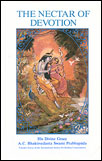
or permanent. This is the subject matter of The Nectar of
Devotion.
This eternal engagement in bhakti-rasa can be understood by a
serious student upon studying The Nectar of Devotion.
Adoption of bhakti-rasa or Krishna consciousness will
immediately bring one to an auspicious life free from anxieties and
will bless one with transcendental existence, thus minimizing the value
of liberation. Bhakti-
rasa itself is sufficient to produce a feeling of liberation
because it attracts the attention of the Supreme Lord, Krishna.
Generally, neophyte devotees are anxious to see Krishna or God, but God
cannot be seen or known by our present materially blunt senses. The
process of devotional service as it is recommended in The Nectar
of Devotion will gradually elevate one from the material
condition of life to the spiritual status, wherein the devotee becomes
purified of all designations. The senses can then become
uncontaminated, being constantly in touch with bhakti-rasa.
When the purified senses are employed in the service of the Lord, one
becomes situated in bhakti-rasa life, and any action performed
for the satisfaction of Krishna in this transcendental bhakti-rasa
stage of life can be relished perpetually. When one is thus engaged in
devotional service, all varieties of rasas or mellows turn into
eternity. In the beginning one is trained according to the principles
of regulation under the guidance of the acharya or spiritual
master, and gradually, when one is elevated, devotional service becomes
automatic and spontaneous eagerness to serve Krishna. There are twelve
kinds of rasas, as will be explained in this book, and by
renovating our relationship with Krishna in five primary rasas
we can live eternally in full knowledge and bliss.
The basic principle of the living condition is that we have a general
propensity to love someone. No one can live without loving someone
else. This propensity is present in every living being. Even an animal
like a tiger has this loving propensity at least in a dormant stage,
and it is certainly present in the human beings. The missing point,
however, is where to repose our love so that everyone can become happy.
At the present moment the human society teaches one to love his country
or family or his personal self, but there is no information where to
repose the loving propensity so that everyone can become happy. That
missing point is Krishna, and The Nectar of Devotion
teaches us how to stimulate our original love for Krishna and how to be
situated in that position where we can enjoy our blissful life.
In the primary stage a child loves his parents, then his brothers and
sisters, and as he daily grows up he begins to love his family,
society, community, country, nation, or even the whole human society.
But the loving propensity is not satisfied even by loving all human
society; that loving propensity remains imperfectly fulfilled until we
know who is the supreme beloved. Our love can be fully satisfied only
when it is reposed in Krishna. This theme is the sum and substance of The
Nectar of Devotion, which teaches us how to love Krishna in five
different transcendental mellows.
Our loving propensity expands just as a vibration of light or air
expands, but we do not know where it ends. The Nectar of Devotion
teaches us the science of loving every one of the living entities
perfectly by the easy method of loving Krishna. We have failed to
create peace and harmony in human society, even by such great attempts
as the United Nations, because we do not know the right method. The
method is very simple, but one has to understand it with a cool head. The
Nectar of Devotion teaches all men how to perform the simple and
natural method of loving Krishna, the Supreme Personality of Godhead.
If we learn how to love Krishna, then it is very easy to immediately
and simultaneously love every living being. It is like pouring water on
the root of a tree or supplying food to one's stomach. The method of
pouring water on the root of a tree or supplying foodstuffs to the
stomach is universally scientific and practical, as every one of us has
experienced. Everyone knows well that when we eat something, or in
other words when we put foodstuffs in the stomach, the energy created
by such action is immediately distributed throughout the whole body.
Similarly, when we pour water on the root, the energy thus created is
immediately distributed throughout the entirety of even the largest
tree. It is not possible to water the tree part by part, nor is it
possible to feed the different parts of the body separately. The
Nectar of Devotion will teach us how to turn the one switch that
will immediately brighten everything, everywhere. One who does not know
this method is missing the point of life.
As far as material necessities are concerned, the human civilization at
the present moment is very much advanced in living comfortably, but
still we are not happy because we are missing the point. The material
comforts of life alone are not sufficient to make us happy. The vivid
example is America: the richest nation of the world, having all
facilities for material comfort, is producing a class of men completely
confused and frustrated in life. I am appealing herewith to such
confused men to learn the art of devotional service as directed in The
Nectar of Devotion, and I am sure that the fire of material
existence burning within their hearts will be immediately extinguished.
The root cause of our dissatisfaction is that our dormant loving
propensity has not been fulfilled despite our great advancement in the
materialistic way of life. The Nectar of Devotion will
give us practical hints how we can live in this material world
perfectly engaged in devotional service and thus fulfill all our
desires in this life and the next.
The Nectar of Devotion is not presented to condemn any way of
materialistic life, but the attempt is to give information to
religionists, philosophers and people in general how to love Krishna.
One may live without material discomfiture, but at the same time he
should learn the art of loving Krishna. At the present moment we are
inventing so many ways to utilize our propensity to love, but factually
we are missing the real point, Krishna. We are watering all parts of
the tree but missing the tree's root. We are trying to keep our body
fit by all means, but we are neglecting to supply foodstuffs to the
stomach. Missing Krishna means missing one's self also. Real
self-realization and realization of Krishna go together simultaneously.
For example, seeing oneself in the morning means seeing the sunrise
also; without seeing the sunshine no one can see himself. Similarly,
unless one has realized Krishna there is no question of
self-realization.
The Nectar of Devotion is specifically presented for
persons who are now engaged in the Krishna consciousness movement. I
beg to offer my sincere thanks to all my friends and disciples who are
helping me to push forward the Krishna consciousness movement in the
Western countries, and I beg to acknowledge, with thanks, the
contribution made by my beloved disciple Srimad Jayananda Brahmachari.
My thanks are due as well to the directors of ISKCON Press, who have
taken so much care in publishing this great literature. Hare Krishna.
A.C. Bhaktivedanta Swami
13 April 1970
ISKCON Headquarters
3764 Watseka Ave.
Los Angeles, California
Something's Missing/ WORLD SANKIRTAN PARTY ©2004 - Hansadutta das
Home | About | Events | World Sankirtan Party | Inside Nam Hatta
eBooks | Site Map | Store