NEW
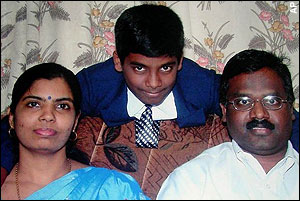
DELHI: The 15-year-old son of two doctors performed a filmed Caesarean
section birth under his parents' watch in southern India in an apparent
bid to gain a spot in the Guinness Book of World Records as the
youngest surgeon.
Instead, the boy's father could be stripped of his licenses and may
face criminal charges, officials said Thursday. go to story
Okay,
so the 15-year-old did undergo training under the auspices of his
doctor parents, but although the parents were licensed to practice,
they were
not licensed to teach, and the whole arrangement apparently contravened
not only the ethics of the medical profession but also the law.
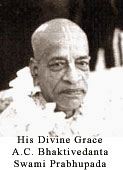
Below, Srila Prabhupada points out the need for training under the
spiritual master, but also warns, "It is not that we are to search out
a
spiritual master whimsically."
In
Need of a Spiritual Master excerpt
from The King of Knowledge, "Knowledge as Faith in Guru
and Surrender to Krishna"
We
cannot approach Krishna by exercising our mind, intelligence or senses.
We can approach Krishna through Krishna's representative, the spiritual
master, by our inquiry, submission and service. We may speculate,
experiment and perform penance and austerity, but all we shall get is
the labor we undertake. In Bhagavad-gita (11.53-54),
Krishna confirms:
I
cannot be known by penance, austerity nor by the study of the Vedas.
Only by pure, unalloyed devotional service can I be seen as I am
standing before you now.
The
living entity begins the path of devotional service when he gets the
opportunity to associate with a pure devotee of the Lord, the spiritual
master. more
Krishna
is a friend to everyone, but He is a special friend to His devotees. As
soon as we become a little inclined toward Him, He begins to give
favorable instructions from within our hearts so that we can gradually
make progress. Krishna is the first spiritual master, and when we
become more interested in Him, we have to go to a sadhu or holy
man who serves as spiritual master from without. This is enjoined by
Sri Krishna Himself in the following verse:
tad
viddhi pranipatena
pariprashnena sevaya
upadekshyanti te jñanam
jñaninas tattva-darshinah
"Just try to learn the truth by approaching a spiritual master. Inquire
from him submissively and render service unto him. The self-realized
soul can impart knowledge unto you because he has seen the truth." (Bg.
4.34)
It
is necessary to select a person to whom we can surrender ourselves. Of
course no one likes to surrender to anyone. We are puffed up with
whatever knowledge we have, and our attitude is, "Oh, who can give me
knowledge?" Some people say that for spiritual realization there is no
need for a spiritual master, but so far as Vedic literature is
concerned, and as far as Bhagavad-gita, Srimad-Bhagavatam
and the Upanishads are concerned, there is need of a
spiritual master. Even in the material world if one wants to learn to
be a musician, he has to search out a musician to teach him, or if one
wants to be an engineer, he has to go to a technological college and
learn from those who know the technology. Nor can anyone become a
doctor by simply purchasing a book from the market and reading it at
home. One has to be admitted to a medical college and undergo training
under licensed doctors. It is not possible to learn any major subject
simply by purchasing books and reading them at home. Someone is needed
to show us how to apply that knowledge which is found in the books. As
far as the science of God is concerned, Sri Krishna, the Supreme
Personality of Godhead Himself, advises us to go to a person to whom we
can surrender. This means that we have to check to see if a person is
capable of giving instructions in Bhagavad-gita and other
literatures of God realization. It is not that we are to search out a
spiritual master whimsically. We should be very serious to find a
person who is actually in knowledge of the subject.
In the beginning of Bhagavad-gita Arjuna was talking to
Krishna just like a friend, and Krishna was questioning how he, as a
military man, could give up fighting. But when Arjuna saw that friendly
talks would not make a solution to his problems, he surrendered unto
Krishna, saying, shishyas te 'ham shadhi mam tvam prapannam:
"Now I am Your disciple and a soul surrendered unto You. Please
instruct me." (Bg. 2.7) This is the process. It is not that we should
blindly surrender, but we should be able to inquire with intelligence.
Without inquiry, we cannot make advancement. In school a student who
makes inquiries from the teacher is usually an intelligent student. It
is generally a sign of intelligence when a small child inquires from
his father, "Oh, what is this? What is that?" We may have a very good
spiritual master, but if we have no power to inquire, we cannot make
progress. Nor should the inquiry be of the nature of a challenge. One
should not think, "Now I will see what kind of spiritual master he is.
I will challenge him." Our inquiries (pariprashnena) should be
on the subject of service (sevaya). Without service, our
inquiries will be futile, but even before making inquiries, we should
have some qualification. If we go to a store to purchase some gold or
jewelry and we know nothing about jewels or gold, we are likely to be
cheated. If we go to a jeweler and say, "Can you give me a diamond?" he
will understand that this is a fool. He could charge us any price for
anything. That kind of searching will not do at all. We first have to
become a little intelligent, for it is not possible to make spiritual
progress otherwise.
The beginning injunction of the Vedanta-sutra is: athato
brahma jijñasa. "Now is the time to inquire about
Brahman." The word atha means that one who is intelligent, who
has come to the point of realizing the basic frustrations of material
life, is capable of making inquiry. In Srimad-Bhagavatam
it is stated that one should inquire from a spiritual master about
subjects that are "beyond this darkness." This material world is by
nature dark, and it is artificially lighted by fire. Our inquiries
should be about the transcendental worlds which lie beyond this
universe. If one is desirous to find out about these spiritual worlds,
he should seek out a spiritual master; otherwise there is no point in
searching. If I want to study Bhagavad-gita or Vedanta-sutra
in order to make material improvement, it is not necessary to find a
spiritual master. One should first want to inquire about Brahman and
then search out a master who has perfect vision of the Absolute Truth (jñaninas
tattva-darshinah [Bg. 4.34]). Krishna is the supreme tattva,
Absolute Truth. In the Seventh Chapter of Bhagavad-gita
Sri Krishna states:
manushyanam
sahasreshu
kashcid yatati siddhaye
yatatam api siddhanam
kashcin mam vetti tattvatah
"Out of many thousands among men, one may endeavor for perfection, and
of those who have achieved perfection, hardly one knows Me in truth."
(Bg. 7.3)
Thus
out of many perfected spiritualists, one man may know what Krishna
actually is. As this verse indicates, the subject matter of Krishna is
not so easy but is very difficult. Yet Bhagavad-gita also
indicates that it is easy.
 International
Herald Tribune
- June 21, 2007 - Associated Press 15-year-old performs
surgery in southern India, sparking outrage
International
Herald Tribune
- June 21, 2007 - Associated Press 15-year-old performs
surgery in southern India, sparking outrage