CALLER
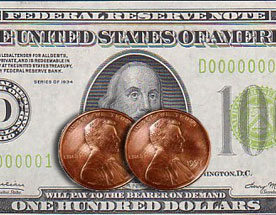
- According to the US Treasury, the Federal Reserve pays $20.60 per
1,000 denomination or a little over two cents for a $100.00 bill, is
that correct?
MR. SUPINSKI - That is probably close.
CALLER - Doesn't the Federal Reserve use the Federal Reserve Notes that
cost about two cents each to purchase US Bonds from the government?
MR. SUPINSKI - Yes, but there is more to it than that.
CALLER - Basically, that is what happens?
MR. SUPINSKI - Yes, basically you are correct.
CALLER - How many Federal Reserve Notes are in circulation?
MR. SUPINSKI - $263 billion and we can only account for a small
percentage.
CALLER - Where did they go?
MR. SUPINSKI - Peoples' mattresses, buried in their back yards and
illegal drug money.
CALLER - Since the debt is payable in Federal Reserve Notes, how can
the $4 trillion national debt be paid-off with the total Federal
Reserve Notes in circulation?
MR. SUPINSKI - I don't know.
CALLER - If the Federal Government would collect every Federal Reserve
Note in circulation would it be mathematically possible to pay the $4
trillion national debt?
MR. SUPINSKI - No.
CALLER - Am I correct when I say, $1 deposited in a member bank $8 can
be lent out through Fractional Reserve Policy?
MR. SUPINSKI - About $7.
CALLER - Correct me if I am wrong but, $7 of additional Federal Reserve
Notes were never put in circulation. But, for lack of better words were
"created out of thin air " in the form of credits and the two cents per
denomination were not paid either. In other words, the Federal Reserve
Notes were not physically printed but, in reality were created by a
journal entry and lent at interest. Is that correct?
MR. SUPINSKI - Yes. go
to story
So
to stop this inflation, the government must stop this paper currency.
Then the inflation... There will be no more inflation. But that they
will not do. They want to cheat people. "In God I trust. Take this
paper and you be satisfied that you have got thousand dollars." That's
all. This cheating is going on. Why should you pay me paper? Give me
real dollar, in gold. That they have none. They haven't got. more
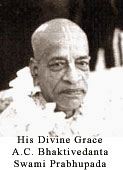
Hari-sauri: How would you control
inflation, how would you solve the inflation problem?
Prabhupada: Inflation
problem, I suggested, make gold coins as medium of exchange.
Hari-sauri: That means that
there'll be the same... it'll have the same value all over the world.
Prabhupada: No question of
value. Money has to be paid by real money-gold, silver. No paper.
Hari-sauri: But whether it's
gold or paper, isn't it all just representative of...
Prabhupada: No, medium of
exchange.
Hari-sauri: Yes.
Prabhupada: If I have to pay
you, if you don't accept paper, then I'll have to give you gold or
silver, and international exchange is going on. Then there is no
inflation, because you'll not accept paper, so what is the use of
printing notes? They are printing notes without any gold reserve.
Hari-sauri: Nothing. It's
just imaginary wealth.
Prabhupada: That's it. Bank
will give you loan, they are eager to give you loan, and you haven't
got to pay anything in gold and silver. One check, that's all. And with
that check you can purchase lots of commodities and hoard it, and price
will be increased. If I have to pay gold for [indistinct], then I have
limited source. The price will not increase. This is the only way.
Introduce gold only, gold and silver. In the British period in our
childhood there was practically no notes. Silver. If I have to take
payment from you, one thousand rupees, you will give me so much silver.
For counting, counting, I have to see whether it is.... There were some
imitation, counterfeit. So each coin you have to see, they were saying
like that, that, "For thousand rupees I have to occupy so much space."
Hari-sauri: And weighed so
much.
Prabhupada: Yes, and weight
was so much. The time was not so bad. If you take some cash, thousand,
two thousand rupees with you, you can safely walk on the street. Now if
somebody knows that he has got thousand rupees cash with him, maybe he
will be killed. The bank, they are so much afraid, they keep police in
bank, police guard, always.
 CALLER
- According to the US Treasury, the Federal Reserve pays $20.60 per
1,000 denomination or a little over two cents for a $100.00 bill, is
that correct?
CALLER
- According to the US Treasury, the Federal Reserve pays $20.60 per
1,000 denomination or a little over two cents for a $100.00 bill, is
that correct? 