Just
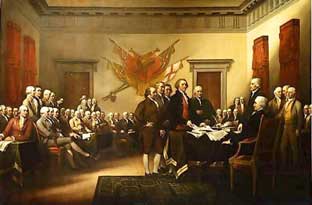
compare the rhetoric of the Declaration of Independence with the
behaviour of George W.
"That all men are created equal" and have "certain unalienable Rights
.. Life, Liberty and the pursuit of Happiness" - it is difficult to
reconcile that with stripping non-citizens of their civil rights after
9/11. Indeed, one could hardly say that José Padilla was freely
granted such rights even as a US citizen.
But then that is covered more freely in the list of gripes the Founding
Fathers had against Farmer George, "For depriving us in many cases, of
the benefit of Trial by Jury", or "For transporting us beyond Seas to
be tried for pretended offences," both of which Rancher George has made
a specialty. The colonists' whinge that "he has affected to render the
Military independent of and superior to the Civil Power", gets a little
too close to the bone as well.
George III also "made Judges dependent on his Will alone for the tenure
of their offices, and the amount and payment of their salaries," which
in spirit, if not in letter, Rancher George has certainly been
emulating that with federal attorneys.go to story
Spiritual
Revolution In
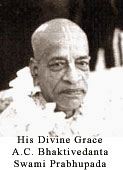
March 1976, in Mayapur, India, the editors of Back to Godhead
conducted a special interview with Srila Prabhupada, who took a hard
look at American slogans such as "All men are created equal," "In God
we trust," and "One nation under God."
As
soon as you point out, "This man is dishonest," and you scrutinize,
everyone is dishonest, then where is dishonesty? It is all honesty.
Because if the whole business is dishonesty, so there is no question of
honesty? Let it go on. That is the public opinion. Why one should be
unnecessarily honest? If the whole world is dishonest, and the
dishonest world is going on, then where is the harm? What is the use of
becoming... The same thing: "It is folly to be wise where ignorance is
bliss." more
BACK
TO GODHEAD: Thomas Jefferson put the basic philosophy of the American
Revolution into the Declaration of Independence. The important men of
the day who signed this document agreed that there are certain very
obvious or self-evident truths, the first of which is that all men are
created equal. By this they meant that all men are equal before the law
and have an equal opportunity to be protected by the law.
PRABHUPADA: Yes, in that sense men are, as you say, created equal.
BTG: Another point in the Declaration of Independence is that all men
are endowed by God with certain natural rights that cannot be taken
away from them. These are the rights of life, liberty, and...
PRABHUPADA: But animals also have the right to life. Why don't animals
also have the right to live? The rabbits, for instance, are living in
their own way in the forest. Why does the government allow hunters to
go and shoot them?
BTG: They were simply talking about human beings.
PRABHUPADA: Then they have no real philosophy. The narrow idea that my
family or my brother is good, and that I can kill all others, is
criminal. Suppose that for my family's sake I kill your father. Is that
philosophy? Real philosophy is suhridam sarva-bhutanam: [Bhagavad-gita
5.29] friendliness to all living entities. Certainly this applies to
human beings, but even if you unnecessarily kill one animal, I shall
immediately protest, "What nonsense are you doing?"
BTG: The founders of America said that another natural right is the
right to liberty, or freedom—freedom in the sense that the government
doesn't have the right to tell you what kind of job you have to do.
PRABHUPADA: If the government is not perfect, it should not be allowed
to tell people what to do. But if the government is perfect, then it
can.
BTG: The third natural right they mentioned was that every human being
has the right to pursue happiness.
PRABHUPADA: Yes. But your standard of happiness may be different from
my standard. You may like to eat meat; I hate it. How can your standard
of happiness be equal to mine?
BTG: So should everyone be free to try to achieve whatever standard of
happiness he wants?
PRABHUPADA: No, the standard of happiness should be prescribed
according to the qualities of the person. You must divide the whole
society into four groups: those with brahmana qualities, those
with kshatriya qualities, those with vaishya qualities,
and those with shudra qualities. Everyone should have good
facility to work according to his natural qualities.
You cannot engage a bull in the business of a horse, nor can you engage
a horse in the business of a bull. Today practically everyone is
getting a college education. But what is taught at these colleges?
Mostly technical knowledge, which is shudra education. Real
higher education means learning Vedic wisdom. This is meant for the brahmanas.
Alone, shudra education leads to a chaotic condition. Everyone
should be tested to find out which education he is suited for. Some shudras
may be given technical education, but most shudras should work
on the farms. Because everyone is coming to the cities to get an
education, thinking, "We can get more money," the agriculture is being
neglected. Now there is scarcity because no one is engaged in producing
nice foodstuffs. All these anomalies have been caused by bad
government. It is the duty of the government to see that everyone is
engaged according to his natural qualities. Then people will be happy.
BTG: So if the government artificially puts all men into one class,
then there can't be happiness.
PRABHUPADA: No, that is unnatural and will cause chaos.
BTG: America's founding fathers didn't like classes, because they'd had
such bad experience with them. Before the revolution, Americans had
been ruled by monarchs, but the monarchs would always become tyrannical
and unjust.
PRABHUPADA: Because they weren't trained to be saintly monarchs. In
Vedic civilization, boys were trained from the very beginning of life
as first-class brahmacharis [celibate students]. They went to
the gurukula, the school of the spiritual master, and learned
self-control, cleanliness, truthfulness, and many other saintly
qualities. The best of them were later fit to rule the country.
The American Revolution has no special significance. The point is that
when people become unhappy, they revolt. That was done in America, that
was done in France, and that was done in Russia.
BTG: The American revolutionaries said that if a government fails to
rule the people properly, then the people have the right to dissolve
that government.
PRABHUPADA: Yes. Just as in Nixon's case: they pulled him down. But if
they replace Nixon with another Nixon, then what is the value? They
must know how to replace Nixon with a saintly leader. Because people do
not have that training and that culture, they will go on electing one
Nixon after another and never become happy. People can be happy. The
formula for happiness is there in the Bhagavad-gita. The
first thing they must know is that the land belongs to God. Why do
Americans claim that the land belongs to them? When the first settlers
went to America, they said, "This land belongs to God; therefore we
have a right to live here." So why are they now not allowing others to
settle on the land? What is their philosophy? There are so many
overpopulated countries. The American government should let those
people go to America and should give them facility to cultivate the
land and produce grains. Why are they not doing that? They have taken
others' property by force, and by force they are checking others from
going there. What is the philosophy behind this?
BTG: There is no philosophy.
PRABHUPADA: Roguism is their philosophy. They take the property by
force, and then they make a law that no one can take another's property
by force. So they are thieves. They cannot restrict God's property from
being occupied by God's sons. America and the other countries in the
United Nations should agree that wherever there is enough land, it may
be utilized by the human society for producing food. The government can
say, "All right, you are overpopulated. Your people can come here. We
will give them land, and they can produce food." We would see a
wonderful result. But will they do that? No. Then what is their
philosophy? Roguism. "I will take the land by force, and then I won't
allow others to come here."
BTG: One American motto is "One nation under God."
PRABHUPADA: Yes, that is Krishna consciousness. There should be one
nation under God, and one world government under God as well.
Everything belongs to God, and we are all His sons. That philosophy is
wanted.
BTG: But in America people are very much afraid of a central government
because they think that whenever there's a strong government there will
always be tyranny.
PRABHUPADA: If the leaders are properly trained, there cannot be
tyranny.
BTG: But one of the premises of the American system of government is
that if a leader has too much power, he will inevitably become corrupt.
PRABHUPADA: You have to train him in such a way that he cannot become
corrupt!
BTG: What is that training process?
PRABHUPADA: That training is the varnashram-dharma. Divide the
society according to quality and train people in the principle that
everything belongs to God and should be used in the service of God.
Then there really can be "one nation under God."
BTG: But if society is divided into different groups, won't there be
envy?
PRABHUPADA: No, no. Just as in my body there are different parts that
work together, so the society can have different parts working for the
same goal. My hand is different from my leg. But when I tell the hand,
"Bring a glass of water," the leg will help. The leg is required, and
the hand is required.
BTG: But in the Western world we have a working class and a capitalist
class, and there is always warfare going on between the two.
PRABHUPADA: Yes. The capitalist class is required, and the working
class is also required.
BTG: But they are fighting.
PRABHUPADA: Because they are not trained up; they have no common cause.
The hand and the leg work differently, but the common cause is to
maintain the body. So if you find out the common cause for both the
capitalists and the workers, then there will be no fighting. But if you
do not know the common cause, then there will always be fighting.
BTG: Revolution?
PRABHUPADA: Yes.
BTG: Then the most important thing is to find the common cause that
people can unite on?
PRABHUPADA: Yes, just like in our Krishna conscious society you come to
consult me about every activity, because I can give you the common
cause. Otherwise, there will be fighting. The government should be very
expert to know the aim of life—the common cause—and they should train
the people to work for the common cause. Then they will be happy and
peaceful. But if people simply elect rascals like Nixon, they will
never find a common cause. Any rascal can secure votes by some
arrangement, and then he becomes the head of the government. The
candidates are bribing, they are cheating, they are making propaganda
to win votes. Somehow or other they get votes and capture the prime
post. This system is bad.
BTG: So if we don't choose our leaders by popular election, how will
society be governed?
PRABHUPADA: You require brahmanas, kshatriyas, vaishyas,
and shudras. Just as when you want to construct a building, you
require engineers. You don't want sweepers. Isn't that so? What will
the sweeper do? No, there must be engineers. So if you follow the
division of varnashram, only kshatriyas are allowed to
govern. And for the legislative assembly—the senators—only qualified brahmanas.
Now the butcher is in the legislative assembly. What does he know about
making laws? He is a butcher, but by winning votes he becomes a
senator. At the present moment, by the principle of vox populi,
a butcher goes to the legislature. So everything depends on training.
In our Krishna conscious society, we're actually doing that, but in the
case of politics, they forget it. There cannot be just one class. That
is foolishness, because we have to engage different classes of men in
different activities. If we do not know the art, then we will fail,
because unless there is a division of work, there will be havoc. We
have discussed all the responsibilities of the king in the Srimad-Bhagavatam.
The different classes in society should cooperate exactly as the
different parts of the body do. Although each part is meant for a
different purpose, they all work for one cause: to maintain the body
properly.
BTG: What is the actual duty of the government?
PRABHUPADA: To understand what God wants and to see that society works
toward that aim. Then people will be happy. But if the people work in
the wrong direction, how can they be happy? The government's duty is to
see that they are working in the right direction. The right direction
is to know God and to act according to His instructions. But if the
leaders themselves do not believe in the supremacy of God, and if they
do not know what God wants to do, or what He wants us to do, then how
can there be good government? The leaders are misled, and they are
misleading others. That is the chaotic condition in the world today.
BTG: In the United States there has traditionally been the separation
of church and state.
PRABHUPADA: I am not talking about the church. Church or no church—that
is not the point. The main thing is that the leaders have to accept
that there is a supreme controller. How can they deny it? Everything in
nature is going on under the Supreme Lord's control. The leaders cannot
control nature, so why don't they accept a supreme controller? That is
the defect in society. In every respect, the leaders are feeling that
there must be a supreme controller, and yet they are still denying Him.
BTG: But suppose the government is atheistic...
PRABHUPADA: Then there cannot be good government. The Americans say
they trust in God. But without the science of God, that trust is simply
fictitious. First take the science of God very seriously, then put your
trust in Him. They do not know what God is, but we do. We actually
trust in God.
They're manufacturing their own way of governing. And that is their
defect. They will never be successful. They are imperfect, and if they
go on manufacturing their own ways and means, they will remain
imperfect. There will always be revolutions—one after another. There
will be no peace.
BTG: Who determines the regulative principles of religion that people
should follow?
PRABHUPADA: God. God is perfect. He does that. According to the Vedic
version, God is the leader of all living entities (nityo nityanam
chetanash chetananam (Katha Upanishad 2.2.13)). We
are different from Him because He is all-perfect and we are not. We are
very small. We have the qualities of God, but in very small quantity.
Therefore we have only a little knowledge—that's airplane, but you
cannot manufacture a mosquito. God has created the mosquito's body,
which is also an "airplane." And that is the difference between God and
us: we have knowledge, but it is not as perfect as God's. So the
leaders of the government have to consult God; then they will rule
perfectly.
BTG: Has God also devised the most perfect government?
PRABHUPADA: Oh, yes. The kshatriyas ruled the government in
Vedic times. When there was a war, the king was the first to fight.
Just like your George Washington: he fought when there was a war. But
what kind of president is ruling now? When there is a war, he sits very
securely and telephones orders. He's not fit to be president. When
there is war, the president should be the first to come forward and
lead the battle.
BTG: But if man is small and imperfect, how can he execute God's
perfect orders for a perfect government?
PRABHUPADA: Although you may be imperfect, because you are carrying out
my order, you're becoming perfect. You have accepted me as your leader,
and I accept God as my leader. In this way society can be governed
perfectly.
BTG: So good government means first of all to accept the Supreme Being
as the real ruler of the government?
PRABHUPADA: You cannot directly accept the Supreme Being. You must
accept the servants of the Supreme Being—the brahmanas or
Vaishnavas [devotees of the Lord]—as your guides. The government men
are kshatriyas—the second class. The kshatriyas should
take advice from the brahmanas or Vaishnavas and make laws
accordingly. The vaishyas should carry out the kshatriyas'
orders in practice. And the shudras should work under these
three orders. Then society will be perfect.
 Guardian
UK commentisfree July 4, 2007
- IAN WILLIAMS George III or George
W?
Guardian
UK commentisfree July 4, 2007
- IAN WILLIAMS George III or George
W?