As
biologists turn up evidence that animals can exhibit emotions and
patterns of cognition once thought of as strictly human, Descartes’s
dictum, “I think, therefore I am,” loses its force.
For
many scientists, the evidence that moral reasoning is a result of
physical traits that evolve along with everything else is just more
evidence against the existence of the soul, or of a God to imbue humans
with souls. For many believers, particularly in the United States, the
findings show the error, even wickedness, of viewing the world in
strictly material terms. And they provide for theologians a growing
impetus to reconcile the existence of the soul with the growing
evidence that humans are not, physically or even mentally, in a class
by themselves.go to story
PROF.
DURCKHEIM: Perhaps it makes a difference if a person thinks, "I am the
spirit, and I have a body," rather than "I am the body, and I have a
soul."
PRABHUPADA: Yes. It is a mistake to think that you are the body and
possess a soul. That is not true. You are the soul, and you are covered
by a temporary body. The soul is the important thing, not the body. For
example, as long as you wear a coat, it is important to you. But if it
becomes torn, you throw it away and purchase another coat. The living
being constantly experiences the same thing. You separate from this
present body and accept another body. That is called death. more
The
temporary material body is certainly a foreign dress. The Bhagavad-gita
(2.20) clearly says that after the destruction of the material body the
living entity is not annihilated, nor does he lose his identity. The
identity of the living entity is never impersonal or formless; on the
contrary, it is the material dress that is formless and that takes a
shape according to the form of the indestructible person. No living
entity is originally formless, as is wrongly thought by those with a
poor fund of knowledge. This mantra verifies the fact that the
living entity exists after the annihilation of the material body.
In the material world, material nature displays wonderful workmanship
by creating varieties of bodies for the living beings according to
their propensities for sense gratification. The living entity who wants
to taste stool is given a material body that is quite suitable for
eating stool—that of a hog. Similarly, one who wants to eat the flesh
and blood of other animals may be given a tiger's body equipped with
suitable teeth and claws. But the human being is not meant for eating
flesh, nor does he have any desire to taste stool, even in the most
aboriginal state. Human teeth are so made that they can chew and cut
fruit and vegetables, although there are two canine teeth so that
primitive humans can eat flesh if they so desire.
But in any case, the material bodies of all animals and men are foreign
to the living entity. They change according to the living entity's
desire for sense gratification. In the cycle of evolution, the living
entity changes bodies one after another. When the world was full of
water, the living entity took an aquatic form. Then he passed to
vegetable life, from vegetable life to worm life, from worm life to
bird life, from bird life to animal life, and from animal life to the
human form. The highest developed form is this human form when it is
possessed of a full sense of spiritual knowledge. The highest
development of one's spiritual sense is described in this mantra: One
should give up the material body, which will be turned to ashes, and
allow the air of life to merge into the eternal reservoir of air. The
living being's activities are performed within the body through the
movements of different kinds of air, known in summary as prana-vayu.
The yogis generally study how to control the airs of the body.
The soul is supposed to rise from one circle of air to another until it
rises to the brahma-randhra, the highest circle. From that
point the perfect yogi can transfer himself to any planet he
likes. The process is to give up one material body and then enter into
another. But the highest perfection of such changes occurs only when
the living entity is able to give up the material body altogether, as
suggested in this mantra, and enter into the spiritual
atmosphere, where he can develop a completely different type of body—a
spiritual body, which never has to meet death or change.
Here in the material world, material nature forces the living entity to
change his body due to his different desires for sense gratification.
These desires are represented in the various species of life, from
germs to the most perfected material bodies, those of Brahma and the
demigods. All of these living entities have bodies composed of matter
in different shapes. The intelligent man sees oneness not in the
variety of the bodies but in the spiritual identity. The spiritual
spark, which is part and parcel of the Supreme Lord, is the same
whether he is in a body of a hog or in the body of a demigod. The
living entity takes on different bodies according to his pious and
vicious activities. The human body is highly developed and has full
consciousness. According to the Bhagavad-gita (7.19), the
most perfect man surrenders unto the Lord after many, many lifetimes of
culturing knowledge. The culture of knowledge reaches perfection only
when the knower comes to the point of surrendering unto the Supreme
Lord, Vasudeva. Otherwise, even after attaining knowledge of one's
spiritual identity, if one does not come to the point of knowing that
the living entities are eternal parts and parcels of the whole and can
never become the whole, one has to fall down again into the material
atmosphere. Indeed, one must fall down even if he has become one with
the brahmajyoti.
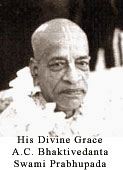
 A.C. Bhaktivedanta Swami
  Guardian
- June 26, 2007 - CORNELIA DEAN Science of the Soul?
‘I Think, Therefore I Am’ Is Losing Force
Guardian
- June 26, 2007 - CORNELIA DEAN Science of the Soul?
‘I Think, Therefore I Am’ Is Losing Force