[Posted March 8, 2007]
Habituated
to Unnecessary Things
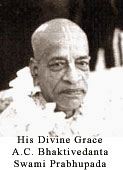
A.C. Bhaktivedanta Swami
  CBSnews.com
- March 8, 2007 - Congress Takes Aim At Credit Card Policies CBSnews.com
- March 8, 2007 - Congress Takes Aim At Credit Card Policies
Lawmakers
Threaten Legislation If Industry Doesn't Voluntarily Curb "Sky-High"
Interest Rates And Fees
Senate Banking Committee Chairman Christopher Dodd and other Democratic
senators challenged credit card executives at a hearing in January over
rising late fees and other penalties and marketing practices they
portrayed as predatory. Dodd, D-Conn., said he was putting the industry
on notice that if it doesn't improve practices on its own, legislation
may be warranted.
Since Democrats assumed control of Congress in January, they have put a
number of consumer issues on the legislative agenda. With Americans
weighed down by some $850 billion in consumer debt, the practices of
the robustly profitable credit card industry are a compelling subject
for scrutiny.
Citigroup, the nation's largest financial institution, announced last
week that it was eliminating the practice of so-called universal
default — raising interest rates for card customers because of their
failure to pay other creditors on time. In addition, Citigroup said it
would eliminate some types of interest rate increases that have been
criticized. go to story
Got
money, now what?
excerpt
from Lecture on Srimad-Bhagavatam 1.2.6, Rome, May 24,
1974
|
Making
Money
|
Can't
Get No Satisfaction A.C.
Bhaktivedanta Swami
So
much human energy is being diverted to making money, for the general
population has increased its capacity to make more and more dollars,
but in the long run the result is that this unrestricted and unlawful
monetary inflation has created a bad economy all over the world... more
|
nashta-prayeshv
abhadreshu
nityam bhagavata-sevaya
bhagavaty uttama-shloke
bhaktir bhavati naishthiki
"By regular attendance in classes on the Bhagavatam and
by rendering of service to the pure devotee, all that is troublesome to
the heart is almost completely destroyed, and loving service unto the
Personality of Godhead, who is praised with transcendental songs, is
established as an irrevocable fact.
—Srimad-Bhagavatam 1.2.18
Here
is the remedy for eliminating all inauspicious things within the heart,
which are considered to be obstacles in the path of self-realization.
The remedy is the association of the Bhagavatas. There are two
types of Bhagavatas, namely the book Bhagavata and the
devotee Bhagavata. Both the Bhagavatas are competent
remedies, and both of them or either of them can be good enough to
eliminate the obstacles. A devotee Bhagavata is as good as the
book Bhagavata because the devotee Bhagavata leads his
life in terms of the book Bhagavata and the book Bhagavata
is full of information about the Personality of Godhead and His pure
devotees, who are also Bhagavatas. Bhagavata book and
person are identical.
The devotee Bhagavata is a direct representative of Bhagavan,
the Personality of Godhead. So by pleasing the devotee Bhagavata
one can receive the benefit of the book Bhagavata. Human reason
fails to understand how by serving the devotee Bhagavata or the
book Bhagavata one gets gradual promotion on the path of
devotion. But actually these are facts explained by Srila Naradadeva,
who happened to be a maidservant's son in his previous life. The
maidservant was engaged in the menial service of the sages, and thus he
also came into contact with them. And simply by associating with them
and accepting the remnants of food left by the sages, the son of the
maidservant got the chance to become the great devotee and personality
Srila Naradadeva. These are the miraculous effects of the association
of Bhagavatas. And to understand these effects practically, it
should be noted that by such sincere association of the Bhagavatas
one is sure to receive transcendental knowledge very easily, with the
result that one becomes fixed in the devotional service of the Lord.
The more progress is made in devotional service under the guidance of
the Bhagavatas, the more one becomes fixed in the
transcendental loving service of the Lord. The messages of the book Bhagavata,
therefore, have to be received from the devotee Bhagavata, and
the combination of these two Bhagavatas will help the neophyte
devotee to make progress on and on.
Generally, people do not understand the need for making spiritual
progress and cleansing the heart of all dirty things (abhadrani).
Material life means dirty life, uncivilized life, yet people think that
having nice clothes and a nice apartment and a nicely washed body means
they are civilized. They do not know how the contamination within their
hearts has attacked them.
In the name of civilization, people have created so many unnecessary
things, called anarthas. For example, thousands of years ago,
in the Vedic age, when there was no so-called advancement of
civilization, people used to eat from utensils made of silver or gold,
or at least some kind of metal. Now people are using plastic, yet they
are still proud of their advanced civilization. Actually, the plastic
utensils are unnecessary. Another example: two hundred years ago in
India there was no industry, but people were so happy. They did not
have to travel two hundred miles or five hundred miles away from home
to earn their livelihood. In Europe and America I have seen that some
people are daily flying by airplane to the place where they earn their
livelihood. From Toronto they are flying to Montreal—almost five
hundred miles. Nearly everyone has to travel at least fifty miles. In
New York many people come from a distant place on Long Island, cross
the river, and then take a bus to reach their place of employment. All
this travel is simply unnecessary.
Chanakya Pandit asks, "Who is happy?" He answers, "The man who does
not work away from home and who is not a debtor—he is happy." Very
simple. Yet now we see that practically everyone works away from home
and everyone is a great debtor. So how can they be happy? In America
the banks canvass, "Borrow money from us, purchase a motorcar, purchase
a house, and as soon as you get your salary, give it to us." Or they
offer, "Take this bank card." It should be known as a bankrupt card. If
you take the card and deposit your money in the bank, then you can
purchase whatever you like with the card. But soon you are without any
money, and all you have left is that card.
So, all these anarthas can immediately be finished if you take
up the process of Krishna consciousness, or bhakti-yoga: anarthopashamam
sakshad bhakti-yogam adhokshaje [Srimad-Bhagavatam
1.7.6]. A good example is our students in the Krishna consciousness
movement. Many are from America or Europe, and they knew very well how
to increase anarthas. But as soon as they joined our Society
they no longer had to pay the cinema bill, the gambling bill, and so
many other bills. Even the medical bills were decreased almost to nil.
Does a person die without smoking? No. It is an anartha. One
becomes habituated to smoking due to bad association: sangat
sanjayate kamah. Because of bad association one learns how to
smoke, how to gamble, how to eat meat, and how to take intoxicants. In
America the government is spending millions of dollars to stop this
intoxication habit among the young people. But the government does not
know how to stop it. Here is the remedy: Krishna consciousness. It is
practical. Anyone who seriously takes up the process of Krishna
consciousness can immediately give up all bad habits, including
intoxication. But still the government will not patronize the Krishna
consciousness movement. They'd rather spend lavishly on some useless
program.
Because the modern people do not know how to get out of the clutches of
all these unnecessary things, the learned Srila Vyasadeva wrote the Srimad-Bhagavatam:
lokasyajanato vidvamsh chakre satvata-samhitam. Take
shelter of the Srimad-Bhagavatam and you will perfectly
learn how to diminish your unnecessary things. The simple process is
given in the previous verse (SB 1.2.17):
shrinvatam
sva-kathah krishnah punya-shravana-kirtanah
hridy antah-stho hy abhadrani vidhunoti suhrit satam
If
you simply hear about Krishna from the Srimad-Bhagavatam
or the Bhagavad-gita, Krishna Himself will cleanse away
your anarthas. In the Bhagavad-gita Krishna is
directly speaking about Himself. But don't misinterpret His words.
Simply hear them as Arjuna did. Someone may say, "Arjuna heard the Bhagavad-gita
directly from Krishna, but now Krishna is absent. So how can we hear it
as Arjuna did?" Because Krishna is absolute, He is nondifferent from
His words. So if you read the Bhagavad-gita as it is,
receiving it through disciplic succession, then your reading is as good
as Arjuna's hearing directly from Krishna. But if you give your own
interpretation of the Bhagavad-gita, or hear the
interpretation of a nondevotee, you'll remain a rascal.
Sanatana Gosvami has forbidden us to hear about Krishna from
nondevotees:
avaishnava-mukhodgirnam
putam hari-kathamritam
shravanam naiva kartavyam sarpocchishtam yatha payah
"One
should not hear anything about Krishna from a non-Vaishnava. Milk
touched by the lips of a serpent has poisonous effects; similarly,
talks about Krishna given by a non-Vaishnava are also poisonous."
Sometimes, in India, people who do not follow the principles of
Vaishnava behavior become professional reciters of the Srimad-Bhagavatam
and hold seven-day public readings, called bhagavata-saptaha.
Such hearing of Srimad-Bhagavatam is forbidden. The
present verse recommends nityam bhagavata-sevaya,
"regular hearing of the Bhagavatam," not saptaham
bhagavata-sevaya, "one-week's hearing of the Bhagavatam."
Is the Bhagavatam such a thing that you can understand
everything just by hearing it for one week? You will not understand one
word by reading the Bhagavatam for only a week, what to
speak of all eighteen thousand verses. The whole of Vedic knowledge is
contained in the Bhagavatam (nigama-kalpa-taror
galitam phalam [SB 1.1.3]), so what will you understand by only
a week's reading?
The real prescription is given here: nityam bhagavata-sevaya.
Every day you should hear the Bhagavatam, and at every
moment you should remember the Bhagavatam. Then nashta-prayeshv
abhadreshu: [SB 1.2.18] the dirty things in your heart will be
eradicated. This is the essence of the Krishna consciousness
movement—to provide you with an opportunity to hear about Krishna
patiently so that the dirty things within your heart will be cleansed
away. What those dirty things are will be mentioned in the next verse:
lust, greed, and other effects of the modes of passion and ignorance (rajas-tamo-bhavah
[SB 1.2.19]).
Back
to Top |