[Posted
January 18, 2007]
The
Clock is Ticking, But Time is Not About to Run Out Just Yet
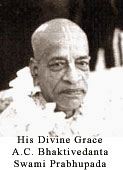
His Divine Grace A.C.
Bhaktivedanta Swami Prabhupada
 The
Guardian
- January 18th, 2007 -
In praise of ... the doomsday clock The
Guardian
- January 18th, 2007 -
In praise of ... the doomsday clock
Some
clocks run more slowly than others, but only one has never reached
midnight and that is something for which everyone should give thanks.
Since 1947 the doomsday clock has kept watch on armageddon, ticking
towards a potential global nuclear holocaust. Set by the Bulletin of
Atomic Scientists, the clock has confronted the world with the prospect
of its instantaneous self-destruction for the last 60 years, a bleak
expression of the threat humankind has created.
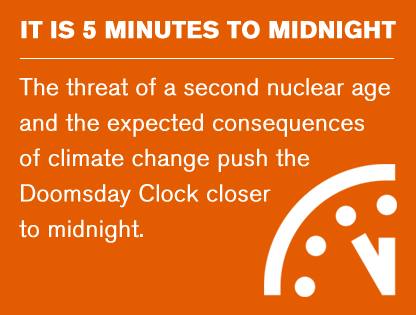
Yesterday the hands advanced for the first time since 2002, edging two
minutes towards the darkness of midnight. They now stand at 11.55pm.
go to story
|
Dangerous
Times
|
Get
Out of Danger by
A.C. Bhaktivedanta Swami Prabhupada
This
material world is certified by the Lord in the Bhagavad-gita
as a
dangerous place full of calamities. Less intelligent persons prepare
plans to adjust to those calamities, without knowing that the nature of
this place is to be full of calamities. They have no information of the
abode of the Lord, which is full of bliss and without trace of
calamity. The duty of the sane person, therefore, is to be undisturbed
by worldly calamities, which are sure to happen in all circumstances.
Suffering all sorts of unavoidable misfortunes, one should make
progress in spiritual realization, because that is the mission of human
life. more
|
TEXT
17
sahasra-yuga-paryantam
ahar yad brahmano viduh
ratrim yuga-sahasrantam
te 'ho-ratra-vido janah
TRANSLATION
By human calculation, a thousand ages taken together is the duration of
Brahma's one day. And such also is the duration of his night.
PURPORT
The duration of the material universe is limited. It is manifested in
cycles of kalpas. A kalpa is a day of Brahma, and one
day of Brahma consists of a thousand cycles of four yugas or
ages: Satya, Treta, Dvapara, and Kali. The cycle of Satya is
characterized by virtue, wisdom and religion, there being practically
no ignorance and vice, and the yuga lasts 1,728,000 years. In
the Treta-yuga vice is introduced, and this yuga lasts
1,296,000 years. In the Dvapara-yuga there is an even greater decline
in virtue and religion, vice increasing, and this yuga lasts
864,000 years. And finally in Kali-yuga (the yuga we have now
been experiencing over the past 5,000 years) there is an abundance of
strife, ignorance, irreligion and vice, true virtue being practically
nonexistent, and this yuga lasts 432,000 years. In Kali-yuga
vice increases to such a point that at the termination of the yuga
the Supreme Lord Himself appears as the Kalki avatara,
vanquishes the demons, saves His devotees, and commences another
Satya-yuga. Then the process is set rolling again. These four yugas,
rotating a thousand times, comprise one day of Brahma, the creator god,
and the same number comprise one night. Brahma lives one hundred of
such "years" and then dies. These "hundred years" by earth calculations
total to 311 trillion and 40 million earth years. By these calculations
the life of Brahma seems fantastic and interminable, but from the
viewpoint of eternity it is as brief as a lightning flash. In the
causal ocean there are innumerable Brahmas rising and disappearing like
bubbles in the Atlantic. Brahma and his creation are all part of the
material universe, and therefore they are in constant flux.
In the material universe not even Brahma is free from the process of
birth, old age, disease and death. Brahma, however, is directly engaged
in the service of the Supreme Lord in the management of this
universe—therefore he at once attains liberation. Elevated sannyasis
are promoted to Brahma's particular planet, Brahmaloka, which is the
highest planet in the material universe and which survives all the
heavenly planets in the upper strata of the planetary system, but in
due course Brahma and all inhabitants of Brahmaloka are subject to
death, according to the law of material nature.
TEXT
18
avyaktad vyaktayah sarvah
prabhavanty ahar-agame
ratry-agame praliyante
tatraivavyakta-samjnake
TRANSLATION
When Brahma's day is manifest, this multitude of living entities comes
into being, and at the arrival of Brahma's night they are all
annihilated.
PURPORT
The less intelligent jivas try to remain within this material
world and are accordingly elevated and degraded in the various
planetary systems. During the daytime of Brahma they exhibit their
activities, and at the coming of Brahma's night they are annihilated.
In the day they receive various bodies for material activities, and at
night these bodies perish. The jivas (individual souls) remain
compact in the body of Vishnu and again and again are manifest at the
arrival of Brahma's day. When Brahma's life is finally finished, they
are all annihilated and remain unmanifest for millions and millions of
years. Finally, when Brahma is born again in another millennium, they
are again manifest. In this way the jivas are captivated by the
material world. However, those intelligent beings who take to Krishna
consciousness and chant Hare Krishna, Hare Rama in devotional service
transfer themselves, even in this life, to the spiritual planet of
Krishna and become eternally blissful there, not being subject to such
rebirths.
Back
to Top |