The
Bhaktivedantas
Krishna
Books
What
is Hare Krishna?
The
Founder-Acharya
Hare
Krishna Mantra
Sankirtan
Movement
Personality
of Godhead
Lord
Chaitanya
A.C.Bhaktivedanta
Swami Prabhupada
Hansadutta
das
Events: Kirtan Festival
World
Sankirtan Party
Submit
News
Email
©
2004 - Hansadutta das
|
| Get Srila
Prabhupada's original, unrevised books. Beware
of imitations. More than 160 titles published! Learn more. |
[Posted
January 31, 2006]
Where is the Real Money?
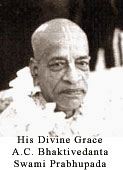
by His Divine Grace A.C.
Bhaktivedanta Swami Prabhupada
Founder-Acharya of the
world-wide Hare Krishna Movement, Brahma Sampradaya Acharya
Room Conversation with
disciples in Bhuvaneshvara, India, January 21, 1977
www.theinternationalforecaster.com, Friday, January
28, 2006--"Train Wreck of the Week" by BOB CHAPMAN--Banks
Planning for the Worst
We are curious why some banks are instructing their employees how to
handle customers in the event of a collapse in the US economy -
specifically telling employees that only agents from the Department of
Fatherland Security will have authority to decide what belongings
customers may have from their safe deposit boxes and that precious
metals and other valuables will not be released to US citizens.
Ramesvara:
There was one question I had, Srila Prabhupada. You have written in the
Third Volume of the First Canto [Srimad Bhagavatam 1.17.39
and 1.17.40] different instructions for the
age of Kali, how there'll be
compulsory marriage and so on and so on. And you mentioned about the
gold standard, that this is very bad, this artificial standard of
monetary exchange.
Prabhupada: Oh, yes. It is very bad.
Ramesvara: In the future this is something that we should
try to correct.
Prabhupada: You should introduce coin, real money.
Hari-sauri: Real gold coins. No paper.
Prabhupada: Anyone has got money... It is fact. And what
is this nonsense, keeping some paper and thinking he has got money? How
cheating it is going on, from government's side. And therefore
artificial inflation. You can print, so the price is increased. Because
you haven't got to pay him real money, you print and pay him, and he
will ask, "Give me this money. Then I'll supply." "All right, take."
You print and pay.
Ramesvara: It's definitely a means that the government has
for controlling. Because they can withdraw money, pull it back out of
circulation by increasing the interest the banks give, or they can get
more money in...
Prabhupada: Anything done artificially.
Ramesvara: They control the amount of interest on loans.
It's all standardized from what they call the Federal Reserve system.
This was introduced during the Depression by the bankers.
Prabhupada: Whatever they do, when you receive money in
the paper it has no value. Bad money. It is bad money. It is not good
money.
Ramesvara: Actually most purchasing in America is done on
credit now. Even a step beyond paper money is credit, no money, buying
on no money, loans.
Prabhupada: That is in India also.
Ramesvara: We don't find these things in Vedic culture too
much.
Prabhupada: There was never paper money.
Hari-sauri: No. They used to...
Prabhupada: That barter system. You have got rice; I have
got something else. So I give you something; you give me something.
Hari-sauri: But isn't inflation possible even with coins?
Even if you have gold coins, isn't inflation still possible?
Prabhupada: No, gold is acceptable by everyone.
Ramesvara: The main point is the barter system.
Hari-sauri: Yes, well its value is recognized by its
purchasing power.
Prabhupada: Yes.
Hari-sauri: So you can alter... Say, you have one gold
coin. You can alter what it...
Prabhupada: No. If you introduce real metal coin, then
there will be no inflation.
Hari-sauri: There's only a certain amount of metal.
Prabhupada: That's all right. The exchange... The more
demand, more price. So suppose here is a spectacle. I am demanding ten
rupees. So both of you are customer, and you are asking for this
spectacle. Then I am increasing my price. So if you can pay me by
printing paper, you'll accept any price. That means artificially price
is increased. Is it not?
Ramesvara: Yes.
Hari-sauri: So the idea is that with coins the man who has
the goods, he can't...
Prabhupada: Therefore... Suppose he has got ten coins; you
have got ten coins. I am wanting fifteen coins. So there will be no
competition. I have to accept either from you or you, ten coins.
Hari-sauri: Right. Because there's only that much money.
Prabhupada: But if I increase price and if you print... If
you have got power to print, "All right. Take fifteen coins, er,
fifteen rupees." But you [can] print and pay me. But if the gold, the
coin, is there, you cannot increase on that.
Hari-sauri: He can't increase the price of the product,
and the man who got..., 'cause there's only a certain amount of money
there.
Prabhupada: But I can increase the price provided you pay
me. But by printing, it is easier. But if you have to collect coins,
that will be difficult, so there will be no artificial increase of...
Hari-sauri: Yes. Coins is a check...
Prabhupada: Yes.
Hari-sauri: ...on charging too much.
Prabhupada: That is wanted. And these rascals, they are
artificially printing paper as money. And I am a rascal; I'm demanding
more because I have got customer.
Ramesvara: The difference between Vedic culture and...,
the Krishna conscious culture and the modern culture is very, very
dramatic, very big difference. So the transforming of society...
Prabhupada: And besides that, if we concentrate in farm
project there will be no need of exchange, because I'll be satisfied
with my products. That's all. There is no need of exchange. Whatever I
need, I get in my farm.
Ramesvara: Weaving, cloth.
Prabhupada: Everything I get. So I haven't got to go
outside for exchange. If you are satisfied in your farm—I am
satisfied—then where is question of exchange? There is no need of
artificial... So this banking, "fanking," everything will collapse
automatically. There is no money, who is going to keep money in the
bank?
Hari-sauri: Who needs it?
Prabhupada: [laughs] So this artificial way of banking,
that will be also collapsed.
purport,
Srimad Bhagavatam 1.17.39: According to Srimad-Bhagavatam,
gold encourages falsity, intoxication, prostitution, envy and enmity.
Even a gold-standard exchange and currency is bad. Gold-standard
currency is based on falsehood because the currency is not on a par
with the reserved gold. The basic principle is falsity because currency
notes are issued in value beyond that of the actual reserved gold. This
artificial inflation of currency by the authorities encourages
prostitution of the state economy. The price of commodities becomes
artificially inflated because of bad money, or artificial currency
notes. Bad money drives away good money. Instead of paper currency,
actual gold coins should be used for exchange, and this will stop
prostitution of gold. Gold ornaments for women may be allowed by
control, not by quality, but by quantity. This will discourage lust,
envy and enmity. When there is actual gold currency in the form of
coins, the influence of gold in producing falsity, prostitution, etc.,
will automatically cease. There will be no need of an anticorruption
ministry for another term of prostitution and falsity of purpose.
purport,
Srimad-Bhagavatam
1.17.40: Thus the age of Kali began with gold standardization, and
therefore falsity, intoxication, animal slaughter and prostitution are
rampant all over the world, and the saner section is eager to drive out
corruption. The counteracting process is suggested above, and everyone
can take advantage of this suggestion.
Back
to Top |
