UN-united: cannot stop war
by A.C. Bhaktivedanta Swami Prabhupada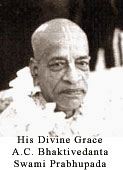
Associated Press, Friday, July 21, 2006 - by
SAM F. GHATTAS - U.N. post hit in Israel-Hezbollah fighting
 BEIRUT, Lebanon — A U.N.-run observation post near the
border was struck during fighting between Israel and Hezbollah
militants on Friday, while Israel pushed ahead with airstrikes on
Lebanon and warned people in the south to flee as it prepared for a
likely ground invasion to set up a deep buffer zone.
The Israeli army said Hezbollah rockets hit the U.N. post near Zarit,
just inside Israel, but a U.N. officer said it was an artillery shell
fired by the Israeli Defense Force.
BEIRUT, Lebanon — A U.N.-run observation post near the
border was struck during fighting between Israel and Hezbollah
militants on Friday, while Israel pushed ahead with airstrikes on
Lebanon and warned people in the south to flee as it prepared for a
likely ground invasion to set up a deep buffer zone.
The Israeli army said Hezbollah rockets hit the U.N. post near Zarit,
just inside Israel, but a U.N. officer said it was an artillery shell
fired by the Israeli Defense Force.
Comment Send this story to a friend
If
one does not come to Krishna consciousness, he may be relieved for the
time being from the reactions of sinful activities, but he will again
commit transgressions. Therefore Parikshit Maharaja said: kvachin
nivartate 'bhadrat kvachich charati tat punah prayashchittam ato
'partham: [Srimad-Bhagavatam 6.1.10] "Repetitive
sinning and atoning seem to me like nothing but a waste of time." He
gave the example of an elephant which cleanses his body thoroughly in a
lake or reservoir, but as soon as he comes onto shore he takes dust and
throws it all over his body and immediately becomes dirty again. Thus
Parikshit Maharaja said that although one may cleanse himself in the
process of atonement, if he again commits the same sinful acts, what is
the use? Therefore the second question put by Parikshit Maharaja to
Shukadeva Gosvami is very important: How can one ultimately become free
from all contamination brought about by the material modes of nature?
If one cannot achieve liberation, what is the use of atonement?
In answer, Shukadeva Goswami said that merely counteracting karma,
fruitive activities, by other activities cannot bring one's miseries to
a final end. For example, the United Nations is attempting to establish
peace in the world, but they cannot stop war. War breaks out again and
again. After the First World War statesmen and diplomats manufactured
the League of Nations. Then the Second World War came, and now they
have devised the United Nations, but war is still going on. The actual
goal is to stop war, but that cannot be done. By one action war is
created, and by another action war is stopped for the time being, but
again at the next opportunity there is another war. The cycle of sinful
activities and atonement is like that. What we actually want is to be
free from suffering and war, but that does not happen.
Shukadeva Goswami said that one kind of war causes a disturbance, and
another kind of war stops it for some time, but that is not the
ultimate solution to the problem. Shukadeva states that these troubles
happen due to ignorance: avidvad-
adhikaritvat. Avidvat means "lack of knowledge." Avidvat-adhikaritvat
prayashchittam vimarshanam. Real atonement is performed in
knowledge. Why is there fighting and why are there miseries? Unless
these "why" questions, which in the Vedas are called Kena
Upanishad, arise in one's mind, one is not fulfilling the proper
function of his human life. These questions must arise: "Why am I
suffering? Wherefrom have I come? What is my constitutional position?
Where shall I go after death? Why am I put into a miserable form of
life? Why are there birth, death, old age and disease?"
How can these questions be solved? Shukadeva Goswami says: nashnatah
pathyam evannam vyadhayo 'bhibhavanti hi/ evam niyamakrid rajan shanaih
kshemaya kalpate [SB 6.1.12]. If one wants to actually stop
diseased life, he must follow a regulative principle. If a person does
not follow the program given by a physician to cure his disease, he
cannot be cured. Similarly, if one does not think or act wisely, as
Vedic knowledge prescribes, how can he stop the problems of life?
Simply by atonement there may be a temporary suppression of
difficulties, but they will arise again.
Shukadeva Goswami says that in material or sinful life we act in a way
in which we are forced to commit sins and suffer as a result. This is
so, and if we want to stop this cycle of suffering and victimization,
we have to advance in knowledge. Ordinary people, or karmis,
are fruitive actors who work all day and night to get some enjoyable
results and then again suffer. Thus the problems of such karmis
are never solved. It is suggested therefore that one elevate himself to
the platform of knowledge as prescribed in Srimad-Bhagavatam.
The first necessity is tapasya, or acceptance of austerity. If
a
doctor advises a diabetic patient not to eat but to starve for some
days, although no one likes to starve, the patient must voluntarily
accept starvation if he wants to be cured. This is tapasya: voluntary
acceptance of a miserable condition. The ability to do this is good,
and human life is meant for that purpose. Indeed, Vedic culture
prescribes tapasya, and one can see many tapasvis
undergoing austerities in India. In the winter they stand in water up
to their necks and meditate. Standing in water during severe cold is
not very comfortable, but they voluntarily do it. In the summer they
also ignite fires all around themselves and sit down in the midst of
the blazes and meditate. These are examples of severe tapasya
undertaken by many ascetics in India.
Some tapasya is certainly required. Without it, one can not
advance in spiritual life or knowledge. If we simply engage in the
animal propensities of eating, sleeping, mating and defending, not
accepting the tapasya process, human life is a failure. If one
wants to become an initiated member of our Krishna consciousness
society, we first of all ask him to undergo tapasya. In the
Western countries especially it is a great tapasya to give up
illicit sex life, intoxication, meat-eating and gambling. Although we
require only these austerities, it is very difficult to observe them.
In England, a wealthy aristocrat inquired from a Vaishnava Godbrother:
"Swamiji, can you make me a brahmana?" The Swamiji replied,
"Yes, why not? You just have to observe these four principles—no
illicit sex, intoxication, gambling and meat-eating." "Impossible," the
Britisher replied. Yes, it is impossible, for in Europe or in America
self-indulgence is the way of life from the very beginning. Indian
gentlemen often come to the West to learn these indulgences, and they
think themselves to be thus advancing. Indians are automatically taught
tapasya through their Vedic culture, but they come to
America to forget that culture and accept another type of life. The
real fact is, however, that if one wants to advance in spiritual
understanding and solve all the problems of life, he must accept this
life of tapasya—austerity and restriction.
Restriction is for human beings, not for animals. We encounter
restrictions daily in our common dealings. We cannot drive a car on the
left or run a red light without risking apprehension by the law. If a
dog, however, walks on the left side of the street or crosses against a
red light, it is not punished because it is an animal. The law
therefore makes distinctions between human beings and animals because
human beings supposedly have advanced consciousness. If we do not
follow rules and regulations, we again lapse into animalism. Apparently
propaganda is being made celebrating freedom as opposed to a regulated
life, but one who sees things as they are can understand that freedom
from all restriction is animal life. Therefore Shukadeva Goswami
recommends tapasya. If we want actual freedom from the problems
of life, we have to accept a life of austerity. Bondage to material
life is the only other alternative.
What is tapasya? What is austerity? The first principle of
austerity is brahmacharya, restricted sex life. The real
meaning of brahmacharya is complete celibacy, and according to
Vedic culture in the beginning of life one should strictly follow the
regulations of brahmacharya. When he is grown up, the brahmachari
can marry and become grihastha, and as a grihastha he
can have sex, but in the brahmacharya life strict celibacy is
the rule. In the present age people have become degraded for want of tapasya
because they are not taught how to execute tapasvi life.
Criticism for its own sake will not do; one must be effectively trained
in the life of
tapasya.
In the Vedas it is said that those who execute a
regulated life of tapasya are brahmanas. Etad
aksharam gargi viditvasmal lokat praiti sa brahmanah/ etad aksharam
gargy aviditvasmal lokat praiti sa kripanah. Everyone is dying,
for no one can live here permanently, but one who dies after executing
a life of tapasya is a brahmana, and one who dies like
a cat or dog, without executing tapasya, is called a kripana.
These two words are used frequently in Vedic literature—brahmana
and kripana. Kripana means "miser" and brahmana
refers to a liberal, broad-minded person. Brahma janatiti
brahmanah: One who knows the supreme, the Absolute Truth, is a brahmana,
but one who does not know is an animal. This is the difference between
animal and man; man, to deserve the name, must be educated to
understand the Absolute Truth. Because human life is meant for
knowledge, there are schools and colleges, philosophers and scientists
and mathematicians. The processes of eating, sleeping, mating and
defending need not be taught, for they are learned instinctively. Human
life is obviously meant for more. It is meant for tapasya and
knowledge.
There are descriptions in the Vedas of brahmacharya,
celibacy, which characterize the beginning of a life dedicated to tapasya:
Smaranam kirtanam kelih prekshanam guhyabhashanam/ sankalpo
'dhyavasayash cha kriya
-nirvrittir eva cha (Shridhara 6.1.12). To properly
execute celibacy, one should not even think or even talk of sex life.
Reading modern literature and newspapers which are filled with sexual
material is also against the principles of brahmacharya.
Similarly, indulging in sex in any way, looking at and whispering with
girls, and determining or endeavoring to engage in sex life are all
against the principles of brahmacharya. One executes real brahmacharya
when all these activities come to a halt.
By austerity, celibacy, and control of the mind and senses one can
advance in pure life. Similarly, advancement can be made through
charity properly directed. That is called tyaga, renunciation.
If one has a million dollars, he should not keep it, but, as long as it
is within his jurisdiction, he should spend it for Krishna. Money or
energy is properly utilized when it is directed to Krishna.
As soon as one quits his body, all his monetary resources and
everything else that he has collected in connection with his body is
finished, for the spirit soul transmigrates to another body, and one
does not know where the money which he earned in his previous body is
being kept or how it is being spent. A person may leave the world
declaring how the money should be spent by his sons or heirs, but even
if one leaves millions of dollars, in his next life he has no claim to
it. Therefore as long as it is in one's hand, it is better to spend it
for a good purpose. If one spends it for bad purposes, he becomes
entangled, but if he spends it for good purposes, he gets good in
return. This is very clearly stated in Bhagavad-gita .
Bhagavad-gita explains that there are three kinds of
charity—charity in the mode of goodness, passion and ignorance. A
person in the mode of goodness knows where charity should be given. In Bhagavad-gita
Krishna says:
samo 'ham sarva-bhuteshu
na me dveshyo 'sti na priyah
ye bhajanti tu mam bhaktya
mayi te teshu chapy aham
"I envy no one, nor am I partial to anyone. I am equal to all. But whoever renders service unto Me in devotion is a friend, is in Me, and I am also a friend to him." (Bg. 9.29)
Krishna
is not in want of money, for He is the original proprietor of
everything (Ishavasyam idam sarvam [Ishopanishad
mantra 1]). But still He asks us for charity. For example, Krishna, in
the guise of Vamana, a dwarf brahmana, went to beg from Bali
Maharaja. Even though He is sarva-loka-maheshvaram [Bg. 5.29],
the proprietor of all the planets, He nonetheless says, "Please give in
charity to Me." Why? It is for our interest, for the sooner we return
Krishna's money to Krishna, the better situated we will be. Of course
this may not be very pleasant to hear, but actually we are all thieves,
for we have stolen God's property. If one who has something is not God
conscious, it is to be understood that he has stolen God's property.
That is the nature of material life. If this is considered thoughtfully
and if one comes to real knowledge, he will realize that if we do not
understand God, whose property we are using, whatever we possess is
stolen property. It is also stated in Bhagavad-gita that
if one does not spend his money for yajna, sacrifice, he is
understood to be a thief (
We should use this great opportunity, human life, to understand all
these points which are mentioned in the authoritative books of Vedic
knowledge like Srimad-Bhagavatam and Bhagavad-gita.
In the Bhagavatam Shukadeva Goswami declares that real
atonement necessitates thoughtfulness, sobriety and meditation. One
must consider whether he is the body or whether he is transcendental to
the body, and one must try to know what God is. These ideas are to be
studied in Krishna consciousness. We should not be frivolous or waste
time. If one wants this knowledge, he has to practice austerity, tapasya,
and the beginning of tapasya, as already explained, is brahmacharya—
celibacy or restricted sex life. The pivot of material attraction is
sex, not only for human society but for animal society also. Sparrows
and pigeons have sex three hundred times daily, although they are
strict vegetarians, and the lion, which is not a vegetarian, has sex
once a year. Spiritual life is not a question of vegetarianism but of
understanding higher knowledge. When one comes to the platform of
elevated knowledge, he naturally becomes a vegetarian. Panditah
sama-
darshinah: [Bg. 5.18] one who is very highly learned does not
distinguish between a learned scholar, a brahmana
, an elephant, a dog and a cow. He is sama-darshi; his vision
enables him to see them all equally. How is this? He does not see the
body but the soul, the spiritual spark (Brahman). He thinks: "Here is a
dog, but it is also a living entity, although by his past karma
he has become a dog. And this learned scholar is also a living spark,
but he has taken good birth because of his past karma." When
one comes to that position, he does not see the body, but the spiritual
spark, and he does not distinguish between one living entity and
another.
Actually we do not make distinctions between carnivores and
vegetarians, for the grass has life just as the cow or the lamb. A
guideline, however, should be the Vedic instruction given in Ishopanishad:
ishavasyam idam sarvam
yat kincha jagat
yam jagattena tyaktena bhunjitha
ma gridhah kasya svid dhanam
"Everything animate or inanimate that is within the universe is controlled and owned by the Lord. One should therefore accept only those things necessary for himself, which are set aside as his quota, and one must not accept other things, knowing well to whom they belong." (Ishopanishad, Mantra 1)
Since
everything is the property of the Supreme Lord, one can only
enjoy what is allotted to him by the Lord, and one cannot touch
another's property. According to Vedic life and according to all Vedic
scriptures, a man should live on fruits and vegetables, for his teeth
are made in such a way that these can be very easily eaten and
digested. Although it is nature's law that one has to live by eating
other living entities (jivo jivasya jivanam), one must use
discretion. Fruits, flowers, vegetables, rice, grain and milk are made
for human beings. Milk, for example, is an animal product, the blood of
an animal transformed, but the cow delivers more milk than is needed by
her calf because milk is intended for man. Man should simply take the
milk and let the cows live, and thus following nature's law, man will
be happy. Tena tyaktena bhunjitha: [Ishopanishad
mantra 1] one should take whatever God allots to him and thus live
comfortably.
We have to elevate our consciousness through this science of Krishna.
Charity is within everyone's heart, but we do not know how to make the
best use of it. Whatever we spend in terms of energy should be for
Krishna, for it all belongs to Him. By spending for Krishna, one will
not be a loser. Krishna is so kind that when we offer Him food, He
accepts and yet leaves everything for us to eat. Simply by offering
food to Krishna we can become devotees. We need not spend an extra
farthing. In the higher sense, everything belongs to Krishna, but if we
offer everything to Krishna, we will be elevated. This is a sublime and
proven way for advancement in pure life.
UN-united: cannot stop war/ WORLD SANKIRTAN PARTY ©2004 - Hansadutta das
Home | About | Events | World Sankirtan Party | Inside Nam Hatta
eBooks | Site Map | Store