 Krishna Books What is Hare Krishna? The Founder-Acharya Hare Krishna Mantra Sankirtan Movement Personality of Godhead Lord Chaitanya A.C.Bhaktivedanta Swami Prabhupada Hansadutta das Events: Kirtan Festival World Sankirtan Party Submit News © 2004 - Hansadutta das |
Unconditional Love for God or
Sex?
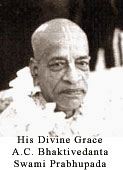
His Divine Grace A.C.
Bhaktivedanta Swami Prabhupada |
| Related
Articles The Founder Acharya The Supreme Reservoir of Erotic Principles Marriage and Krishna Consciousness Related Topics Love and Sex |
Hayagriva:
Kierkegaard wrote one book called Works of Love, in which
he saw God as the hidden source of, of love. He says man, "A man must
love God in unconditional, in unconditional obedience and love Him in
adoration. It would be ungodliness if any man dared to love himself in
this way or dared to love another man in this way or dared to permit
another man to love him in this way. God you must love in unconditional
obedience even if that which He demands of you may seem injurious to
you, for God's wisdom is incomparable with respect to your own."
Prabhupada: Yes. That is the instruction of Bhagavad-gita.
God demands that "You give up your own plans or any other's so-called
intelligent person's plan or philosopher's plan. Take My plan," sarva-dharman
parityajya mam ekam sharanam vraja [Bhagavad-gita
18.66], "just surrender unto Me fully, then I shall take care of you so
that you will not suffer." That is our position. If we fully depend on
Krishna, the Supreme Personality of Godhead, then He will guide us how
to make progress back to home, back to Godhead.
Hayagriva: As far as defining love, what is love—people
speak of love—he says, "If someone asks what is love, Paul answers, 'It
is the fulfillment of the law.' Love is a matter of conscience, and
hence it is not a matter of impulse and inclination, nor is it a matter
of emotion, nor a matter for intellectual calculation. There is only
one kind of love." And he says that is spiritual love.
Prabhupada: Yes. Love in the material world is impossible.
In the material world everyone is interested for his own sense
gratification. The love between man and woman, young boy and young
girl, that is not love, that is lust, because both the parties are
interested in sense gratification. But that is not love. Love means the
parties, they will not think of his own sense gratification but the
sense gratification of the beloved. That is pure love. That is not
possible in the material world, but we see the example of love in the
picture of Vrindavana. In the Vrindavana village, everyone—man, animals
and fruits, flowers, water, everything—they are only for loving
Krishna. They do not want any return from Krishna. That is real love, anyabhilashita-shunyam
[Brahma-samhita 1.1.11]. If one loves God with some
motive, that is material love. Pure love is simply to satisfy the
desires of the Supreme Personality of Godhead. Therefore in the
material world the love, word "love," is misused. The propensity of
lusty desires is going on as love. Real love is only with
God—individually, collectively, anyway. And that Krishna, the Supreme
Personality of Godhead, He is the supreme object of love, either by
adoration or by serving or making friendship with Him, or loving Him as
child, or loving Him as beloved—there are five different relationships:
shanta, dasya, sakhya, vatsalya, madhurya—that is real
love.
Hayagriva: And he says, "Ultimately, love of God is the
decisive thing. From it stems love to the neighbor. If you love God
above else, then you also love your neighbor, and in your neighbor
every man. To help another man to love God is to love the other man. To
be helped by another man to love God is to be loved."
Prabhupada: That is our Krishna consciousness movement. We
are learning how to love God, and we are teaching the same principle to
the whole world, without any discrimination, that "God is one." Not
that there are different Gods of different faiths. God cannot be two. Eko
brahma dvitiyam nasti. God is one. There cannot be any
competitor. His name is Asamaurdhva; nobody is equal to Him,
nobody is greater than Him. Therefore God is great. Nobody is equal. So
in any form of religion, if love of God is instructed, that is
first-class religion. It doesn't matter whether it is Christian
religion or Hindu religion or Muslim religion. The test is how the
followers have learned to love God. And now God being the center of
love and everything being God's expansion, so a lover of God is lover
of everyone. He does not discriminate that "Only man should be loved,
and man should be given service." No. He is interested with all living
entities, never mind in which form he is existing. So he is interested
in..., lover of God loves everyone, and the love reaches everyone. The
example is given in this connection. Just to water the root of the tree
means to expand nourishment for all other parts of the tree, namely the
trunk, branches, leaves, twigs, everything. Or to supply food in the
stomach means satisfying the necessities of all parts of the body. This
is the fact. God being everything, maya tatam idam sarvam
[Bhagavad-gita 9.4], as it is stated in the Bhagavad-gita,
nothing can exist without God, and everything is expansion. Another
word is there in the Vishnu Purana. It is said that the
fire remaining in one place distributes its heat and light. Eka-sthane
sthitasyagner jyotsna vistarini yatha. The fire can distribute
its heat and light although localized in a place. Similarly God, He is
in His own abode, but by His energy He is present everywhere. Sarva-vyapi,
all-pervading. The all-pervading feature of God means everything is
manifestation of His energy. Nothing can exist without God. But it does
not mean everything is God. Everything is resting on His energy, but
not everything God. In spite of expanding, God, by His different
potencies, He keeps His personality. That is God.
Hayagriva: Concerning individuality, Kierkegaard writes,
"God is the origin and wellspring of all individuality. To have
individuality is to believe in the individuality of everyone else, for
the individuality in not mine. It is the gift of God through which He
permits me to be, and through which He permits everyone to be."
Prabhupada: That's the fact. He explains..., this fact is
explained in the Vedic literature, nityo nityanam chetanash
chetananam (Katha Upanishad 2.2.13), Katha
Upanishad, that He is also living being and we are also living
being. So He is also eternal; we are also eternal. So qualitatively we
are one, but quantitatively we are different, because eko yo
bahunam vidadhati kaman: that one, singular number, eternal
living being, Krishna, or God, He is maintaining everyone. So that is
the difference. The one living being, the Supreme Living Being, the
great living being, is maintaining other living beings who are part and
parcel of the Supreme. So both of us, we are the living beings,
individual, eternal, but God is Supreme; we are subordinate. That is
difference. So our natural position should be to love God, being part
and parcel of God.
Hayagriva: Concerning the purpose of prayer, he writes,
"The true
relation in prayer is not when God hears what is prayed for, but when
the person praying continues to pray until he is the one who hears what
God wills."
Prabhupada: Yes. That's very nice. He becomes qualified to
understand God and to talk with God, to take direction of God. That is
stated in the Bhagavad-gita:
tesham satata-yuktanam
bhajatam priti-purvakam
dadami buddhi-yogam tam
yena mam upayanti (te) [Bhagavad-gita 10.10]
Our ultimate goal is to give up this material world and go back to home, back to Godhead. So this being ultimate goal of life, if we offer prayer to the Supreme Lord... Not only prayer. Prayer is one of the service. This is also nine. There are different, nine kinds of service:
shravanam kirtanam vishnoh
smaranam pada-sevanam
archanam vandanam dasyam
sakhyam atma-nivedanam [Srimad Bhagavatam 7.5.23]
Vandanam.
Prayer means vandanam. So this is also service. Either you take
all the nine different items, or you take some of them, or at least one
of them, then you will make progress in spiritual life. So some of them
offer prayers, just like Christians, Muhammadans, they offer prayer. So
it is as good as the Hindus give service in the temple, decorates the
Deity, cleanses the temple and offers food. In this way they are
engaged. This is called archanam. Archanam is also
devotional service as well as offering prayer. So by this devotional
service one makes progress in spiritual life, and when he is sincere in
his service, then God is within him, He takes charge of him and gives
him instruction how quickly and swiftly he can approach God. So this is
fact. Our... He is not hankering after our service. He is complete in
Himself. He doesn't require anyone's service. But if we offer service
to Him, then we become purified, and... [break] ...complete
purification. We can talk with God, we can see God, we can take His
instruction, as Arjuna is talking with God, personally taking His
instruction and acting according to His instruction.
Hayagriva: Kierkegaard felt that God's will... He says,
"There is a God. His will is made known to me in holy scripture and in
my conscience."
Prabhupada: Yes.
Hayagriva: God intervenes in the world through the
individual acting according to scripture.
Prabhupada: Yes. These is a word, sadhu shastra
guru vakya chittete koriya aikya. We can approach God by
understanding a saintly person, by studying the Vedic scriptures, and
explained directly by the bona fide spiritual master. So sadhu
means saintly person, and shastra means scriptures, and guru
means spiritual master—and that they should be corroborated. A sadhu
is he who talks in terms of scripture. Similarly, guru is he
who talks in terms of scripture. Guru cannot manufacture words
which is not in the scriptures. And that is not scripture which does
not tally with the words of guru and sadhu. So these
three items should be corroborated, and then we can understand who is guru,
who is sadhu, and who is, what is scripture. Then we take
instruction from them, and we can perfectly make progress towards
understanding of the Supreme Personality of Godhead.
Hayagriva: He says, "The only thing which enters Him, God,
who is all-majestic, is obedience."
Prabhupada: Yes.
Hayagriva: "It is so easy to see that one to whom
everything is equally important and equally insignificant can only be
interested in one thing: obedience."
Prabhupada: Yes. That is wanted, and Krishna, or God,
demands that. Full obedience. Sarva-dharman parityajya mam ekam
sharanam vraja [Bhagavad-gita 18.66]. That is the
qualification. Tad viddhi pranipatena [Bhagavad-gita
4.34]. So original obedience
is to the Supreme Personality of Godhead, similarly obedience to the
spiritual master is representative of God. So anyone who carries out
the order of God, he can become bona fide guru, because he is
not manufacturing anything. He is simply presenting what God is
speaking, or the
shastra is speaking. God, when He comes as incarnation, He does not
speak anything which is not in the scripture. That, just like in the Bhagavad-gita,
Krishna gives reference to the Brahma-sutra, Vedanta-sutra.
He is God. Whatever He is speaking, that is final, that's, that's a
fact. Still, He is giving honor to the Vedanta
-sutra. Brahma-sutra-padaish chaiva hetumadbhir
vinishchitaih [Bhagavad-gita 13.5]. He is giving
reference to the Brahma-sutra because spiritual knowledge
is asserted there with logic and philosophy. So we cannot accept anyone
as incarnation of God if He speaks nonsense, not corroborating with the
standard scripture.
Hayagriva: Concerning worship, he writes, "The only
adequate way to express the sense of God's majesty is to worship Him,
to renounce everything as an act of worship offered to God, and so not
because He needs to use you as an instrument but to renounce everything
yourself as the most insignificant suprafluity, an article of luxury.
That means to worship." That is, worship is renunciation.
Prabhupada: Yes. Worship is the beginning, begins with
renunciation, or the renouncing any motive. Ahaituky apratihata.
Our only business is to love God. That is first-class religious system
which teaches the followers to love God without any motive. Ahaituky
apratihata. Such kind of worship will not be checked by any
material condition. In any condition of life one can love God. God will
help. Buddhi-yogam dadami tam. That is pure worship and
pure love for God. [break]
Hayagriva: This is the last point we're making on
Kierkegaard. It's concerning God's personality.
Prabhupada: Yes.
Hayagriva: He writes, "God is certainly personal, but
whether He wishes to be so in relation to the individual depends on
whether it pleases God."
Prabhupada: Yes.
Hayagriva: "It is the grace of God that He wishes to be
personal in relation to you. If you throw away His grace, He punishes
you by behaving objectively, or impersonally, towards you."
Prabhupada: [laughing] That's right. That is very good.
Impersonal conception of God is a troublesome business. That is stated
in the Bhagavad-gita: kleshah adhikataras tesham
avyakta asakta chetasam. Find out this verse.
Hari-sauri: [reads:]
klesho 'dhikataras tesham
avyaktasakta-chetasam
avyakta hi gatir duhkham
dehavadbhir avapyate [Bhagavad-gita 12.5]
"For those whose minds are attached to the unmanifested, impersonal feature of the Supreme, advancement is very troublesome. To make progress in that discipline is always difficult for those who are embodied."
Prabhupada:
Purport.
Hari-sauri: [reads:] The group of transcendentalists who
follow the path of the inconceivable, unmanifested, impersonal feature
of the Supreme Lord are called jnana-yogis, and persons who are
in full Krishna consciousness, engaged in devotional service to the
Lord, are called bhakti-yogis. Now, here the difference between
jnana-yoga and bhakti-yoga is definitely
expressed. The process of jnana-yoga, although ultimately
bringing one to the same goal, is very troublesome, whereas the path of
bhakti-yoga, the process of being in direct service to the
Supreme Personality of Godhead, is easier and is natural for the
embodied soul. The individual soul is embodied since time immemorial.
It is very difficult for him to simply theoretically understand that he
is not the body. Therefore, the bhakti-yogi accepts the Deity
of Krishna as worshipable because there is some bodily conception fixed
in the mind, which can thus be applied. Of course, worship of the
Supreme Personality of Godhead in His form within the temple is not
idol worship. There is evidence in the Vedic literature that worship
may be saguna and nirguna—of the Supreme possessing or
not possessing attributes. Worship of the Deity in the temple is
saguna worship, for the Lord is represented by material qualities.
But the form of the Lord, though represented by material qualities such
as stone, wood, or oil paint, is not actually material. That is the
absolute nature of the Supreme Lord.
A crude example may be given here. We may find some mailboxes on the
street, and if we post our letters in those boxes, they will naturally
go to their destination without difficulty. But any old box, or an
imitation, which we may find somewhere, which is not authorized by the
post office, will not do the work. Similarly, God has an authorized
representation in the Deity form, which is called archa-vigraha.
This archa-vigraha is an incarnation of the Supreme Lord. God
will accept service through that form. The Lord is omnipotent and
all-powerful; therefore, by His incarnation as archa-vigraha,
He can accept the services of the devotee, just to make it convenient
for the man in conditioned life.
So, for a devotee, there is no difficulty in approaching the Supreme
immediately and directly, but for those who are following the
impersonal way to spiritual realization, the path is difficult. They
have to understand the unmanifested representation of the Supreme
through such Vedic literatures as the Upanishads, and
they have to learn the language, understand the nonperceptual feelings,
and they have to realize all these processes. This is not very easy for
a common man. A person in Krishna consciousness, engaged in devotional
service, simply by the guidance of the bona fide spiritual master,
simply by offering regulative obeisances unto the Deity, simply by
hearing the glories of the Lord, and simply by eating the remnants of
foodstuffs offered to the Lord, realizes the Supreme Personality of
Godhead very easily. There is no doubt that the impersonalists are
unnecessarily taking a troublesome path with the risk of not realizing
the Absolute Truth at the ultimate end. But the personalist, without
any risk, trouble, or difficulty, approaches the Supreme Personality
directly. A similar passage appears in Srimad-Bhagavatam
. It is stated there that if one has to ultimately surrender unto the
Supreme Personality of Godhead (This surrendering process is called bhakti.),
but instead takes the trouble to understand what is Brahman and what is
not Brahman and spends his whole life in that way, the result is simply
troublesome. Therefore it is advised here that one should not take up
this troublesome path of self-realization because there is uncertainty
in the ultimate result.
A living entity is eternally an individual soul, and if he wants to
merge into the spiritual whole, he may accomplish the realization of
the eternal and knowledgeable aspects of his original nature, but the
blissful portion is not realized. By the grace of some devotee, such a
transcendentalist, highly learned in the process of jnana-yoga,
may come to the point of bhakti-yoga, or devotional service. At
that time, long practice in impersonalism also becomes a source of
trouble, because he cannot give up the idea. Therefore an embodied soul
is always in difficulty with the unmanifest, both at the time of
practice and at the time of realization. Every living soul is partially
independant, and one should know for certain that this unmanifested
realization is against the nature of his spiritual blissful self. One
should not take up this process. For every individual living entity the
process of Krishna consciousness, which entails full engagement in
devotional service, is the best way. If one wants to ignore this
devotional service, there is the danger of turning to atheism. Thus
this process of centering attention on the unmanifested, the
inconceivable, which is beyond the approach of the senses, as already
expressed in this verse, should never be encouraged at any time,
especially in this age. It is not advised by Lord Krishna.
Hayagriva: He [Kierkegaard] says, "If you throw away His
grace, He punishes you by behaving objectively toward you, and in that
sense one may say that the world has not got a personal God in spite of
all the proofs. But while dons and parsons," that is priests, "drivel
on," talk on, "about the millions of truths about God's personality,
the truth is that there are no longer the men living who could bear the
pressure and weight of having a personal God." Because he feels that a
personal God would make demands on man, and so therefore men reject the
idea of a personal God.
Prabhupada: Yes. Personal God means He is demanding, as
Krishna is demanding, man-mana bhava mad-bhakto mad-yaji mam
namaskuru: [Bhagavad-gita 18.65] "Always think of
Me, or offer Me worship, offer Me obeisances, and become My devotee.
And give up all other engagement. Simply be engaged in My service."
This is the demand of God, and if we carry out His demand, then we are
perfect. Tyaktva deham punar janma naiti [Bhagavad-gita
4.9]. If you simply carry out the orders of God then you become
qualified, fit for going back to home, back to Godhead. This is clearly
stated. Tyaktva deham. We have to give up this body, but
a devotee, a pure devotee, after giving up this body, he doesn't accept
another material body, but in his original, spiritual body he goes back
to home, back to Godhead.
Unconditional Love for God or Sex?/ WORLD SANKIRTAN PARTY ©2004 - Hansadutta das
Home | About | Events | World Sankirtan Party | Inside Nam Hatta
eBooks | Site Map | Store