Life
Extension Magazine
- June 22, 2007 - Gary Null, PhD; Carolyn Dean MD, ND;
Martin Feldman, MD; Debora Rasio, MD; and Dorothy Smith, PhD Death by Medicine
A
group of researchers meticulously reviewed the statistical evidence and
their findings are absolutely shocking.4 These researchers have
authored a paper titled “Death by Medicine” that presents compelling
evidence that today’s system frequently causes more harm than good.
This fully referenced report shows the number of people having
in-hospital, adverse reactions to prescribed drugs to be 2.2 million
per year. The number of unnecessary antibiotics prescribed annually for
viral infections is 20 million per year. The number of unnecessary
medical and surgical procedures performed annually is 7.5 million per
year. The number of people exposed to unnecessary hospitalization
annually is 8.9 million per year.
The most stunning statistic, however, is that the total number of
deaths caused by conventional medicine is an astounding 783,936 per
year. It is now evident that the American medical system is the leading
cause of death and injury in the US. (By contrast, the number of deaths
attributable to heart disease in 2001 was 699,697, while the number of
deaths attributable to cancer was 553,251.5) go to story
Life
cannot be prolonged by heart transplant. You cannot increase the
duration of life. One can perhaps give some relief to disease, that is
another thing, but the duration of life is destined. From the dead
body, one cannot bring life. Similarly, it may appear that one is
prolonging the duration of life by medicines or heart transplant, but
that is not the case. If one lives 4 years after having had a heart
transplant, then by nature's law he was destined to live four years
with or without having had a heart transplant. So what is the value of
heart transplant?
Only by the yogic process can one prolong the life. By stopping the
breathing process, keeping in samadhi, the breath period is not
being misused, and he increases the life span. Therefore, destiny can
only be changed by devotional service or yoga. Otherwise, what you must
suffer, you must suffer, and what you must enjoy, you must enjoy. more
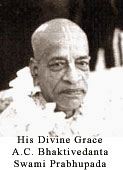
PRABHUPADA:
Take this, this allopathic treatment, failure.
SVARUP DAMODAR: Yes, it's a failure, allopathic treatment.
TAMAL KRSNA: Srila Prabhupada, would you be interested in hearing any
of the Bhagavatam that they have edited? I thought that
would be nice.
UPENDRA: I'd like to give Prabhupada a bath.
PRABHUPADA: Yes. That will be nice. You sit down, all, and let us try.
BHAVANANDA: Srila Prabhupada, Upendra wants to know if he can give you
a bath.
PRABHUPADA: I have no objection.
TAMAL KRSNA: So after the bath we'll have Bhagavata.
PRABHUPADA: Hm.
TAMAL KRSNA: Okay.
PRABHUPADA: And stop all medicine. [laughter]
TAMAL KRSNA: This is the real medicine.
SVARUP DAMODAR: The trouble with the allopathic medicine is that they
have so much side effects that it might make very uncomfortable to...
PRABHUPADA: This is already uncomfortable.
BHAVANANDA: I think that this doctor's desire you have seen through.
His desire was to remove you from here somehow or other. First to
remove you for an x-ray, then...
TAMAL KRSNA: Another trick they have is that you have one trouble, so
they give you a medicine, but the medicine causes a worse trouble. And
eventually such bad trouble is created that they get you depending on
them, and then they say, "Now the only thing left, you must come to the
hospital for operation." Then they kill you.
SVARUP DAMODAR: Yes, injection, operation.
TAMAL KRSNA: He was asking us, "Does your Guruji have any...? Will he
take an injection?" So we said, "No." He was hopeless. He was guessing.
SVARUP DAMODAR: Yes, he didn't know the real cause.
PRABHUPADA: They do not know. They use machine. Their means of
knowing—machine. They do not know.
SVARUP DAMODAR: I have many medical friends. They frankly admit that
oftentimes they kill the patients in the name of treating. It comes out
that it was their own medicine that they gave.
PRABHUPADA: Yes. Recently that Dalmia secretary... What is his name?
TAMAL KRSNA: Hita-sarana Sharma.
PRABHUPADA: In pathology his prescription was replaced by another.
TAMAL KRSNA: I don't follow. Recently whose?
UPENDRA: Prescription was replaced by another.
PRABHUPADA: He had some trouble. So, what is called? Pathology?
TAMAL KRSNA: Pathology? No.
PRABHUPADA: No, laboratory testing?
TAMAL KRSNA: What's laboratory test called?
SVARUP DAMODAR: Pathology?
BHAVANANDA: Yes.
PRABHUPADA: So his case was transferred to another.
TAMAL KRSNA: [laughs] Oh, boy.
SVARUP DAMODAR: One after another.
BHAVANANDA: Mixed up.
TAMAL KRSNA: Mixed up. His diagnosis was given to someone else. They
made a mistake, and then they treated the other person.
PRABHUPADA: And he was being treated as tuberculosis.
ADI-KESHAVA: Sometimes they make the operations, and they leave the
knife in, and they sew the knife up inside after they make an
operation. Or the scissors. They take some clamps and they sew them
inside the wound. And then the man says, "Oh, I have a pain in my
side." And they say, "Oh, new disease," and they make another operation
and take out the clamps or the knife.
SVARUP DAMODAR: Sometimes they only depend on machines, these medical
doctors. That's why he's mentioning about x-ray. Through these machines
you cannot tell the correct diagnosis.
PRABHUPADA: I have got many experiences in my family life. One servant,
Kashiram.
SVARUP DAMODAR: Kashiram.
PRABHUPADA: Yes his name was Kashiram. So he was howling, howling. So
we took him to the hospital, and so many student doctors surrounded.
They diagnosed something, strangulation or something like that.
TAMAL KRSNA: Strangulation.
PRABHUPADA: Yes. Then they were prepared to surgical operation. Then
another experienced doctor came. He said, "Let us wait today." So he
was kept in the hospital, and we came back. That Kashiram... Another
friend, servant of the neighborhood, and so he said, "Babaji, he has
drunk this."
TAMAL KRSNA: He got a little drunk.
PRABHUPADA: So I said, "Don't delay. So many doctors..." And next
morning he came back and said, "The doctor said, 'You are all right,
you can go.'"
TAMAL KRSNA: He was just drunk from liquor.
SVARUP DAMODAR: I had a similar story. It is my own personal
experience. In 1974 I came here in India. I got malaria in the United
States in summer 1975. Then temperature was very high. I went to the
Baptist Hospital in Atlanta. They thought it was a virus, viral
infection. They couldn't diagnose. Then they gave some medicine, and
then I went. But it started again the following day, and I went to
another doctor. He could not diagnose. So they gave me glucose
injection, a big bottle, thinking it was a strange viral infection. So
about six, seven doctors, they couldn't diagnose for three-four days.
Then one day there was a doctor who came from Vietnam, he had some
experience in tropical disease. So he thought it might be malarial
fever. Then, after that, I was surrounded by many doctors thinking that
it was a strange disease before, but they diagnosed... But it was not
right. They did all the wrong medicine, thinking it was a viral
infection.
PRABHUPADA: Yes.
SVARUP DAMODAR: This is in America just two years ago.
TAMAL KRSNA: I told you the story of my father recently, Srila
Prabhupada, how he had the arthritis in the hip, so they gave him a new
hip. Then it moved to the other hip, and they replaced the other hip.
So after eight weeks he was in bed in the hospital, and then they said,
"Now you can try to walk." So they gave him crutches, and they stood
him up, and after eight weeks of all these operations, as soon as he
stood up he had a heart attack and died right on the spot. They were
very sure. "Now you're all right," they told him.
Devotee: My great-uncle, he had tonsillitis, so he went to a friend who
was a doctor, and the friend said, "That's all right. We'll operate,
and I will not charge you anything." So he went into the hospital, and
in the operation the doctor dropped a scalpel, and after that—he was
very big, and he became very small, never could eat again.

 Life
Extension Magazine
- June 22, 2007 - Gary Null, PhD; Carolyn Dean MD, ND;
Martin Feldman, MD; Debora Rasio, MD; and Dorothy Smith, PhD
Death by Medicine
Life
Extension Magazine
- June 22, 2007 - Gary Null, PhD; Carolyn Dean MD, ND;
Martin Feldman, MD; Debora Rasio, MD; and Dorothy Smith, PhD
Death by Medicine