 Krishna Books What is Hare Krishna? The Founder-Acharya Hare Krishna Mantra Sankirtan Movement Personality of Godhead Lord Chaitanya A.C.Bhaktivedanta Swami Prabhupada Hansadutta das Events: Kirtan Festival World Sankirtan Party Submit News © 2004 - Hansadutta das |
Shortcomings of Marxism
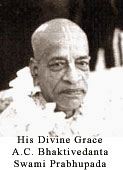
by His Divine Grace A.C.
Bhaktivedanta Swami Prabhupada
|
 Telegraph.co.uk,
Sunday, November 19, 2006 - By ANDREW ALDERSON, Chief
Reporter and JAMES GLOVER, Sunday Telegraph -
Telegraph.co.uk,
Sunday, November 19, 2006 - By ANDREW ALDERSON, Chief
Reporter and JAMES GLOVER, Sunday Telegraph - 
|
Motives
and Motivation
|
The Premise is the Problem by Hansadutta das The whole premise of modern civilization, based on the idea of advancement of education, technology, industry and economics is dismissed by us (VAISHNAVAS) as ERRONEOUS and therefore IRRELEVANT for the well being of this planet earth with its 4 to 5 billion human beings and innumerable animals, insects, etc. more |
Syamasundar: Karl Marx
contended that philosophers have only interpreted the world; the point
is to change it. His philosophy is often called "dialectical
materialism" because it comes from the dialectic of George
Hegel—thesis, antithesis, and synthesis. When applied to society, his
philosophy is known as communism. His idea is that for many
generations, the bourgeoisie [the property owners] have competed with
the proletariat [the working class], and that this conflict will
terminate in the communist society. In other words, the workers will
overthrow the capitalistic class and establish a so-called dictatorship
of the proletariat, which will finally become a classless society.
Prabhupada: But how is a
classless society possible? Men naturally fall into different classes.
Your nature is different from mine, so how can we artificially be
brought to the same level?
Syamasundar: His idea is that
human nature, or ideas, are molded by the means of production.
Therefore everyone can be trained to participate in the classless
society.
Prabhupada: Then training is
required?
Syamasundar: Yes.
Prabhupada: And what will be
the center of training for this classless society? What will be the
motto?
Syamasundar: The motto is
"From each according to his ability, to each according to his need."
The idea is that everyone would contribute something, and everyone
would get what he needed.
Prabhupada: But everyone's
contribution is different. A scientific man contributes something, and
a philosopher contributes something else. The cow contributes milk, and
the dog contributes service as a watchdog. Even the trees, the birds,
the beasts—everyone is contributing something. So, by nature a
reciprocal arrangement is already there among social classes. How can
there be a classless society?
Syamasundar: Well, Marx's
idea is that the means of production will be owned in common. No one
would have an advantage over anyone else, and thus one person could not
exploit another. Marx is thinking in terms of profit.
Prabhupada: First we must
know what profit actually is. For example, the American hippies already
had "profit". They were from the best homes, their fathers were
rich—they had everything. Yet they were not satisfied; they rejected
it. No, this idea of a classless society based on profit-sharing is
imperfect. Besides, the communists have not created a classless
society. We have seen in Moscow how a poor woman will wash the streets
while her boss sits comfortably in his car. So where is the classless
society? As long as society is maintained, there must be some higher
and lower classification. But if the central point of society is one,
then whether one works in a lower or a higher position, he doesn't
care. For example, our body has different parts—the head, the legs, the
hands—but everything works for the stomach.
Syamasundar: Actually, the
Russians supposedly have the same idea: they claim the common worker is
just as glorious as the top scientist or manager.
Prabhupada: But in Moscow we
have seen that not everyone is satisfied. One boy who came to us was
very unhappy because in Russia young boys are not allowed to go out at
night.
Syamasundar: The Russian
authorities would say that he has an improper understanding of Marxist
philosophy.
Prabhupada: That "improper
understanding" is inevitable. They will never be able to create a
classless society because, as I have already explained, everyone's
mentality is different.
Syamasundar: Marx says that
if everyone is engaged according to his abilities in a certain type of
production, and everyone works for the central interest, then
everyone's ideas will become uniform.
Prabhupada: Therefore we must
find out the real central interest. In our International Society for
Krishna Consciousness [ISKCON], everyone has a central interest in
Krishna. Therefore one person is speaking, another person is typing,
another is going to the press or washing the dishes, and no one is
grudging, because they are all convinced they are serving Krishna.
Syamasundar: Marx's idea is
that the center is the state.
Prabhupada: But the state
cannot be perfect. If the Russian state is perfect, then why was
Khrushchev driven from power? He was elected premier. Why was he driven
from power?
Syamasundar: Because he was
not fulfilling the aims of the people.
Prabhupada: Well, then, what
is the guarantee the next premier will do that? There is no guarantee.
The same thing will happen again and again. Because the center,
Khrushchev, was imperfect, people begrudged their labor. The same thing
is going on in non-communist countries as well. The government is
changed, the prime minister is deposed, the president is impeached. So
what is the real difference between Russian communism and other
political systems? What is happening in other countries is also
happening in Russia, only they call it by a different name. When we
talked with Professor Kotovsky of Moscow University, we told him he had
to surrender: either he must surrender to Krishna or to Lenin, but he
must surrender. He was taken aback at this.
Syamasundar: From studying
history, Marx concluded that the characteristics of culture, the social
structure, and even the thoughts of the people are determined by the
means of economic production.
Prabhupada: How does he
account for all the social disruption in countries like America, which
is so advanced in economic production?
Syamasundar: He says that
capitalism is a decadent form of economic production because it relies
on the exploitation of one class by another.
Prabhupada: But there is
exploitation in the communist countries also. Khrushchev was driven out
of power because he was exploiting his position. He was giving big
government posts to his son and son-in-law.
Syamasundar: He was deviating
from the doctrine.
Prabhupada: But since any
leader can deviate, how will perfection come? First the person in the
center must be perfect, then his dictations will be correct. Otherwise,
if the leaders are all imperfect men, what is the use of changing this
or that? The corruption will continue.
Syamasundar: Presumably the
perfect leader would be the one who practiced Marx's philosophy without
deviation.
Prabhupada: But Marx's
philosophy is also imperfect! His proposal for a classless society is
unworkable. There must be one class of men to administer the government
and one class of men to sweep the streets. How can there be a classless
society? Why should a sweeper be satisfied seeing someone else in the
administrative post? He will think, "He is forcing me to work as a
sweeper in the street while he sits comfortably in a chair." In our
international society, I am also holding the superior post: I am
sitting in a chair, and you are offering me garlands and the best food.
Why? Because you see a perfect man whom you can follow. That mentality
must be there. Everyone in the society must be able to say, "Yes, here
is a perfect man. Let him sit in a chair, and let us all bow down and
work like menials." Where is that perfect man in the communist
countries?
Syamasundar: The Russians
claim that Lenin is a perfect man.
Prabhupada: Lenin? But no one
is following Lenin. Lenin's only perfection was that he overthrew the
czar's government. What other perfection has he shown? The people are
not happy simply reading Lenin's books. I studied the people in Moscow.
They are unhappy. The government cannot force them to be happy
artificially. Unless there is a perfect, ideal man in the center, there
cannot possibly be a classless society.
Syamasundar: Perhaps they see
the workers and the managers in the same way that we do—in the absolute
sense. Since everyone is serving the state, the sweeper is as good as
the administrator.
Prabhupada: But unless the
state gives perfect satisfaction to the people, there will always be
distinctions between higher and lower classes. In the Russian state,
that sense of perfection in the center is lacking.
Material stomach is always hungry
Syamasundar: Their goal is the production
of material goods for the enhancement of human well-being.
Prabhupada: That is useless!
Economic production in America has no comparison in the world, yet
still people are dissatisfied. The young men are confused. It is
nonsensical to think that simply by increasing production everyone will
become satisfied. No one will be satisfied. Man is not meant simply for
eating. He has mental necessities, intellectual necessities, spiritual
necessities. In India many people sit alone silently in the jungle and
practice yoga. They do not require anything. How will increased
production satisfy them? If someone were to say to them, "If you give
up this yoga practice, I will give you two hundred bags of
rice," they would laugh at the proposal. It is animalistic to think
that simply by increasing production everyone will become satisfied.
Real happiness does not depend on either production or starvation, but
upon peace of mind. For example, if a child is crying but the mother
does not know why, the child will not stop simply by giving him some
milk. Sometimes this actually happens: the mother cannot understand why
her child is crying, and though she is giving him her breast, he
continues to cry. Similarly, dissatisfaction in human society is not
caused solely by low economic production. That is nonsense. There are
many causes of dissatisfaction. The practical example is America, where
there is sufficient production of everything, yet the young men are
becoming hippies. They are dissatisfied, confused. No, simply by
increasing economic production people will not become satisfied. Marx's
knowledge is insufficient. Perhaps because he came from a country where
people were starving, he had that idea.
Syamasundar: Yes, now we've
seen that production of material goods alone will not make people happy.
Prabhupada: Because they do
not know that real happiness comes from spiritual understanding. That
understanding is given in the Bhagavad-gita: God is the
supreme enjoyer, and He is the proprietor of everything. We are not
actually enjoyers; we are all workers. These two things must be there:
an enjoyer and a worker. For example, in our body the stomach is the
enjoyer and all other parts of the body are workers. So this system is
natural: there must always be someone who is the enjoyer and someone
who is the worker. It is present in the capitalist system also. In
Russia there is always conflict between the managers and the workers.
The workers say, "If this is a classless society, why is that man
sitting comfortably and ordering us to work?" The Russians have not
been able to avoid this dilemma, and it cannot be avoided. There must
be one class of men who are the directors or enjoyers and another class
of men who are the workers. Therefore the only way to have a truly
classless society is to find that method by which both the managers and
the workers will feel equal happiness. For example, if the stomach is
hungry and the eyes see some food, immediately the brain will say, "O
legs, please go there!" and "Hand, pick it up," and "Now please put it
into the mouth." Immediately the food goes into the stomach, and as
soon as the stomach is satisfied, the eyes are satisfied, the legs are
satisfied, and the hand is satisfied.
Syamasundar: But Marx would
use this as a perfect example of communism.
Prabhupada: But he has
neglected to find out the real stomach.
Syamasundar: His is the
material stomach.
Prabhupada: But the material
stomach is always hungry again; it can never be satisfied.
In the Krishna consciousness movement we have the substance for feeding
our brains, our minds, and our souls.
Yasya prasadad bhagavat-prasadah: if the spiritual master is
satisfied, then Krishna is satisfied, and if Krishna is satisfied, then
everyone is satisfied. Therefore you are all trying to satisfy your
spiritual master. Similarly, if the communist countries can come up
with a dictator who, if satisfied, automatically gives satisfaction to
all the people, then we will accept such a classless society. But this
is impossible. A classless society is only possible when Krishna is in
the center. For the satisfaction of Krishna, the intellectual can work
in his own way, the administrator can work in his way, the merchant can
work in his way, and the laborer can work in his way. This is truly a
classless society.
Syamasundar: How is this
different from the communist country, where all sorts of men contribute
for the same central purpose, which is the state?
Prabhupada: The difference is
that if the state is not perfect, no one will willingly contribute to
it. They may be forced to contribute, but they will not voluntarily
contribute unless there is a perfect state in the center. For example,
the hands, legs, and brain are working in perfect harmony for the
satisfaction of the stomach. Why? Because they know without a doubt
that by satisfying the stomach they will all share the energy and also
be satisfied. Therefore, unless the people have this kind of perfect
faith in the leader of the country, there is no possibility of a
classless society.
Syamasundar: The communists
theorize that if the worker contributes to the central fund, he will
get satisfaction in return.
Prabhupada: Yes, but if he
sees imperfection in the center, he will not work enthusiastically
because he will have no faith that he will get full satisfaction. That
perfection of the state will never be there, and therefore the workers
will always remain dissatisfied.
Syamasundar: The
propagandists play upon this dissatisfaction and tell the people that
foreigners are causing it.
Prabhupada: But if the people
were truly satisfied, they could not be influenced by outsiders. If you
are satisfied that your spiritual master is perfect—that he is guiding
you nicely—will you be influenced by outsiders?
Syamasundar: No.
Prabhupada: Because the
communist state will never be perfect, there is no possibility of a
classless society.
Not exempt from exploitation
Syamasundar: Marx examines
history and sees that in Greek times, in Roman times, and in the Middle
Ages slaves were always required for production.
Prabhupada: The Russians are
also creating slaves—the working class. Joseph Stalin stayed in power
simply by killing all his enemies. He killed so many men that he is
recorded in history as the greatest criminal. He was certainly
imperfect, yet he held the position of dictator, and the people were
forced to obey him.
Syamasundar: His followers
have denounced him.
Prabhupada: That's all well
and good, but his followers should also be denounced. The point is that
in any society there must be a leader, there must be directors, and
there must be workers, but everyone should be so satisfied that they
forget the difference.
Syamasundar: No envy.
Prabhupada: Ah, no envy. But
that perfection is not possible in the material world. Therefore Marx's
theories are useless.
Syamasundar: But on the other
hand, the capitalists also make slaves of their workers.
Prabhupada: Wherever there is
materialistic activity, there must be imperfection. But if they make
Krishna the center, then all problems will be resolved.
Syamasundar: Are you saying
that any system of organizing the means of production is bound to be
full of exploitation?
Prabhupada: Yes, certainly,
certainly! The materialistic mentality means exploitation.
Syamasundar: Then what is the
solution?
Prabhupada: Krishna
consciousness!
Syamasundar: How is that?
Prabhupada: Just make Krishna
the center and work for Him. Then everyone will be satisfied. As it is
stated in the Srimad-Bhagavatam [4.31.14]:
yatha taror mula-nishechanena
tripyanti tat-skandha-bhujopashakhah
pranopaharach cha yathendriyanam
tathaiva sarvarhanam achyutejya
If you simply pour water on the root of a tree, all the branches, twigs, leaves, and flowers will be nourished. Similarly, everyone can be satisfied simply by achyutejya. Acyuta means Krishna, and ijya means worship. So this is the formula for a classless society: Make Krishna [God] the center and do everything for Him. There are no classes in our International Society for Krishna Consciousness. Now you are writing philosophy, but if I want you to wash dishes, you will do so immediately because you know that whatever you do, you are working for Krishna and for your spiritual master. In the material world different kinds of work have different values, but in Krishna consciousness everything is done on the absolute platform. Whether you wash dishes or write books or worship the Deity, the value is the same because you are serving Krishna. That is a classless society. Actually, the perfect classless society is Vrindavana. In Vrindavana, some are cowherd boys, some are cows, some are trees, some are fathers, some are mothers, but the center is Krishna, and everyone is satisfied simply by loving Him. When all people become Krishna conscious and understand how to love Him, then there will be a classless society. Otherwise it is not possible.
Who is the proprietor?
Syamasundar: Marx's
definition of communism is "The common or public ownership of the means
of production, and the abolition of private property." In our
International Society for Krishna Consciousness, don't we have the same
idea? We also say, "Nothing is mine." We have also abolished private
property.
Prabhupada: While the
communist says, "Nothing is mine," he thinks everything belongs to the
state. The state, however, is simply an extended "mine." For example,
if I am the head of a family, I might say, "I do not want anything for
myself, but I want many things for my children." Mahatma Gandhi, who
sacrificed so much to drive the English out of India, was at the same
time thinking, "I am a very good man; I am doing national work."
Therefore, this so-called nationalism or so-called communism is simply
extended selfishness. The quality remains the same. The real change
occurs when we say, "Nothing belongs to me; everything belongs to God,
Krishna, and therefore I should use everything in His service." That is
factual.
Syamasundar: Marx says that
the capitalists are parasites living at the cost of the workers.
Prabhupada: But the
communists are also living at the cost of the workers: the managers are
drawing big salaries, and the common workers are dissatisfied. Indeed,
their godless society is becoming more and more troublesome. Unless
everyone accepts God as the only enjoyer and himself simply as His
servant, there will always be conflict. In the broad sense, there is no
difference between the communists and the capitalists because God is
not accepted as the supreme enjoyer and proprietor in either system.
Actually, no property belongs to either the communists or the
capitalists. Everything belongs to God.
No change of heart by force
Syamasundar: Marx condemns
the capitalists for making a profit. He says that profit-making is
exploitation and that the capitalists are unnecessary for the
production of commodities.
Prabhupada: Profit-making may
be wrong, but that exploitative tendency is always there, whether it is
a communist or a capitalist system. In Bengal it is said that during
the winter season the bugs cannot come out because of the severe cold.
So they become dried up, being unable to suck any blood. But as soon as
the summer season comes, the bugs get the opportunity to come out, so
they immediately bite someone and suck his blood to their full
satisfaction. Our mentality in this material world is the same: to
exploit others and become wealthy. Whether you are a communist in the
winter season or a capitalist in the summer season, your tendency is to
exploit others. Unless there is a change of heart, this exploitation
will go on.
I once knew a mill worker who acquired some money. Then he became the
proprietor of the mill and took advantage of his good fortune to become
a capitalist. Henry Ford is another example. He was an errand boy, but
he got the opportunity to become a capitalist. There are many such
instances. So, to a greater or lesser degree, the propensity is always
there in human nature to exploit others and become wealthy. Unless this
mentality is changed, there is no point in changing from a capitalist
to a communist society. Material life means that everyone is seeking
some profit, some adoration, and some position. By threats the state
can force people to curb this tendency, but for how long? Can they
change everyone's mind by force? No, it is impossible. Therefore,
Marx's proposition is nonsense.
Syamasundar: Marx thinks the
minds of people can be changed by forced conditioning.
Prabhupada: That is not
possible. Even a child cannot be convinced by force, what to speak of a
mature, educated man. We have the real process for changing people's
minds: chanting the Hare Krishna mantra. Cheto-darpana-marjanam:
[Chaitanya-charitamrita Antya 20.12] This process cleanses
the heart of material desires. We have seen that people in Moscow are
not happy. They are simply waiting for another revolution. We talked to
one working-class boy who was very unhappy. When a pot of rice is
boiling, you can take one grain and press it between your fingers, and
if it is hot you can understand all the rice is boiling. Thus we can
understand the position of the Russian people from the sample of that
boy. We could also get further ideas by talking with Professor Kotovsky
from the India Department of Moscow University. How foolish he was! He
said that after death everything is finished. If this is his knowledge,
and if that young boy is a sample of the citizenry, then the situation
in Russia is very bleak. They may theorize about so many things, but we
could not even purchase sufficient groceries in Moscow. There were no
vegetables, fruits, or rice, and the milk was of poor quality. If that
Madrasi gentleman had not contributed some dahl and rice, then
practically speaking we would have starved. The Russians' diet seemed
to consist of only meat and liquor.
Syamasundar: The communists
play upon this universal profit motive. The worker who produces the
most units at his factory is glorified by the state or receives a small
bonus.
Prabhupada: Why should he get
a bonus?
Syamasundar: To give him some
incentive to work hard.
Prabhupada: Just to satisfy
his tendency to lord it over others and make a profit, his superiors
bribe him. This Russian communist idea is very good, provided the
citizens do not want any profit. But that is impossible, because
everyone wants profit. The state cannot destroy this tendency either by
law or by force.
Syamasundar: The communists
try to centralize everything—money, communications, and transport—in
the hands of the state.
Prabhupada: But what benefit
will there be in that? As soon as all the wealth is centralized, the
members of the central government will appropriate it, just as
Khrushchev did. These are all useless ideas as long as the tendency for
exploitation is not reformed. The Russians have organized their country
according to Marx's theories, yet all their leaders have turned out to
be cheaters. Where is their program for reforming this cheating
propensity?
Syamasundar: Their program is
to first change the social condition, and then, they believe, the
corrupt mentality will change automatically.
Prabhupada: Impossible. Such
repression will simply cause a reaction in the form of another
revolution.
Syamasundar: Are you implying
that the people's mentality must first be changed, and then a change in
the social structure will naturally follow?
Prabhupada: Yes. But the
leaders will never be able to train all the people to think that
everything belongs to the state. This idea is simply utopian nonsense.
Syamasundar: Marx has another
slogan: "Human nature has no reality." He says that man's nature
changes through history according to material conditions.
Prabhupada: He does not know
the real human nature. It is certainly true that everything in this
cosmic creation, or jagat, is changing. Your body changes
daily. Everything is changing, just like waves in the ocean. This is
not a very advanced philosophy. Marx's theory is also being changed; it
cannot last. But man does have a fundamental nature that never changes:
his spiritual nature. We are teaching people to come to the standard of
acting according to their spiritual nature, which will never change.
Acting spiritually means serving Krishna. If we try to serve Krishna
now, we will continue to serve Krishna when we go to Vaikuntha, the
spiritual world. Therefore, loving service to Lord Krishna is called nitya,
or eternal. As Krishna says in the Bhagavad-gita,
nitya-yukta upasate: "My pure devotees perpetually worship Me
with devotion."
The communists give up Krishna and replace Him with the state. Then
they expect to get the people to think, "Nothing in my favor;
everything in favor of the state." But people will never accept this
idea. It is impossible; let the rascals try it! All they can do is
simply force the people to work, as Stalin did. As soon as he found
someone opposed to him, he immediately cut his throat. The same disease
is still there today, so how will their program be successful?
Syamasundar: Their idea is
that human nature has no reality of its own. It is simply a product of
the material environment. Thus, by putting a man in the factory and
making him identify with the state and something like scientific
achievement, they think they can transform him into a selfless person.
Prabhupada: But because he
has the basic disease, envy, he will remain selfish. When he sees that
he is working so hard but that the profit is not coming to him, his
enthusiasm will immediately slacken. In Bengal there is a proverb: "As
a proprietor I can turn sand into gold, but as soon as I am no longer
the proprietor, the gold becomes sand." The Russian people are in this
position. They are not as rich as the Europeans or the Americans, and
because of this they are unhappy.
Syamasundar: One of the
methods the authorities in Russia use is to constantly whip the people
into believing there may be a war at any moment. Then they think, "To
protect our country, we must work hard."
Prabhupada: If the people
cannot make any profit on their work, however, they will eventually
lose all interest in the country. The average man will think, "Whether
I work or not, I get the same result. I cannot adequately feed and
clothe my family." Then he will begin to lose his incentive to work. A
scientist will see that despite his high position, his wife and
children are dressed just like the common laborer.
Syamasundar: Marx says that
industrial and scientific work is the highest kind of activity.
Prabhupada: But unless the
scientists and the industrialists receive sufficient profit, they will
be reluctant to work for the state.
Syamasundar: The Russian goal
is the production of material goods for the enhancement of human
well-being.
Prabhupada: Their "human
well-being" actually means, "If you don't agree with me, I'll cut your
throat." This is their "well-being." Stalin had his idea of "human
well-being," but anyone who disagreed with his version of it was killed
or imprisoned. They may say that a few must suffer for the sake of
many, but we have personally seen that Russia has achieved neither
general happiness nor prosperity. For example, in Moscow none of the
big buildings have been recently built. They are old and ravaged, or
poorly renovated. Also, at the stores the people had to stand in long
lines to make purchases. These are indications that economic conditions
are unsound.
God consciousness the final revolution
Syamasundar: Marx considered
religion an illusion that must be condemned.
Prabhupada: The divisions
between different religious faiths may be an illusion, but Marx's
philosophy is also an illusion.
Syamasundar: Do you mean that
it's not being practiced?
Prabhupada: In the sixty
years since the Russian Revolution, his philosophy has become
distorted. On the other hand, Lord Brahma began the Vedic religion
countless years ago, and though foreigners have been trying to
devastate it for the last two thousand years, it is still intact. Vedic
religion is not an illusion, at least not for India.
Syamasundar: Here is Marx's
famous statement about religion. He says, "Religion is the sigh of the
oppressed creature, the heart of the heartless world, just as it is the
spirit of the spiritless situation. It is the opium of the people."
Prabhupada: He does not know
what religion is. His definition is false. The Vedas
state that religion is the course of action given by God. God is a
fact, and His law is also a fact. It is not an illusion. Krishna gives
the definition of religion in Bhagavad-gita [18.66]: sarva-dharman
parityajya mam ekam sharanam vraja. To surrender unto God—this
is religion.
Syamasundar: Marx believes
everything is produced from economic struggle and that religion is a
technique invented by the bourgeoisie or the capitalists to dissuade
the masses from revolution by promising them a better existence after
death.
Prabhupada: He himself has
created a philosophy that is presently being enforced by coercion and
killing.
Syamasundar: And he promised
that in the future things will be better. So he is guilty of the very
thing that he condemns religion for.
Prabhupada: As we have often
explained, religion is that part of our nature which is permanent,
which we cannot give up. No one can give up his religion. And what is
that religion? Service. Marx desires to serve humanity by putting
forward his philosophy. Therefore that is his religion. Everyone is
trying to render some service. The father is trying to serve his
family, the statesman is trying to serve his country, and the
philanthropist is trying to serve all humanity. Whether you are Karl
Marx or Stalin or Mahatma Gandhi, a Hindu, a Muslim, or a Christian,
you must serve. Because we are presently rendering service to so many
people and so many things, we are becoming confused. Therefore, Krishna
advises us to give up all this service and serve Him alone:
sarva-dharman parityajya
mam ekam sharanam vraja
aham tvam sarva-papebhyo
mokshayishyami ma shucah
"Abandon all varieties of service and just surrender unto Me. I shall deliver you from all sinful reactions. Do not fear." [Bhagavad-gita 18.66]
Syamasundar: The communists—and even to a
certain extent the capitalists—believe that service for the production
of goods is the only real service. Therefore they condemn us because we
are not producing anything tangible.
Prabhupada: How can they
condemn us? We are giving service to humanity by teaching the highest
knowledge. A high-court judge does not produce any grains in the field.
He sits in a chair and gets $25,000 or $30,000. Does that mean he is
not rendering any service? Of course he is. The theory that unless one
performs manual labor in the factory or the fields he is not doing
service would simply give credit to the peasant and the worker. It is a
peasant philosophy.
There is a story about a king and his prime minister. Once the king's
salaried workers complained, "We are actually working, and this
minister is doing nothing, yet you are paying him such a large salary.
Why is that?" The king then called his minister in and also had someone
bring in an elephant. "Please take this elephant and weigh it," the
king said to his workers. The workers took the elephant to all the
markets, but they could not find a scale large enough to weigh the
animal. When they returned to the palace the king asked, "What
happened?" One of the workers answered, "Sir, we could not find a scale
large enough to weigh the elephant." Then the king addressed his prime
minister, "Will you please weigh this elephant?" "Yes, sir," said the
prime minister, and he took the elephant away. He returned within a few
minutes and said, "It weighs 11,650 pounds." All the workers were
astonished. "How did you weigh the elephant so quickly?" one of them
asked. "Did you find some very large scale?" The minister replied, "No.
It is impossible to weigh an elephant on a scale. I went to the river,
took the elephant on a boat, and noted the watermark. After taking the
elephant off the boat, I put weights in the boat until the same
watermark was reached. Then I had the elephant's weight." The king said
to his workers, "Now do you see the difference?" One who has
intelligence has strength, not the fools and the rascals. Marx and his
followers are simply fools and rascals. We don't take advice from them;
we take advice from Krishna or His representative.
Syamasundar: So religion is
not simply a police force to keep people in illusion?
Prabhupada: No. Religion
means to serve the spirit. That is religion. Everyone is rendering
service, but no one knows where his service will be most successful.
Therefore Krishna says, "Serve Me, and you will serve the spiritual
society." This is real religion. The Marxists want to build a so-called
perfect society without religion, yet even up to this day, because
India's foundation is religion, people all over the world adore India.
Syamasundar: Marx says that
God does not create man; rather, man creates God.
Prabhupada: That is more
nonsense. From what he says, I can tell he is a nonsensical rascal and
a fool. One cannot understand that someone is a fool unless he talks. A
fool may dress very nicely and sit like a gentleman amongst gentlemen,
but we can tell the fools from the learned men by their speech.
Syamasundar: Marx's follower
was Nikolai Lenin. He reinforced all of Marx's ideas and added a few of
his own. He believed that revolution is a fundamental fact of history.
He said that history moves in leaps, and that it progresses toward the
communist leap. He wanted Russia to leap into the dictatorship of the
proletariat, which he called the final stage of historical development.
Prabhupada: No. We can say
with confidence—and they may note it carefully—that after the Bolshevik
Revolution there will be many other revolutions, because as long as
people live on the mental plane there will be only revolution. Our
proposition is to give up all these mental concoctions and come to the
spiritual platform. If one comes to the spiritual platform, there will
be no more revolution. As Dhruva Maharaja said, natah param
parama vedmi na yatra nadah: "Now that I am seeing God, I am
completely satisfied. Now all kinds of theorizing processes are
finished." So God consciousness is the final revolution. There will be
repeated revolutions in this material world unless people come to
Krishna consciousness.
Syamasundar: The Hare Krishna
revolution.
Prabhupada: The Vedic
injunction is that people are searching after knowledge, and that when
one understands the Absolute Truth, he understands everything. Yasmin
vijnate sarvam evam vijnatam bhavati (Mundaka Upanishad
1.3). People are trying to approach an objective, but they do not know
that the final objective is Krishna. They are simply trying to make
adjustments with so many materialistic revolutions. They have no
knowledge that they are spiritual beings and that unless they go back
to the spiritual world and associate with the Supreme Spirit, God,
there is no question of happiness. We are like fish out of water. Just
as a fish cannot be happy unless he is in the water, we cannot be happy
apart from the spiritual world. We are part and parcel of the Supreme
Spirit, Krishna, but we have left His association and fallen from the
spiritual world because of our desire to enjoy this material world. So
unless we reawaken the understanding of our spiritual position and go
back home to the spiritual world, we can never be happy. We can go on
theorizing for many lifetimes, but we will only see one revolution
after another. The old order changes, yielding its place to the new. Or
in other words, history repeats itself.
Syamasundar: Marx says that
there are always two conflicting properties in material nature, and
that the inner pulsation of opposite forces causes history to take
leaps from one revolution to another. He claims that the communist
revolution is the final revolution because it is the perfect resolution
of all social and political contradictions.
Prabhupada: If the communist
idea is spiritualized, then it will become perfect. As long as the
communist idea remains materialistic, it cannot be the final
revolution. They believe that the state is the owner of everything. But
the state is not the owner; the real owner is God. When they come to
this conclusion, then the communist idea will be perfect. We also have
a communistic philosophy. They say that everything must be done for the
state, but in our International Society for Krishna Consciousness we
are actually practicing perfect communism by doing everything for
Krishna. We know Krishna is the supreme enjoyer of the result of all
work (bhoktaram yajna-
tapasam [Bg. 5.29]). The communist philosophy as it is now
practiced is vague, but it can become perfect if they accept the
conclusion of the Bhagavad-gita—that Krishna is the
supreme proprietor, the supreme enjoyer, and the supreme friend of
everyone. Then people will be happy. Now they mistrust the state, but
if the people accept Krishna as their friend, they will have perfect
confidence in Him, just as Arjuna was perfectly confident in Krishna on
the battlefield of Kurukshetra. The great victory of Arjuna and his
associates on the battlefield of Kurukshetra showed that his confidence
in Krishna was justified:
yatra yogeshvarah krishno
yatra partho dhanur-dharah
tatra shrir vijayo bhutir
dhruva nitir matir mama
"Wherever there is Krishna, the master of all mystics, and wherever there is Arjuna, the supreme archer, there will also certainly be opulence, victory, extraordinary power, and morality. That is my opinion." [Bhagavad-gita 18.78]
So if Krishna is at the center of society, then the people will be perfectly secure and prosperous. The communist idea is welcome, provided they are prepared to replace the so-called state with God. That is religion.
Shortcomings of Marxism/ WORLD SANKIRTAN PARTY ©2004 - Hansadutta das
Home | About | Events | World Sankirtan Party | Inside Nam Hatta
eBooks | Site Map | Store
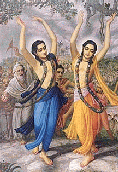
Sri Guru and Gauranga
Related Articles
The Founder Acharya
Spiritual Communism
People's Government
You are Corrupt; Therefore Your Government is Corrupt
They Do Not Know Who is the Right Man
World in Danger
Related Topics
Aim of Life
World Community - Government, Economy, Politics
Back to Top
Back to Top
Back to Top
Back to Top
Back to Top
Back to Top
Back to Top
Back to Top
Back to Top
Back to Top
Back to Top
Back to Top
Back to Top
Back to Top
Back to Top
Back to Top
Back to Top
Back to Top