 Krishna Books What is Hare Krishna? The Founder-Acharya Hare Krishna Mantra Sankirtan Movement Personality of Godhead Lord Chaitanya A.C.Bhaktivedanta Swami Prabhupada Hansadutta das Events: Kirtan Festival World Sankirtan Party Submit News © 2004 - Hansadutta das |
The Healing Power
of Sound
by Simon Heather, BSoc.Sc, MBAcC, MCOH |

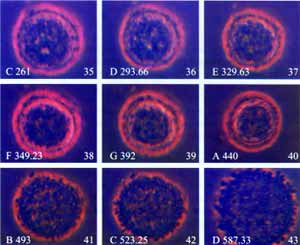 Hela cancer cells being broken up by the musical scale played on a xylophone[6] |
In experimental
sessions on actual cancer patients, the music produced equally
astonishing results. Female volunteers with breast cancer were taught
to tone the whole scale, using a violin to keep a base note for 21
minutes at a time. They spent 3-1/2 hours a day doing this for a month.
One woman’s tumour disappeared completely.[7]
Fabien Maman took healthy blood cells and played a xylophone to them.
He photographed the changes in the electromagnetic fields around the
cells using Kirlian photography. Subjected to a chromatic scale of
frequencies, the slight difference of a half tone would produce a
completely different shape and colour in the energy field of the cell.
He found that the note ‘C’ made them longer, ‘D’ produced a variety of
colours, ‘E’ made them spherical and ‘A’ (440Hz) changed the colour of
their energy field from red to pink.
In his next experiment, Fabien took a sample of blood from a person’s
finger. He then asked the person to sing the seven notes of the major
scale to their own blood cell. With each note, the cell’s energy field
changed its shape and colour. When the person sang an ‘F’ to their own
blood cells, the cells resonated perfectly with the voice, producing a
balanced, round shape and vibrant colours of magenta and turquoise.
He says, ‘The cells are completely bathed in light and alive with full
resonance, clear evidence that this ‘F’ is the fundamental sound of the
singer… Fundamental sound can be very helpful for the physical body
through its harmonising and regenerating effect at the cellular level.’[8]
 Blood cells responding to the sound of a person's voice[9] |
From his
experiments, Fabien concluded that, ‘In the human voice there is an
added element which cannot be found in any other instrument… The human
voice carries its own spiritual resonance… This difference, evident
from the photographs, is what makes the voice the most powerful healing
instrument – particularly when the person needing the healing produced
the sounds with his or her own voice.’[10]
Jim Oliver says that the body responds to sounds that we cannot hear.
He says, ‘We put the selected sounds exclusively into a pair of
headphones and put them on a client’s ankles. They responded to the
sound even though their ears could not hear the sound. Once you vibrate
a part of the body the blood cells carry this resonance to the whole
body very quickly.’[11]
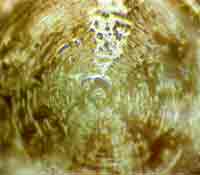
Water crystals produced when distilled water was frozen after being played heavy metal music[13]
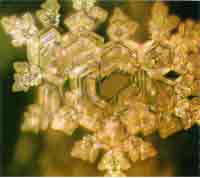
Water crystals formed when distilled water was frozen after being played Bach's 'Air on a G String'
Masaru Emoto
A Japanese scientist, Masaru Emoto, wanted to find a way of
scientifically evaluating water quality. He decided to freeze samples
of water taken from different sources to compare their crystalline
structure. When pure water crystallizes it forms a pure crystal; would
contaminated water also form a pure crystal?
Water was placed in petri dishes in a freezer for two hours, then
placed under a microscope and photographed at a magnification of
200-500 times. Although the crystals that formed were all unique, the
crystals from water of the same source were all similar in shape. Over
a four-year period his team took 10,000 photographs.
Tap water from Japanese cities generally would not form complete
crystals. Tap water from London formed no crystals at all. Spring water
generally produced the most beautiful crystals, as did water from holy
places such as Lourdes.
Masaru Emoto’s next experiment was playing music to water. He placed
distilled water in between two speakers and played one piece of music
fully at normal volume. Then he froze the water.
Classical music produced beautiful crystals of slightly different
colours. Healing music, a Tibetan mantra and folk music also produced
beautiful crystals. Heavy metal music produced a pattern that looked
like a crystal that had exploded into a thousand pieces. Japanese pop
music produced ugly square-shaped crystals rather then the normal
hexagonal ones.[12]
Since our body is made up of 70% water, Masaru Emoto’s work
demonstrates that we are constantly being influenced by the sounds
around us and by the information stored in the water we consume.
Music as Medicine
Don Campbell, in his book The Mozart Effect, shows how
music, particularly Mozart’s, has all kinds of beneficial effects for
human health. Scientists suggest that listening to Mozart helps us to
improve our powers of concentration and enhances our ability to make
intuitive leaps, by organizing the firing pattern of neurones in the
cerebral cortex.[14]
The foetus prefers Mozart and Vivaldi to other composers. When pregnant
mothers listened to Mozart and Vivaldi, the babies’ heart rates
invariably steadied and kicking declined. Rock music ‘drove most
foetuses to distraction’ and they ‘kicked violently’ when it was played
to their pregnant mothers.[15]
Slower tempo music slows our breathing rate. The human heartbeat will
tend to match the rhythm of music. Listening to Pacabel’s "Canon", for
instance, at around 64 beats per minute, the rate of a resting heart
beat, will slow our breathing rate and heart rate and change our brain
wave pattern from beta to alpha. Music will also calm our nervous
system and affect metabolism.
The pitch and rhythm of music influence the limbic system, affecting
our emotions. Scientists concluded that preferred music ‘may elicit a
profound positive emotional experience that can trigger the release of
hormones, which can contribute to a lessening of those factors which
enhance the disease process’.[16]
Music is now used to reduce the pain and anxiety of patients undergoing
dental treatment and surgical operations. In a study of 59,000
patients, 97% of patients stated that music really helped them to relax
in the post-operative situation and during surgery in regional
anaesthesia.[17]
In his research, Dr Mike Lewis found that classical music works on the
whole brain, whereas pop music affects only one side of the brain. He
says, ‘I recommend that those who are looking for a peak experience try
classical. Mozart is a great place to start, but it is a question of
trial and error, find what works for you.’[18]
Singing/Toning
Dr Tomatis found that a child traumatized by an enraged or screaming
adult learns to survive by shutting out these noises. Once the hearing
shuts down the child will find it hard to learn.[19]
This explains why some people can sing in tune while others consider
themselves ‘tone deaf’. It is impossible for us to make a sound unless
we have heard that sound or note before. I have found from experience
in teaching voice work that once a person’s hearing is reawakened then
they can begin to hear what is sung to them and can then accurately
copy this sound.
Toning is defined as – ‘to make sound with an elongated vowel for an
extended period’. Toning with other people creates a feeling of unity.
It also helps us to release stress and repressed emotions. Regular
toning and humming helps to re-energize the body and restore health to
the mind, body and spirit.
Toning has a neurochemical effect on the body, boosting the immune
system and causing the release of endorphins. Toning assists in good
breathing and posture. The muscles of the digestive system are massaged
and stimulated by regular toning. Toning has also been effective in
relieving insomnia.[20]
Wolfson
Alfred Wolfson was a German-born singing teacher who was plagued by the
sounds of artillery and human agony that he experienced as a soldier in
the trenches in World War I. Wolfson cured himself of aural
hallucinations by singing the terrible sounds that haunted him. He went
on to develop a therapeutic method that was based on using the voice.
He taught his students to make spontaneous noises, including those of
animals, birds and even machines.
Using Jung’s concept of the anima and animus, Wolfson taught that by
extending the vocal range through singing exercises, one could contact
the opposite polarity within oneself, thereby integrating the psyche
and healing a variety of psychological and physical conditions.[21]
Laurel Elizabeth Keys, in her book Toning the Creative Power of
the Voice, says, ‘A whiny weak voice will suck in negativity,
attracting lingering illness like cancer, asthma, allergies, tumors,
rheumatism and arthritis. No healing will be possible until the person
reverses their tonal pattern.’[22]
Laurel discovered toning by accident. One day her body became filled
with a sound so great that she had to express it. ‘Each time I toned,
my body felt exhilarated, alive as it had never felt before, a feeling
of wholeness and extreme well-being.’[22]
Chant
Dr Tomatis discovered the power of chant after visiting a monastery in
France. The new abbot had stopped the monks chanting. The Benedictine
monks normally chant for six to eight hours a day. The abbot believed
that the Gregorian chant served no useful purpose and that without it
they could recapture that time for other things.
The monks had been chanting in order to ‘charge up’ themselves, but
they hadn’t realized what they were doing. As the days passed they
became more and more tired. A procession of doctors came to the
monastery over a period of several months. They changed the monks’ diet
and sleep patterns but the monks became more tired than ever.
When the abbot called in Dr Tomatis in February 1967, Tomatis found 70
out of the 90 monks ‘slumping in their cells like wet dishrags’. He
reintroduced their chanting immediately. By November, almost all of
them had gone back to their normal activities, their prayer, their few
hours of sleep, and their arduous work schedule.[23]
Principles of Sound Healing
Entrainment
The principle of entrainment explains how sound healing works. A
harmonious sound projected at a person who is in a state of disharmony
will eventually bring them into resonance with the harmonious sound.
Our atoms, molecules, cells, glands and organs all have a vibrational
frequency. Sounds from outside our body will stimulate sympathetic
vibration in the molecules and cells of our body.
Intention
The sound wave created by a person singing or playing an instrument
will carry information to the receiver of the sound. We all know that a
song can be sung with a loving intention or an aggressive intention.
When a mother sings a lullaby to her child, the child feels the love in
the mother’s voice and is rocked to sleep. At a football match, fans
sing aggressive chants directed at the opposing supporters and their
team. Here the intention is to intimidate.
Sympathetic Resonance
When two objects have similar vibratory characteristics that allow them
to vibrate at the same frequency, they form a resonant system. When a
‘C’ tuning fork is struck, another ‘C’ tuning fork close by will also
begin to vibrate. For healing to occur there must be a resonance or
rapport between healer and patient.
Pure Tone
Jonathan Goldman in his book Healing Sounds says, “When we have learned
techniques for harmonic toning, the human voice is able to create
nearly every frequency, at least within the bandwidth of audible
frequency.” Jonathan offers the simple formula, “Frequency plus
Intention equals Healing.” If we can find a pure sound frequency
coupled with a pure intention then healing will occur. When our body
receives a pure tone our muscles will relax and tension will be
released.[24]
Sound Healing
When working with a person in a sound healing session I use my voice to
scan over their body. I find that my voice will ‘break up’ over areas
of their body where there is pain, disease or poor function. I then
administer sound healing through my voice using different tones, vowel
sounds and harmonics until the imbalance is cleared. I use healing
songs, prayers and mantras. I will also help a person find their
fundamental sound.
I use a wide range of sound healing techniques to treat all conditions.
These include combining my voice with instruments, using sound in
combination with bodywork, encouraging the person to express their pain
through sound, using tuning forks and different musical intervals.
Dissonant intervals can be used in sound healing to help a person to
get in touch with painful emotions. When the dissonance is resolved by
sounding the interval above, the person listening will experience a
feeling of release, lightness and joy. If the person has experienced
deep trauma, I will often chant the person’s name to call back their
spirit.
Sound healing can be combined with other healing therapies such as
massage and bodywork. After a sound healing treatment most people
report a feeling of deep relaxation and an improvement in the function
of mind and body. Structural imbalances in the body will often correct
themselves during the sound treatment.
References
1. Goldman Jonathan. Healing Sounds. Element
Books. Shaftesbury. p30. ISBN 1-85230-314-X. 1992.
2. Tomatis Alfred. The Conscious Ear. Station
Hill Press. New York. ISBN 0-88268-108-7. 1991.
3. Jenny Hans. Cymatics, Volumes I and II.
Basilius Presse AG. Basel. 1974.
4. Maman Fabien. The Role of Music in the
Twenty-First Century. Tama-Do Press. California. p61. ISBN
0-9657714-0-7. 1997.
5. Maman Fabien. ibid. p90.
6. Maman Fabien. ibid. p56. Photograph reproduced
with permission from Fabien Maman.
7. Campbell Don. The Mozart Effect. Avon Books.
New York. pp242-243. ISBN 0-380-97418-5. 1997.
8. Maman Fabien. ibid. p20.
9. Maman Fabien. ibid. p80. Photograph reproduced
with permission from Fabien Maman.
10. Maman Fabien. ibid. p81.
11. Oliver Jim. Notes from CD Harmonic
Resonance. The Relaxation Company. New York. 1995.
12. Emoto Masaru. The Message from Water. HADO
Kyoikusha. Tokyo. ISBN 4-939098-00-1. 1999.
13. Emoto Masaru. ibid. pp77,87. Photographs
reproduced with permission from Masaru Emoto.
14. Campbell Don. ibid. p23.
15. Campbell Don. ibid. p15.
16. Campbell Don. ibid. p73.
17. Harvey Arthur. Music in Attitudinal
Medicine. in Campbell Don ed. Music: Physician for Times to Come. Quest
Books. Illinois. p189. ISBN 0-8356-0668-6. 1991.
18. Lewis Mike. Why Music Heals Your Mind.
Interview. Sunday Express. p51.21 May 2000.
19. Joudry Patricia. Sound Therapy for the
Walkman. Steele and Steele. Dolmen. Canada. p7. ISBN 0-9691687-0-5.
1984.
20. Campbell Don. ibid. pp92-93.
21. Campbell Don. ibid. pp102-103.
22. Keys Laurel Elizabeth. Toning the Creative
Power of the Voice. DeVorss and Co. California. pp10-12. ISBN
0-87516-176-6. 1973.
23. Wilson Tim. Chant the Healing Powers of
Voice and Ear. in Campbell Don ed. Music: Physician for Times to Come.
Quest Books. Illinois. pp12-14. ISBN 0-8356-0668-6. 1991.
24. Goldman Jonathan. ibid. p94.
About the Author
Simon Heather is a qualified acupuncturist, healer and bodyworker. He
has made an extensive study of sound healing. In 1996
he founded the UK Sound Healers Association, a non-profit making
organization dedicated to promoting sound healing. He has
taught sound healing workshops in Australia, Canada, South Africa,
Zimbabwe, the UK and the USA.
He has written four books, and has recently completed a comprehensive
guide to sound healing entitled The Healing Power
of Sound. At present he is running workshops for those who wish
to reconnect with their true voice and to experience
the healing power of sound, and training courses for healers and
therapists who wish to use sound as part of their healing
practice.
According
to the Vedas, sound is the
origin of the creation, the origin of matter.
Home | About | Events | World Sankirtan Party | Inside Nam Hatta
eBooks | Site Map | Store

Sri Guru and Gauranga
Related Articles
Hare Krishna Mantra
Events: Kirtan Festival
The Beginning, Middle and End of Spiritual Life
The Krishna Consciousness Movement is the Genuine Vedic Way
Pain Management Therapy
Vedic Conception of Sound in Four Features
Related Topics
The Holy Name - Chanting the Holy Name
Health
Back to Top
Back to Top
Back to Top
Back to Top
Back to Top
Back to Top
Back to Top
Back to Top
Back to Top
Back to Top