
Krishna Books
What is Hare Krishna?
The Founder-Acharya
Hare Krishna Mantra
Sankirtan Movement
Personality of Godhead
Lord Chaitanya
A.C.Bhaktivedanta Swami Prabhupada
Hansadutta das
Events: Kirtan Festival
World Sankirtan Party
Submit News
© 2004 - Hansadutta das
| Get Srila Prabhupada's original, unrevised books. Beware of imitations. More than 160 titles published! Learn more. |
Back to Godhead - Part 1
by His Divine Grace A.C. Bhaktivedanta Swami Prabhupada
Founder-Acharya of the world-wide Hare Krishna Movement, Brahma Sampradaya Acharya

TEXT 24
ahimsaya paramahamsya-charyaya
smritya mukundacharitagrya-sidhuna
yamair akamair niyamaish chapy anindaya
nirihaya dvandva-titikshaya cha
SYNONYMS
ahimsaya—by nonviolence; paramahamsya-charyaya—by following in the footsteps of great acharyas; smritya—by remembering; mukunda—the Supreme Personality of Godhead; acharita-agrya—simply preaching His activities; sidhuna—by the nectar; yamaih —by following regulative principles; akamaih—without material desires; niyamaih—by strictly following the rules and regulations; cha—also; api—certainly; anindaya—without blaspheming; nirihaya—living simply, plain living; dvandva—duality; titikshaya—by tolerance; cha—and.
TRANSLATION
A candidate for spiritual advancement must be nonviolent, must follow in the footsteps of great acharyas, must always remember the nectar of the pastimes of the Supreme Personality of Godhead, must follow the regulative principles without material desire and, while following the regulative principles, should not blaspheme others. A devotee should lead a very simple life and not be disturbed by the duality of opposing elements. He should learn to tolerate them.
PURPORT
The devotees are actually saintly persons, or sadhus. The first
qualification of a sadhu, or devotee, is
ahimsa, or nonviolence. Persons interested in the path of
devotional service, or in going back home, back to Godhead, must first
practice ahimsa, or nonviolence. A sadhuis described as
titikshavah karunikah (Srimad-Bhagavatam
3.25.21). A devotee should be tolerant and should be very much
compassionate toward others. For example, if he suffers personal
injury, he should tolerate it, but if someone else suffers injury, the
devotee need not tolerate it. The whole world is full of violence, and
a devotee's first business is to stop this violence, including the
unnecessary slaughter of animals. A devotee is the friend not only of
human society but of all living entities, for he sees all living
entities as sons of the Supreme Personality of Godhead. He does not
claim himself to be the only son of God and allow all others to be
killed, thinking that they have no soul. This kind of philosophy is
never advocated by a pure devotee of the Lord.
Suhridah sarva-dehinam: a true devotee is the friend of all
living entities. Krishna claims in Bhagavad-gita to be
the father of all species of living entities; consequently the devotee
of Krishna is always a friend of all. This is called ahimsa.
Such nonviolence can be practiced only when we follow in the footsteps
of great acharyas. Therefore, according to our Vaishnava
philosophy, we have to follow the great acharyas of the four sampradayas,
or disciplic successions.
Trying to advance in spiritual life outside the disciplic succession is
simply ludicrous. It is said, therefore, acharyavan purusho veda:
one who follows the disciplic succession of acharyas knows
things as they are (Chandogya Upanishad 6.14.2). Tad-vijnanartham
sa gurum evabhigacchet: [Mundaka Upanishad 1.2.12]
in order to understand the transcendental science, one must approach
the bona fide spiritual master. The word smritya is very
important in spiritual life. smritya means remembering Krishna
always. Life should be molded in such a way that one cannot remain
alone without thinking of Krishna. We should live in Krishna so that
while eating, sleeping, walking and working we remain only in Krishna.
Our Krishna consciousness society recommends that we arrange our living
so that we can remember Krishna. In our ISKCON society the devotees,
while engaged in making Spiritual Sky incense, are also hearing about
the glories of Krishna or His devotees. The shastra recommends,
smartavyah satatam vishnuh: Lord Vishnu should be
remembered always, constantly. Vismartavyo na jatuchit:
Vishnu should never be forgotten. That is the spiritual way of life. Smritya.
This remembrance of the Lord can be continued if we hear about Him
constantly. It is therefore recommended in this verse: mukundacharitagrya-sidhuna.
Sidhu means "nectar." To hear about Krishna from Srimad-Bhagavatam
or Bhagavad-gita or similar authentic literature is to
live in Krishna consciousness. Such concentration in Krishna
consciousness can be achieved by persons who are strictly following the
rules and regulative principles. We have recommended in our Krishna
consciousness movement that a devotee chant sixteen rounds on beads
daily and follow the regulative principles. That will help the devotee
be fixed in his spiritual advancement in life.
It is also stated in this verse that one can advance by controlling the
senses (yamaih). By controlling the senses, one can become a svami
or gosvami. One who is therefore enjoying this supertitle, svami
or gosvami, must be very strict in controlling his senses.
Indeed, he must be master of his senses. This is possible when one does
not desire any material sense gratification. If, by chance, the senses
want to work independently, he must control them. If we simply practice
avoiding material sense gratification, controlling the senses is
automatically achieved.
Another important point mentioned in this connection is anindaya—we
should not criticize others' methods of religion. There are different
types of religious systems operating under different qualities of
material nature. Those operating in the modes of ignorance and passion
cannot be as perfect as that system in the mode of goodness. In Bhagavad-gita
everything has been divided into three qualitative divisions; therefore
religious systems are similarly categorized. When people are mostly
under the modes of passion and ignorance, their system of religion will
be of the same quality. A devotee, instead of criticizing such systems,
will encourage the followers to stick to their principles so that
gradually they can come to the platform of religion in goodness. Simply
by criticizing them, a devotee's mind will be agitated. Thus a devotee
should tolerate and learn to stop agitation.
Another feature of the devotee is nirihaya, simple living. Niriha
means "gentle," "meek" or "simple." A devotee should not live very
gorgeously and imitate a materialistic person. Plain living and high
thinking are recommended for a devotee. He should accept only so much
as he needs to keep the material body fit for the execution of
devotional service. He should not eat or sleep more than is required.
Simply eating for living, and not living for eating, and sleeping only
six to seven hours a day are principles to be followed by devotees. As
long as the body is there it is subjected to the influence of climatic
changes, disease and natural disturbances, the threefold miseries of
material existence. We cannot avoid them. Sometimes we receive letters
from neophyte devotees questioning why they have fallen sick, although
pursuing Krishna consciousness. They should learn from this verse that
they have to become tolerant (dvandva-titikshaya). This is the
world of duality. One should not think that because he has fallen sick
he has fallen from Krishna consciousness. Krishna consciousness can
continue without impediment from any material opposition. Lord Sri
Krishna therefore advises in Bhagavad-gita (2.14), tams
titikshasva bharata: "My dear Arjuna, please try to tolerate all
these disturbances. Be fixed in your Krishna conscious activities."
Back to Godhead - Part 1/ WORLD SANKIRTAN PARTY ©2004 - Hansadutta das
Home | About | Events | World Sankirtan Party | Inside Nam Hatta
eBooks | Site Map | Store
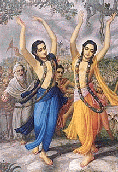
Sri Guru and Gauranga
Related Articles
The Founder Acharya
Globalization in the Face of Disparity
The Krishna Consciousness Movement is the Genuine Vedic Way
The Spirit of Bhagavad-gita As It Is
The Sankirtan Movement
Hare Krishna Mantra
Initiation into Spiritual Life
Related Topics
Aim of Life
Knowledge - Enlightenment
Krishna Consciousness, the Process
Religion
Spiritual Master - Rittvik - Initiation
Back to Top
Back to Top