INSIDE NAMHATTA
News, Developments, Issues important to disciples of His Divine Grace A.C. Bhaktivedanta Swami Prabhupada
Just as the sun rises first in India and gradually spreads its lights to the West, the matchless splendor of spiritual truth appears first in India and gradually spreads to the Western countries.



The Evolution of Spiritual Science
Stage by stage development of relationships with God
About the author: Bhaktivinoda Thakura led the revival of the Gaudiya sampradaya in India in the 19th Century and even attempted to spread the teachings of Sri Chaitanya Mahaprabhu abroad by literary contributions. His efforts were greatly expanded by Srila Bhaktisiddhanta Sarasvati Thakura in the early 20th Century, who established an institution called Gaudiya Math, which spread Krishna consciousness all over India, as well as in Burma, and an attempt was made to introduce it in Europe as well. Actually his preachers also preached in what is now known as Pakistan and Bangladesh. During Srila Bhaktisiddhanta Sarasvati Thakura's time there continued to be challenges to the authenticity of our line, as it was not strictly a diksha-sampradaya. But Srila Bhaktisiddhanta Sarasvati Thakura in relating the history of the Vishva-vaishnava-raja-sabha, the Society of the foremost devotees established by Srila Jiva Gosvami, explained that the sabha was sometimes manifested by the presence of a maha-bhagavata and sometimes unmanifest in unfortunate times, but was always present in the shiksha of the mahajanas like Srila Bhaktivinoda Thakura, who revitalized it in the late 19th Century. This sabha then became a revolutionary world movement in the latter 20th Century by the heroic efforts of His Divine Grace A.C. Bhaktivedanta Swami Prabhupada, the Founder/Acharya of the International Society for Krishna Consciousness.—Rupa-vilasa das, A Ray of Vishnu (Appendix VIII - Some Notes on the Gaudiya Sampradaya)

The Bhaktivedantas World Sankirtan Party and Inside Nam Hatta are hosted by Hansadutta das, a senior disciple of Srila Prabhupada and trustee of The Bhaktivedanta Book Trust. Participate or learn more about World Sankirtan Party.
History is always a record, oral or written of past events. Christianity and Islam being recent creations have not only no history themselves beyond 1600 and 1400 years respectively, but they also have done their worst in suppressing and befudging or destroying all earlier accounts to leave nothing for invidious comparison. But luckily for us Vedic records such as Shreemad Bhagvatam, the Brahmand Puran, the Ramayan, the Mahabharat and number of other Sanskrit texts have preserved for mankind a meticulous history from the very first generation of human beings, nay, even from before the creation - an account of almost 2000 million years! more
If the reader carefully considers, it will be found that the spiritual science gradually evolved from ancient times and became more simple, more clear and more condensed. The more impurities arising from time and place are removed, the more the beauties of the spiritual science brightly shine before us. This spiritual science took birth in the land of kusha grass on the banks of the Sarasvati river in Brahmavarta.
By studying the history of the world, it is found that the spiritual
science reached its peak in Navadvip. The Supreme Absolute Truth is the
only object of love for the living entities. Unless one worships Him
with attachment, however, the living entity can never attain Him. Even
if a person gives up all affection for this world and thinks of the
Supreme Lord, He is still not easily achieved. He is controlled and
attained by transcendental mellows alone. These mellows are of five
types: shanta, dasya, sakya, vatsalya and madhurya.
The first mellow, shanta, is the stage in which the living
entity surpasses the pains of material existence and situates himself in
transcendence. In that state there is a little happiness, but no
feeling of independence. At that time the relationship between the
practitioner and the Lord is not yet established.
Dasya rasa is the second mellow. It contains all the
ingradients of shanta rasa as well as affection. "The Lord is
my master, and I am His eternal servant". This type of relationship is found in dasya rasa. No one cares much for any of the best things of this world unless they are connected with affection. Therefore dasya rasa is superior to shanta rasa in many ways.
Sakya is superior to dasya. In dasya rasa
there is a thorn in the form of awe and reverence, but the main ornament in sakya rasa is the feeling of friendship in equality. Among the servants, one who is a friend is superior. There is no doubt about it. In sakya rasa all the wealth of shanta and dasya is included
It is easy to understand that vatsalya is superior to sakya.
A son gives more affection and happiness than any friend. Therefore in vatsalya rasa we find the wealth of four rasas. Although vatsalya rasa is superior to these other rasas, it appears insgnificant before madhurya rasa. There may be many secrets
unknown between father and son, but this not the case between husband and wife. Therefore, if we deeply consider, it will be seen that all the above-mentioned rasas attain perfection within madhurya rasa.
If we go through the histories of these five rasas, it is
clearly understood that shanta rasa was seen in the beginning days of
India. When the soul was not satisfied after performing sacrifices with
material ingredients, then transcendentalists like Sanaka, Sanatana,
Sanat-kumara, Sananda, Narada and Lord Shiva all became detached from
the material world, situated in transcendence and realized shanta
rasa.
Much later, dasya rasa manifested in Hanuman, the servant of
Sri Ramachandra. That same dasya rasa gradually expanded in the
northwest and manifested in a great personality named Moses.
In the age of Dvapara, Uddhava and Arjuna became the qualified
authorities of sakya rasa. They preached this rasa
throughout the world. Gradually that rasa expanded up to the Arabian countries and touched the heart of Mohammed, the knower of religious principles.
Vatsalya rasa manifested throughout India in different forms at
different times. Among the different forms, vatsalya mixed with
opulence crossed India and appeared in a great personality named Jesus
Christ, who was a preacher of Jewish religious principles.
Madhurya rasa first shone brightly in Braj. It is extremely rare for
this rasa to enter the hearts of conditioned souls, because
this rasa tends to remain with qualified, pure living entities. This confidential rasa was preached by Chaitanya Mahaprabhu, the moon
of Navadvipa, along with His followers.
Till now, this rasa has not crossed beyond India. Recently a scholar from England named Newman realized something about this rasa and wrote a book about it. The people of Europe and America have not been satisfied with vatsalya rasa mixed with opulence as preached by Jesus Christ. I hope, by the grace of the Lord, in a very short time they will become attached to drinking the intoxicating nectar of madhurya rasa.
It has been seen that any rasa that appears in India eventually spreads to the western countries, therefore madhurya rasa will soon be preached throughout the world. Just as the sun rises first in India and gradually spreads its lights to the West, the matchless splendor of
spiritual truth appears first in India and gradually spreads to the
Western countries.
Comments
Sorry, comments are disabled for archived pages.
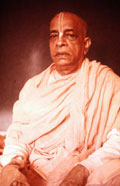
His Divine Grace A.C. Bhaktivedanta Swami Prabhupada
Related Articles
Related Topics